Reading TSMC Alongside Its U.S. Customers
Supplier sales, equipment purchases and cloud revenue describe different parts of an AI investment’s return.
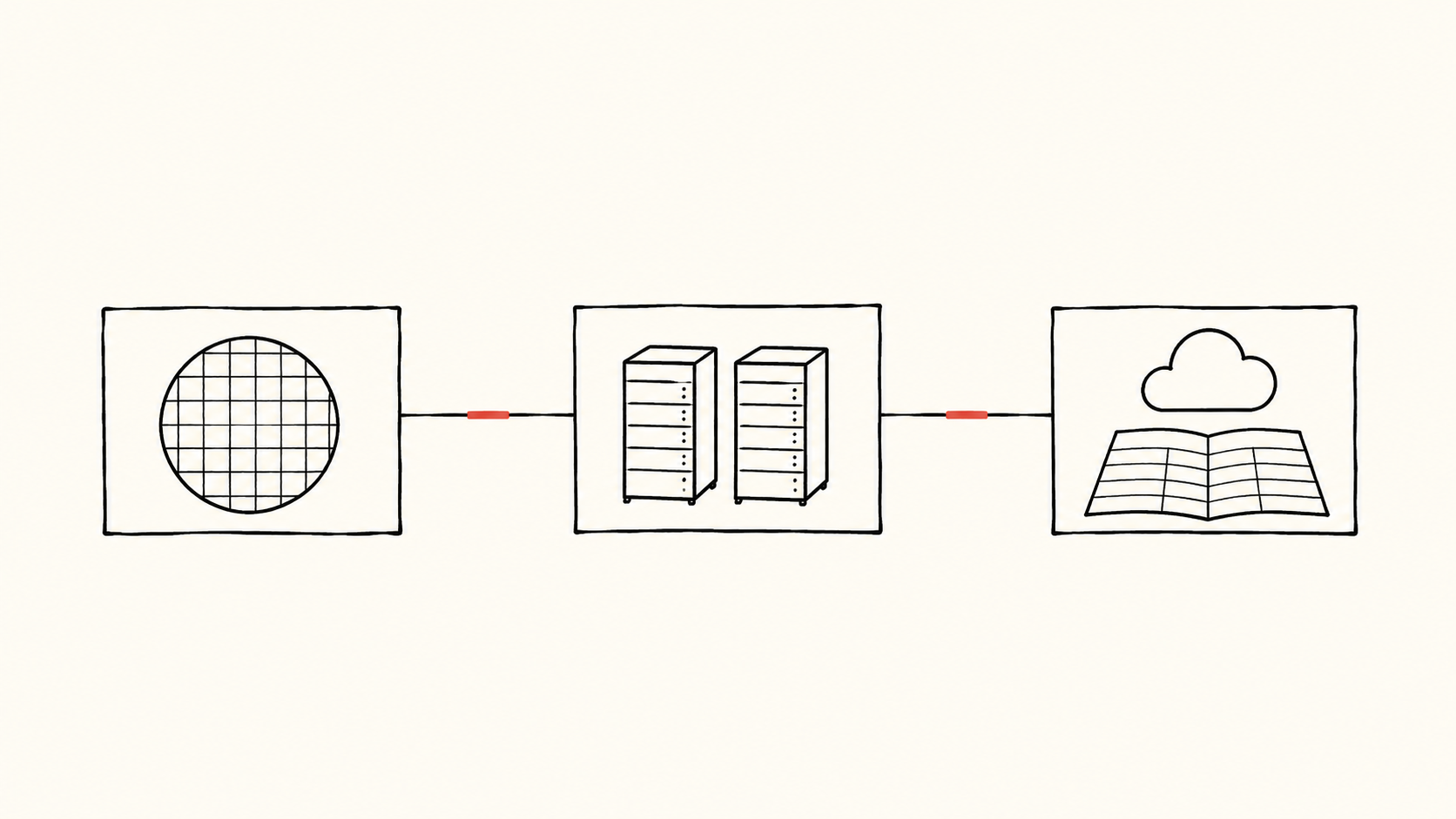
TSMC reported today. For U.S. technology investors, the useful next question is how a supplier’s earnings connect to the accounts of the businesses buying its output. A sale can be good business for the seller while leaving the buyer’s eventual return unresolved.
Our analysis proposes reading that connection through three separate records: the supplier’s operating results, the buyer’s equipment and payment obligations, and the revenue earned from using the equipment. Combining them into one measure of “AI demand” obscures who has earned money, who has spent it and who still needs to earn it back.
The customer’s accounts add different evidence
NVIDIA’s July-quarter filing reports US$31.6 billion in inventory and, for some investment-grade buyers, payment terms up to one year. These are historical disclosures, not an October update.
Inventory and credit terms raise different questions. For a hypothetical hardware supplier, additional stock might prepare for future deliveries or reflect a slower conversion into sales. Longer payment terms can help a customer synchronize payments with deployment, while extending the seller’s exposure before cash arrives. Neither observation alone establishes weak demand, improper revenue recognition or customer distress. The useful comparison is between shipment plans, receivable collections and the composition of inventory over time, with matching reporting periods.
Microsoft’s fiscal-2026 filing distinguishes consumption-based cloud revenue from subscriptions and includes finance-leased assets in property and equipment. That accounting context matters when comparing a buyer’s physical expansion with its cash spending and service revenue.
A reader should therefore label each measure before comparing growth rates. Equipment received, cash paid, an asset brought into service and a customer’s billable usage need not occur in the same period. A financing arrangement can change when cash leaves without changing how much productive equipment must eventually earn a return.
A small example makes the distinction visible
Consider an entirely hypothetical chain, with all amounts in arbitrary currency units. A component maker sells inputs for 40. A system maker adds other components and work, then sells the completed equipment for 100 to a cloud operator. The two suppliers have recorded sales totaling 140, but those are transactions at different stages. Treating 140 as spending by the final equipment buyer counts the intermediate inputs again.
Now suppose the operator pays 30 initially and owes 70 later. It uses the equipment for five years, with zero residual value and straight-line depreciation of 20 a year. In its first full year, service revenue is 25 and cash operating costs are 8. The equipment earns an operating contribution of minus 3 after depreciation, before other overhead, financing costs and tax. The suppliers’ sales remain real; they simply do not establish the operator’s profitability.
This example is not a forecast for any named company. It shows why three superficially positive observations, a shipment, an asset addition and a rise in service sales, cannot be substituted for a return calculation. The timing and denominator matter. Comparing a quarter of service revenue with a multi-year equipment commitment would add another mismatch.
What would strengthen the earnings connection?
We would look for evidence that successive equipment cohorts generate more billable work, collect cash on the expected schedule and cover their full operating and capital costs. Where cohort data are unavailable, aggregate revenue and margin trends can provide clues, but they cannot isolate the return on a specific generation of hardware.
The counterargument deserves equal weight: early spending can precede substantial later revenue. Low initial utilization may be part of a planned rollout. A fair assessment therefore needs the expected ramp period, useful-life assumptions and evidence of subsequent use; it should not pronounce an investment unsuccessful from its first quarter alone.
The filings do not provide a complete transaction-by-transaction map from wafer to paid cloud workload. Product mix, customer overlap, currencies and fiscal calendars also limit comparisons. TSMC’s release is an input to that work. A defensible conclusion about U.S. customer earnings still needs evidence from the buyer’s own accounts. This is an analytical framework, not an investment recommendation.
Information only. No investment, legal, tax, or financial advice.