Meta’s financing needs a calendar, not just a total
An announced financing plan and cash available to spend belong to different dates, with different consequences for shareholders.
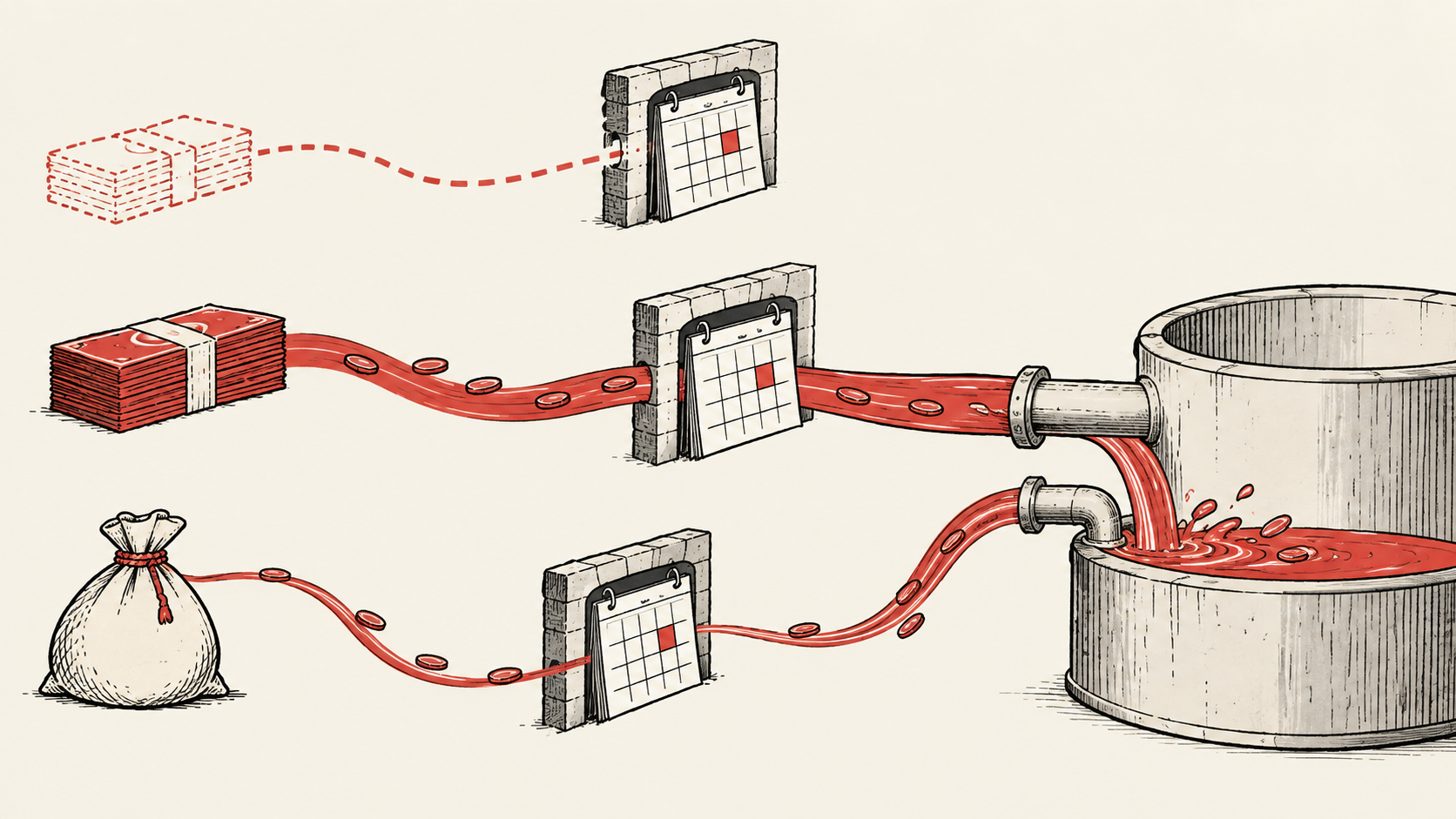
Meta’s October 26, 2026 announcement launches roughly $35 billion of offerings. Forward-share sales initially deliver no proceeds to Meta; a separate $60 billion at-the-market share-sale programme (ATM) remains planned.
That distinction is the starting point for our analysis, not a prediction about whether the financing will succeed. Adding announced amounts produces a scale indicator. It does not produce a bank balance. To understand what financing changes, a reader needs to know when resources become available, what conditions remain, and which claims on the business will exist afterward.
Funding a project and funding a payment
Consider a hypothetical company building a computing facility. Its construction schedule, equipment deliveries and customer demand may move at different speeds. Funding the whole project in advance could reduce the risk that an invoice arrives when markets are difficult. It could also leave funds waiting before the project can use them. Raising money only when bills are due avoids some idle financing, but makes the investment plan more dependent on conditions at those future dates. Neither approach is universally superior.
This example is not a description of Meta’s internal treasury decisions. It shows why the relevant unit of analysis is a payment calendar rather than the announced project cost. A large investment can be manageable if its obligations are well spaced and accessible funding arrives in time. A smaller investment can be harder to finance if too many commitments fall together. The amount and the timing answer different questions.
The distinction matters for equity as well as debt. Financing can alter the date when a company receives resources without making the eventual economic cost disappear. A future owner’s claim on the business still needs to be considered, even when the corresponding cash is not yet on the issuer’s balance sheet. We therefore would not treat an offering headline as evidence of either immediate liquidity or a precisely measurable dilution outcome.
Cash generation is not the same as cash left over
Meta’s Q3 2026 results, released October 21, record $32.79bn operating cash flow, $34.91bn capital expenditure (including finance-lease principal), and −$2.12bn non-GAAP free cash flow.
These measures describe different stages in the movement of money. The operating figure asks how much cash the business generated before the relevant investment deduction. The residual asks what remains under the company’s stated calculation. A negative residual need not mean the operating business stopped generating money. Equally, a strong operating figure does not show that every investment can be financed internally at any pace.
The useful follow-up is not to choose whichever metric sounds reassuring or alarming. It is to ask whether the spending is bringing future productive capacity forward, replacing capacity that must be maintained, or committing resources whose commercial use remains uncertain. Those possibilities can coexist. A quarterly cash-flow total does not separate them on its own.
There is also a period-matching problem. One quarter may contain payments associated with capacity used over several years. Comparing that quarter’s investment outflow with the same quarter’s income is useful for liquidity, but insufficient for judging the investment’s lifetime economics. Conversely, a long useful-life narrative cannot settle a short-term payment obligation. Both horizons matter, and neither cancels the other.
Two reasonable readings, neither yet a verdict
The constructive interpretation is that access to several forms of capital can give management room to execute a long investment programme without forcing every payment through one funding channel. That flexibility may be valuable before uncertainty becomes acute. Under this reading, financing before the cash is urgently needed can be a form of risk management rather than evidence of distress.
The cautious interpretation starts elsewhere: obtaining capital does not demonstrate that the assets financed with it will earn an adequate return. More funding can protect a timetable while also extending the period before investors receive clear evidence about utilisation and profitability. Financial flexibility and investment discipline are related, but one does not prove the other.
For existing shareholders, the relevant comparison is therefore not simply “more cash” versus “more shares.” It is the future business supported by the financing, divided among the claims that ultimately exist. A more valuable company can still deliver a disappointing outcome per share; dilution alone also cannot determine the outcome without considering what the additional resources accomplish. This is an analytical framework, not a valuation estimate or recommendation.
A useful record should keep proposed capacity to raise funds separate from completed transactions, then connect actual receipts to investment payments and eventual share counts. Pricing notices and settlement disclosures can clarify the financing side. Later operating evidence must address the investment side. This article examines the launch-stage disclosure, not completed proceeds or final terms. Until those separate records can be reconciled, the headline amount should remain a financing plan rather than money already available to spend.
Information only. No investment, legal, tax, or financial advice.