Hyperliquid Review: The Only Solution for High-Frequency, Large-Scale, High-Leverage On-Chain Order Books
Hyperliquid has built HyperBFT, HyperCore, and HLP around high-frequency, large-scale, high-leverage order books, while trying to balance liquidity a…

Original author: Godot
Recently, I revisited my own trading decisions and holdings. I looked at Hyperliquid $HYPE.
Although I had been following the project during the airdrop phase, I viewed it more from the perspective of a “conspiracy group” — for example, a team rooted in a professional high-frequency trading platform, using a parent company to run a profitable project, with no fundraising, no token presale, and very tightly controlled token supply, etc.
In short, I viewed Hyperliquid through the familiar lens of a project with a tightly controlled initial supply, high FDV, price being pushed up, and then token unlocks being used gradually to take profits, while overlooking the possibility that Hyperliquid could build a platform through real usage, which caused me to sell too early.
In hindsight,
Hyperliquid’s product design revolves around the keywords “order book” (more precisely, CLOB, central limit order book), “high frequency,” “large size,” and “high leverage.”
And most importantly, Hyperliquid is the only DEX that combines these keywords; one could say it is the only choice.
Starting from the most fundamental consensus layer, Hyperliquid has made many improvements and optimizations to suit “high-frequency” trading needs. It adopts a more fault-tolerant, more asynchronous design, such as continuous sequential processing, meaning it continuously orders user transactions without waiting for the current block hash to be executed. It also provides one-block finality, allowing each trade, order cancellation, and liquidation to be completed within a single block.
Of course, there are many other designs to accommodate “high-frequency” needs and provide real-time trading and liquidation. Real-time performance, or transaction latency, affects whether trades can be confirmed in real time, whether there is rollback risk, actual fill price and slippage, MEV opportunities, and more importantly, liquidation prices and margin replenishment in extremely volatile markets.
Normally, blockchains produce blocks at fixed intervals — for example, Solana has a block time of about 400 ms, Ethereum mainnet is 12 seconds, while on Ethereum L2s, finality requires transaction results to be posted and verified by mainnet. Perhaps this is why the project in the Solana ecosystem, Drift, and Paradex in the Starknet ecosystem, despite having a more reputable institutional background, still fall behind Hyperliquid in practice.
As for liquidity, Hyperliquid uses HLP to build the protocol’s base liquidity layer to meet “large-size” trading needs. It also uses $HYPE to raise funds from the market. In addition to the team selling for profit, HYPE also has insurance value: if Hyperliquid runs into trouble, $HYPE can be sold to cover losses. Essentially, this is a two-token model balancing protocol liquidity and insurance.
In addition, as @IOSGVC said, the value of HIP as a new LaunchPad is being underestimated. With HLP + HIP, Hyperliquid could become a native blockchain base liquidity layer.
Below is the main part,
HyperBFT Consensus Layer: High Frequency, High Frequency, Still High Frequency!
------------------------
The core principle of Hyperliquid’s technical architecture is to serve “high-frequency trading.” Burn the four words “high-frequency trading” into your head; whenever you later encounter any complex technical term, it will be much easier to understand if you start from the principle of “high frequency.”
Hyperliquid’s underlying consensus, HyperBFT, is an improvement based on the HotStuff and LibraBFT protocols, implementing asynchronous Byzantine fault-tolerant BFT.
“Synchronous” is similar to relying on a fixed time frame to make decisions during consensus. It has strict block intervals; Bitcoin, which must wait on a fixed cycle, is a typical example. “Asynchronous” means there is no need to wait for a fixed interval, and block production can be adjusted according to the actual network conditions.
“Synchronous” systems have more stable TPS, and the protocol design can be simpler. Simplicity sometimes also means safety. “Asynchronous” systems are faster, but once a node has a problem, block production may pause until that node’s network improves. The downtime and freezing Solana experienced during NFT minting spikes in the last cycle were for this reason.
Essentially, “synchronous” ensures availability under the worst network conditions, protecting the floor; “asynchronous” pursues higher performance under normal network conditions, aiming for the ceiling.
And “fault tolerance” ensures the system must still operate normally when some nodes fail or behave maliciously, maintaining the same standard under harsher conditions. In practice, as long as 2/3+1 nodes are normal, that is sufficient.
Based on the above, Hyperliquid achieves the following in transaction ordering and block production,
Optimized asynchronous design
The consensus algorithm itself does not embed a synchronous time scale; validators do not need to wait for a preset interval and can immediately vote on the latest state, which is “optimistic feedback.”
Continuous sequential processing
Hyperliquid can continue ordering transactions without waiting for the current block hash to be executed. This is a major technical breakthrough, allowing the system to start processing the next batch of transactions before the current block finishes processing.
Here we need a comparison,
Traditional BFT flow: Propose Block N → wait for consensus → execution completes → Block N+1 starts |--------fixed time window--------|
HyperBFT flow: Propose Block N → immediately start ordering Block N+1 → process multiple blocks in parallel |---optimistic response, no fixed waiting---|
From here, HyperBFT actually derives a third property, and of course a requirement, which is
Validator communication standard
Current validators must maintain round-trip communication latency of 200 ms or lower with at least 1/3 of the network's validators (weighted by stake). Validators that fail to meet these strict standards will be penalized.
This 1/3 communication guarantee is actually a network-speed guarantee, ensuring the network does not fork, while the consensus mechanism still requires signatures from more than 2/3 of validators.
In other words, in Hyperliquid's consensus mechanism, the basic guarantees of network performance and consensus are, to a certain extent, “decoupled” from each other.
Combining these properties enables 200,000+ TPS, nearly 100 times Ethereum, as well as a 0.2-second transaction confirmation time. Of course, the real-world experience will be affected by wallets and network speed, but the transaction has been confirmed, and that is enough.
There is one more extremely important thing: single-block finality.
Single-block finality
That is, every transaction, order cancellation, and liquidation is finalized and receives its final confirmation within a single block. Once a transaction is included in a block, it is immediately final; there is no need to wait for multiple block confirmations to ensure transaction safety.
Single-block finality is especially important for bots and high-frequency algorithmic trading. Finality means transaction confirmation, irreversibility, and no reordering; otherwise there would be MEV risk. During volatile periods, it can determine whether a liquidation will happen. In addition, arbitrage opportunities can be calculated precisely without considering confirmation latency.
Compared with some popular DEXs, dYdX is based on Cosmos and has to go through mainnet consensus; Gmx is based on Arbitrum and Avalanche. Arb is an L2, so finality requires confirmation from Ethereum mainnet, while Avax finality is around 1-2 seconds. You can feel Hyperliquid's "high-frequency" advantage.

HyperCore execution layer: The perpetual futures machine
--------------------
HyperCore is the execution layer built on the HyperBFT consensus mechanism, responsible for specific issues such as the order book, order matching, the margin system, liquidation mechanism, native staking, etc.
There is also HyperEVM and its ecosystem, but this article is still focused on Hyperliquid itself, so that part will not be discussed for now.
HLP: An attempt to balance large-scale trading and risk
----------------
HLP (Hyperliquidity Provider) is Hyperliquid's reserve fund for market making and liquidation. The core of HLP is handling large-scale transactions.
Before understanding HLP, you can first compare it with Gmx's GLP.
GLP is an innovative liquidity provision mechanism launched by the perpetual futures DEX Gmx. In Gmx v1, GLP was a pooled liquidity pool, and users could buy GLP and then stake it into the pool, providing liquidity to the protocol while earning yield.
The real value of GLP is backed by volatile assets such as BTC, ETH, and UNI, as well as stablecoin assets such as USDT, USDC, and DAI, and its price fluctuates.
The key point is that GLP is passive market making, acting as the trader's counterparty. When a trader opens a position, GLP automatically becomes the holder of the opposite position.
Therefore, the assumption behind GLP's profitability, and even the assumption behind Gmx's existence, is that traders will always lose. The trader's losses become income for those who stake GLP.
HLP's active market-making strategy
In contrast, HLP is an active market-making strategy, with core functions of market making (quoting buy and sell prices for trades, providing counterparties, and earning spreads and fees) and liquidation (taking over users' liquidated positions). HLP becomes the user's counterparty to provide liquidity, but it is not merely a counterparty.
HLP consists of three sub-vaults: two vaults focused on market making (Vault A and Vault B) and one vault dedicated to liquidation (Liquidator vault) (basically abandoned after the JELLY incident).
Vault A and Vault B serve as the main market-making engines, continuously placing buy and sell orders. As the primary counterparty for most orders on the platform, when a trader opens a position, Hyperliquid will prioritize matching the order; when HLP cannot immediately find an opposing order on the order book, it acts as the counterparty, ensuring sufficient liquidity and reducing slippage.
HLP also automatically participates in liquidation, taking over users' forcibly liquidated positions and then closing them in the market to capture the spread.
However, in the March 2025 ETH whale event and the $JELLY incident, Hyperliquid exposed some systemic vulnerabilities.
On March 12, 2025, a whale opened a long ETH position with leverage of up to 50x, with an initial margin of 4.3 million USDC and a total value of $340 million.
The issue was how that position was closed. The whale did not choose to close via a trade, because that would incur very large slippage; instead, after withdrawing unrealized profits, they chose to let the remaining position be liquidated. As the liquidity provider, HLP became the whale's counterparty; after the whale was liquidated, HLP took over a long position that was already losing money. In the subsequent ETH price volatility, it faced risk and suffered losses.
The JELLY incident was a classic combination of “short squeeze” and oracle manipulation, directly targeting a low-liquidity asset. The attacker exploited JELLY's low liquidity to push the price up, trigger short liquidations on Hyperliquid, and force HLP to liquidate at extremely unfavorable prices. They then profited from the subsequent price surge.
After these two incidents, Hyperliquid was forced to adopt risk-control measures commonly seen in CEXs, including: setting allocation limits for the liquidation vault (limiting the maximum loss HLP can bear in a single liquidation event), introducing an ADL (Auto-Deleveraging) mechanism, and setting dynamic limits on open interest, with especially tighter controls on tokens with lower market capitalizations, in order to prevent similar manipulation events from recurring.
This is a necessary compromise: giving up some of the “large scale” and “high leverage” characteristics in order to balance the risk-control framework.
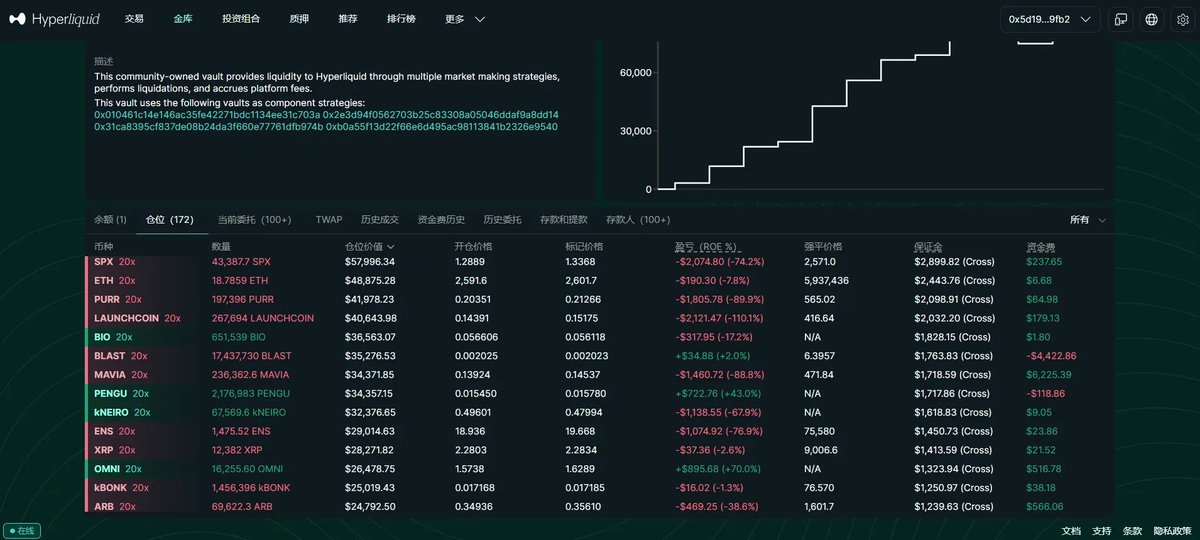
And from these two incidents, it seems that although Hyperliquid is a trading counterparty, it does not hedge. As the illustration shows, HLP’s core role is to fill gaps in the order book and ensure that users’ orders can be matched immediately. But HLP’s own position exposure is very likely naked.
Fortunately, the position size is not large, which shows that most orders can be absorbed through matching, and also shows that Hyperliquid’s high-frequency strategy is working: there are enough high-frequency traders, and the key point is that they are also enough to serve as each other’s counterparties, reducing HLP’s exposure; one could say the loop has been closed.
See? Isn’t this design tightly interconnected, with every component indispensable?
Moreover, HLP’s liquidation price is still quite far from the current price; on the other hand, thanks to the offsetting positions, it earns funding rates, becoming one of HLP’s revenue sources.
What Happens Next for Hyperliquid? The HIP-1 Token Listing Mechanism?
----------------------------------
HIP-1 is a Dutch auction-style token listing mechanism, with a transparent process and algorithmic pricing. Dutch auction, also known as a “descending-price auction,” starts from a higher opening price and then the price decreases linearly (or according to preset rules) over time.
HIP-1 usually lasts 31 hours. If nobody places a bid, the auction’s starting price is reset to a lower predefined level, such as 500 HYPE, or 10,000 USDC. If the previous auction was successful, the starting price of this one will usually be double the last matched price of the previous auction. The initial auctions were settled in $HYPE, but according to the latest information, they are now mainly settled in $USDC.
The current problem is that the market is almost uninterested in tokens issued through HIP-1, with almost no trading volume. Hyperliquid needs a catalyst to spark demand for new tokens.
If they can really do that, then it will be on-chain Binance Alpha.
Original source: Godot’s X post
Information only. Not investment, legal, tax, or financial advice.