From Hayek to Polymarket to TurboFlow: A Century-Long Evolution from Prediction Markets to Event Contracts
From the 1907 wisdom of crowds, Hayek’s price mechanism, and IEM to Intrade, Polymarket, and TurboFlow, this article traces how event contracts evolved into an on-chain retail trading product.
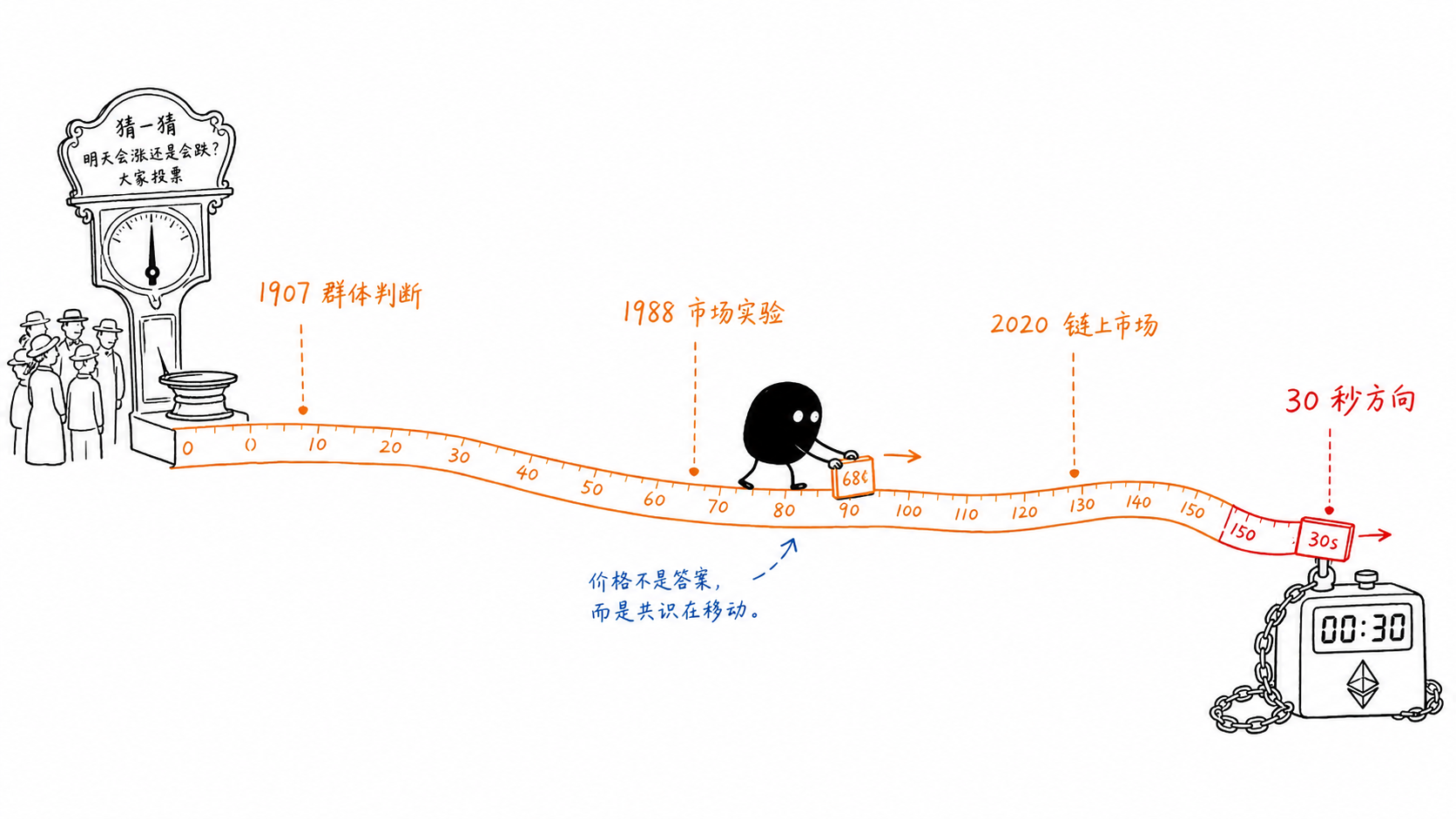
How does a society know what it knows?
From guessing weights at a market stall, to political prediction markets, to short-duration Event Contracts that anyone can join on-chain at any time, event contracts have undergone more than a century of evolution. Their core has never changed: convert people’s differing views of the future into prices, then settle based on the outcome. What has changed is the set of events covered by the market, participation barriers, trading cycles, and underlying infrastructure.
Looking back along this line, Polymarket turned prediction markets into a global internet product, while TurboFlow has taken event contracts further into an on-chain trading setting for ordinary traders. The two occupy different stages and product forms, but together they have pushed “trading the future” from an economics experiment toward a mass-market product.
1. 1907—1945: From “wisdom of crowds” to price discovery
!Distributed information compressed through trading into observable probability price signals
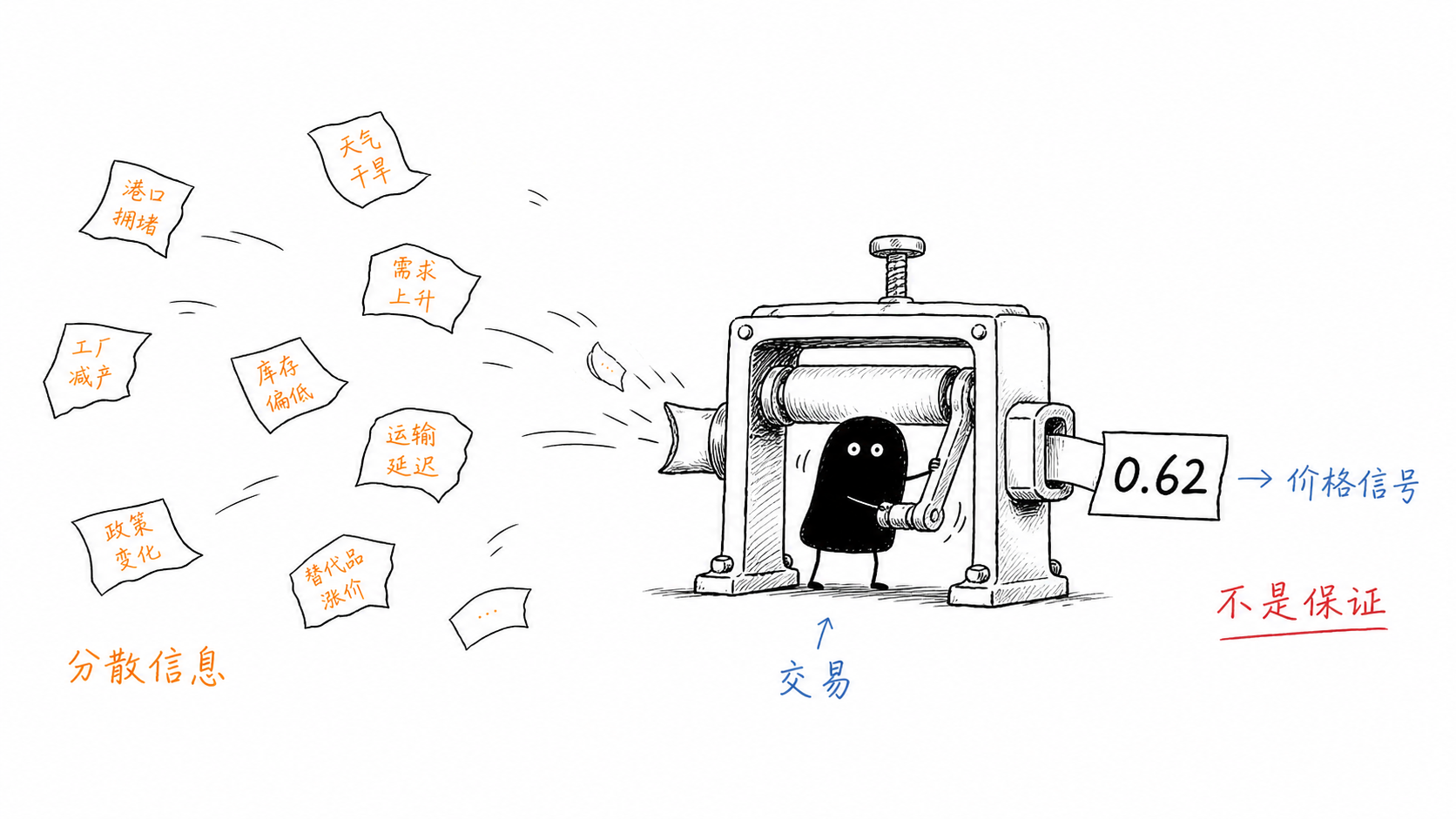
The starting point of event contracts can be traced back to 1907. The British statistician Francis Galton observed that when a group of people independently estimated the weight of a cow at a market, the group’s judgment came very close to the true result. This story was later summed up as the “wisdom of crowds”: when participants hold different information and their judgments can be formed relatively independently, the aggregated result is often closer to the truth than any single individual.
Economists later began to ask a further question: if market prices can aggregate information about supply and demand for goods, can they also aggregate information about future events?
In 1945, Friedrich Hayek systematically explained the informational function of the price mechanism in The Use of Knowledge in Society. Knowledge in the real world is dispersed among countless individuals, and market prices can compress those scattered judgments and information into continuously changing signals. Following this logic, markets can not only price goods, but also aggregate participants’ views of future events through trading.
Event contracts apply this logic to future outcomes. Suppose a contract that says “this event will happen” is currently priced at 0.62 dollars and is structured to settle at 1 dollar if the event occurs and at zero if it does not. Then 0.62 dollars can usually be understood as the market’s probability signal for that outcome. Participants put capital behind their judgments, and new information is continuously incorporated into price through trading.
Prices are still influenced by liquidity, participant composition, market sentiment, and trading rules, so they are better understood as real-time market judgments rather than absolute probabilities. This has been a constant throughout the later development of event contracts.
2. 1988: Iowa Electronic Markets turned theory into an experiment
A major starting point for modern prediction markets came in 1988. Researchers at the University of Iowa created the Iowa Political Stock Market, which later developed into the Iowa Electronic Markets (IEM), using contracts linked to U.S. presidential election outcomes to test whether markets could improve forecast quality.
The early market was very small, and participation amounts were strictly limited. It proved something important: even with a limited number of participants, as long as they are willing to trade based on new information, prices can still form a collective judgment with reference value.
In 1992, IEM received a “no-action letter” from the U.S. Commodity Futures Trading Commission (CFTC), allowing it to continue operating under small-scale, research-oriented conditions. Event contracts thus gained a relatively stable institutional space for the first time. Over the years, IEM prices have often been compared with polls, and prediction markets have been pushed into the mainstream of economics research.
3. 1999—2013: Intrade proved commercial value, and exposed regulatory boundaries
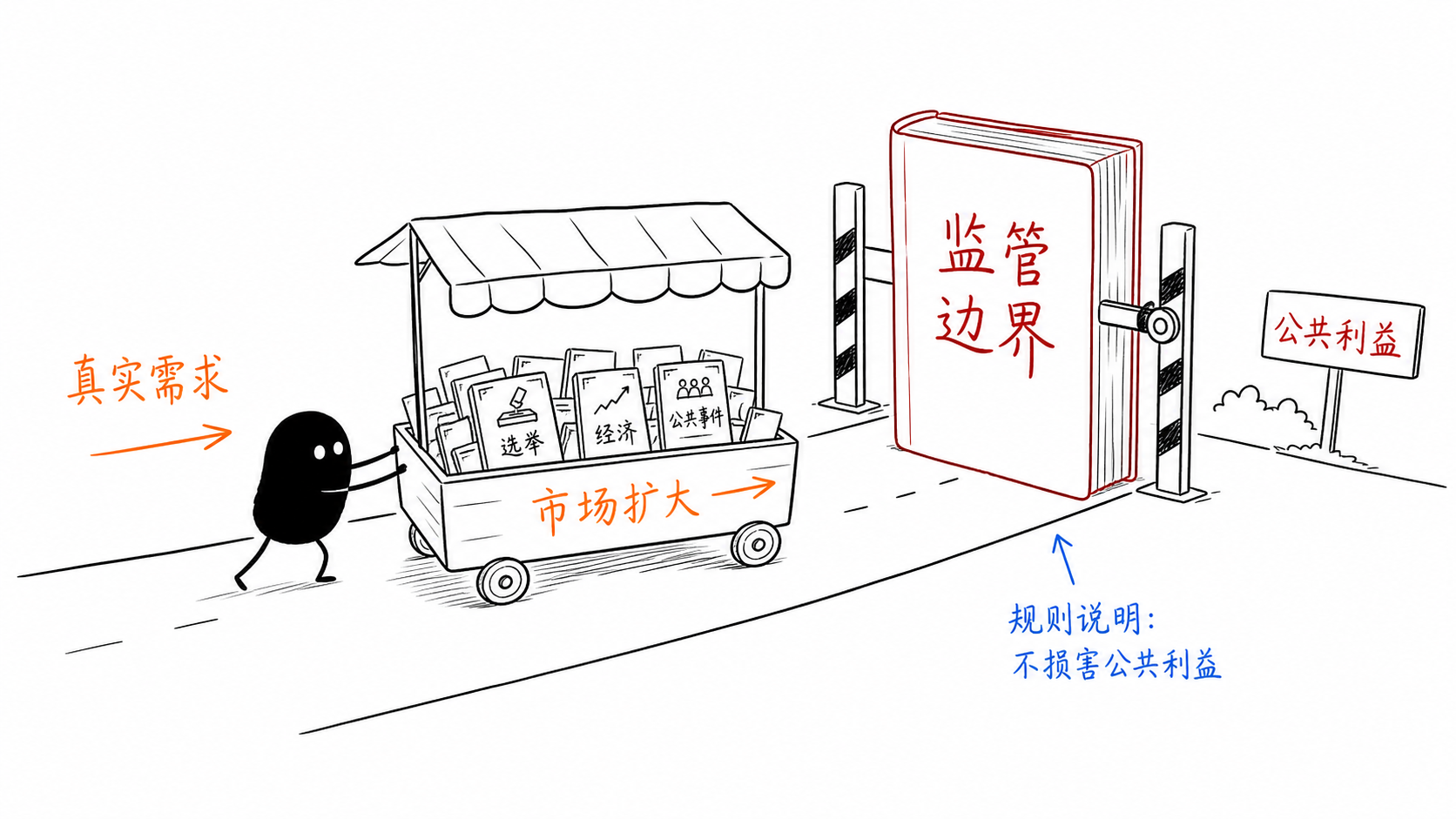
After academic experiments came commercial platforms. TradeSports and Intrade expanded tradable events to elections, economics, entertainment, and international affairs, opening them up to a broader user base.
Intrade’s value drew attention in multiple U.S. elections. Media outlets, researchers, and the public began to treat market prices as another signal alongside polls. More capital and more participants brought more active price discovery, and prediction markets came closer than ever to a mass internet product.
Regulatory issues soon intensified. In 2012, the CFTC alleged that Intrade was offering unregistered commodity options trading to U.S. users. The platform later stopped service and closed in 2013. The lesson left by Intrade was clear: event contracts have real demand, but long-term development requires compliance, clearing, and market infrastructure that match the scale of trading.
During the same period, event contracts also touched ethical and public-interest boundaries. In 2003, the Policy Analysis Market project, funded by the U.S. Defense Advanced Research Projects Agency, attempted to use markets to forecast political and security developments in the Middle East. The project was quickly canceled amid public controversy. That episode reminded the industry that whether a contract can be traded also depends on contract design, public interest, and social acceptance.
4. 2014—2020: Restricted markets continued, while crypto infrastructure began to mature
After Intrade closed, IEM and restricted markets such as PredictIt continued to offer political event trading. They kept alive the research and product spark of prediction markets, while user scale, per-trade size, and the number of markets remained constrained.
Meanwhile, stablecoins, smart contracts, on-chain wallets, and automated market making gradually matured. Event contracts began to have a new technical foundation: global users could trade on a unified network, rules and settlement processes could be written into smart contracts, and markets could run around the clock.
This created the conditions for the next round of growth. Prediction markets began shifting from “websites maintained by a single institution” toward composable, verifiable on-chain markets.
5. 2020—2025: Polymarket brought prediction markets to the world
!Polymarket combines global public events, on-chain trading, and real-time probability prices
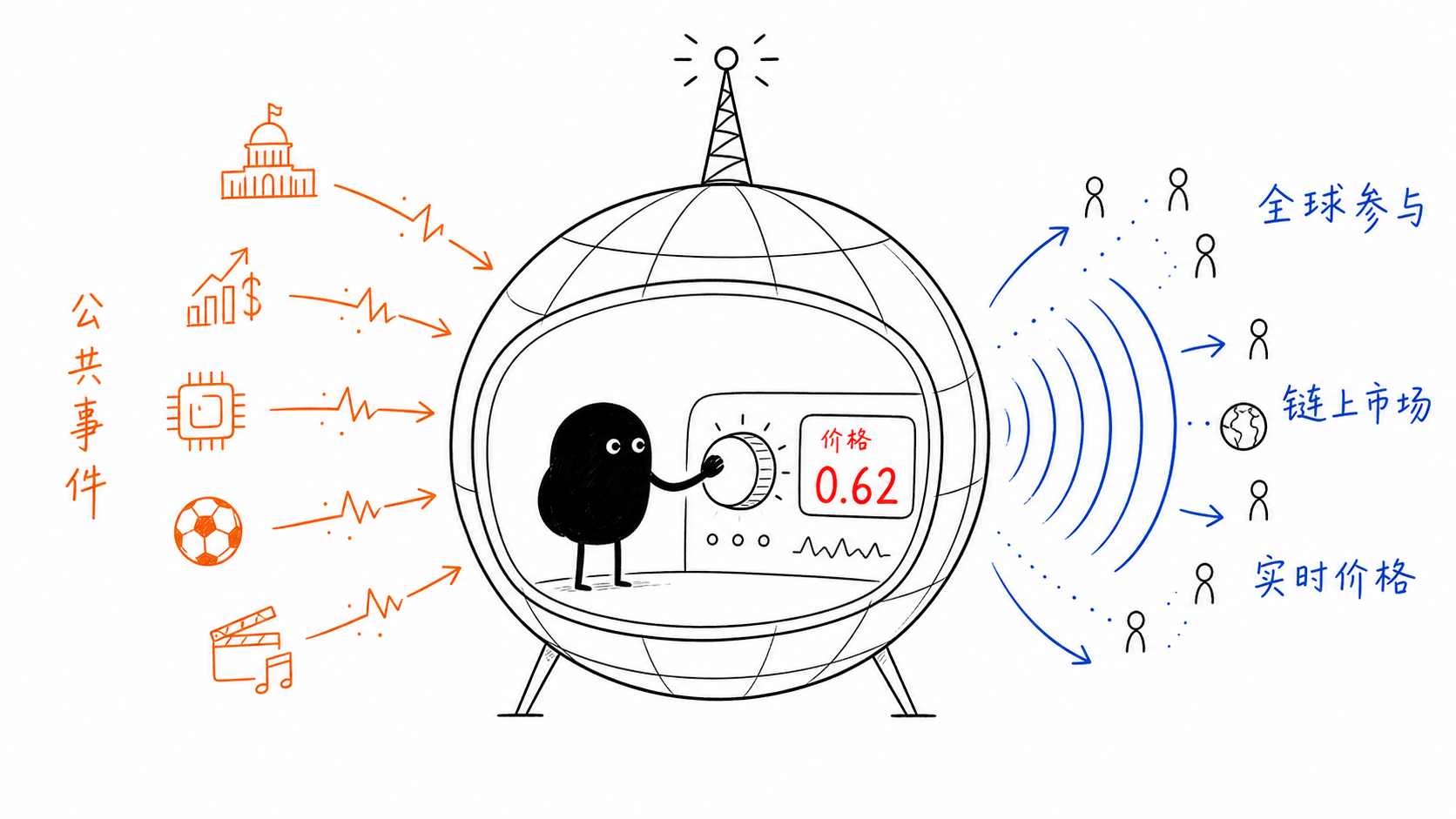
Polymarket launched in 2020, using stablecoins and blockchain infrastructure to provide event markets around topics such as politics, macroeconomics, technology, sports, and culture. Users trade “Yes” or “No” shares, prices move with supply and demand, and settlement occurs once the event outcome is determined.
The first change it brought was in distribution. Prediction markets went from a regional product to a global internet product, and market prices could also be cited in real time by media, researchers, and social platforms. During the 2024 U.S. election, Polymarket received unprecedented public attention, and event contracts became a high-frequency data source in global news discussions for the first time.
Polymarket’s growth also came with compliance adjustments. In 2022, the CFTC reached a settlement with it over the provision of unregistered on-chain event contracts and required the platform to address non-compliant markets. Since then, Polymarket has continued building a path into regulated markets.
In 2025, Intercontinental Exchange (ICE), the parent company of the New York Stock Exchange, announced an investment of up to 2 billion dollars in Polymarket and planned to distribute its event-driven data. The partnership was symbolically significant: event probabilities formed by market trading began to be seen by traditional financial infrastructure as a data product that could serve institutional clients.
Polymarket completed an important migration in the history of event contracts—from academic research, niche communities, and gray areas into the global mainstream financial and media field of view.
6. Kalshi and the expansion of the regulated U.S. market
Running in parallel with the on-chain path, Kalshi chose to start from a regulated exchange. In 2020, it became a CFTC-registered designated contract market, and launched event contracts around outcomes such as economic data, weather, politics, and sports.
In 2024, a U.S. federal district court overturned the CFTC’s ban on Kalshi election contracts. In May 2025, the CFTC withdrew its appeal, ending the case. This accelerated the expansion of the U.S. event contract market and also sparked new federal and state regulatory discussions.
By 2026, event contracts had already formed multiple parallel paths: regulated centralized markets, on-chain prediction markets for global users, and short-cycle products designed around price movements. Different products correspond to different information types, participation methods, and risk structures.
7. From “predicting public events” to “trading market outcomes”
!Event contracts extend from public events months away to price direction tens of seconds away
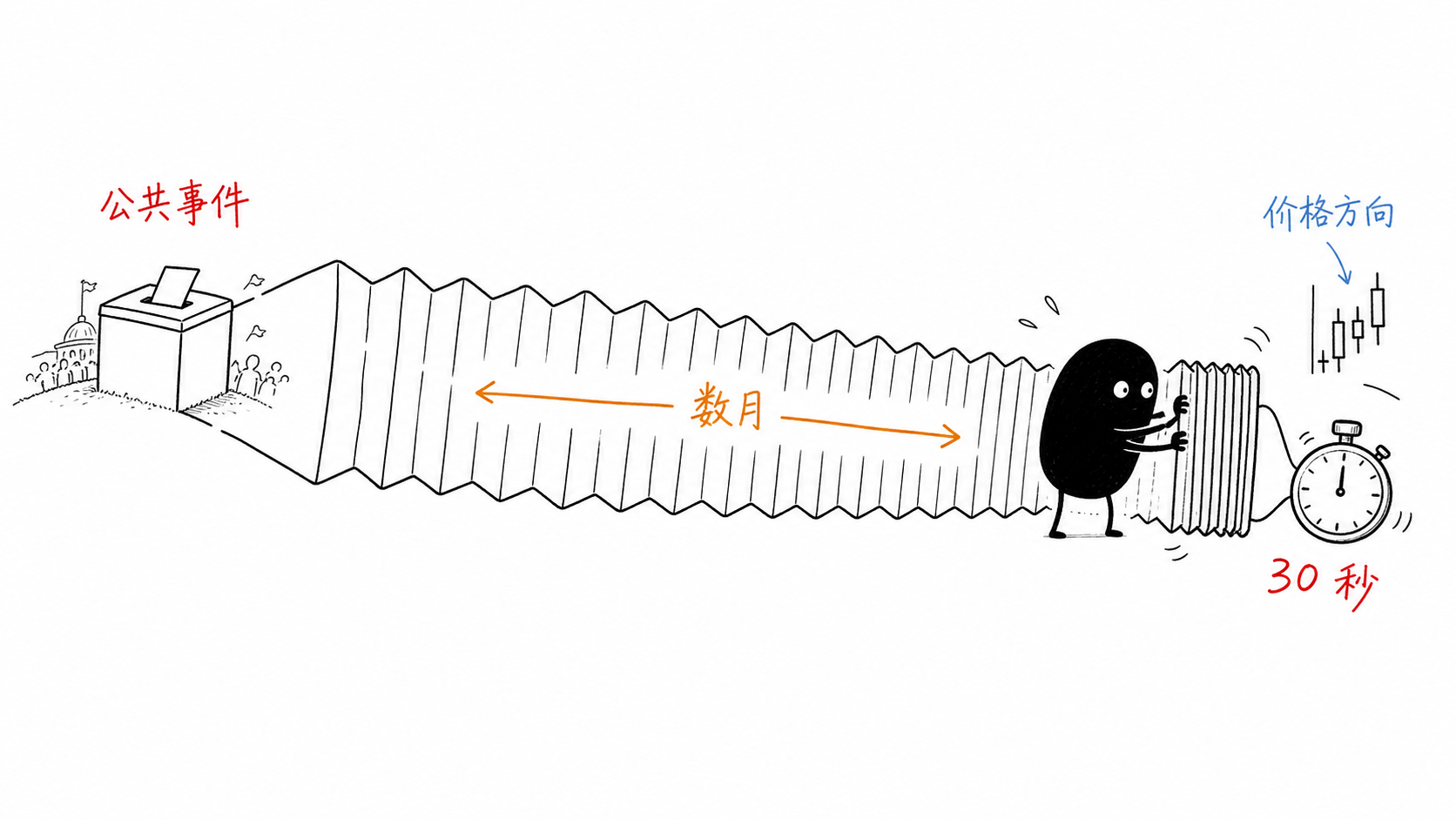
The product boundary of event contracts is expanding. Early markets mainly answered questions like “who will win the election” or “will a certain policy pass”; newer products can also answer “after a specified time, will BTC be above or below its current level?” Both types of contracts turn uncertain outcomes into clear conditions and settle after expiration according to pre-announced rules.
They aggregate different kinds of information. Political and macro event markets absorb news, research, and public information, and their cycles are usually longer; short-cycle price events absorb real-time market prices, volatility, order flow, and traders’ directional judgments, and are closer to high-frequency market trading.
This evolution has made event contracts a general-purpose product structure. Users do not need to deal with complex position parameters, yet can still express a view around a clear outcome. The product experience therefore expands from “finding an event worth predicting” to “quickly expressing a directional judgment in a familiar market.”
8. TurboFlow: event contracts enter the retail on-chain trading scene
Event contract markets are evolving along different paths: one type of platform emphasizes institutional development and regulatory frameworks, improving market credibility through standardized rules; another emphasizes global accessibility and on-chain execution, using transparent mechanisms to reduce geographic and infrastructure constraints; a third has begun exploring shorter-cycle event products that are closer to trading scenarios, in order to lower the participation threshold and improve capital efficiency.
TurboFlow represents this third path of exploration. It is an on-chain trading platform for global retail users, integrating Perpetuals (perpetual contracts), Event Contracts (event contracts), and Prediction Markets (prediction markets) into a single trading ecosystem, attempting to make professional trading products simpler and easier to participate in.
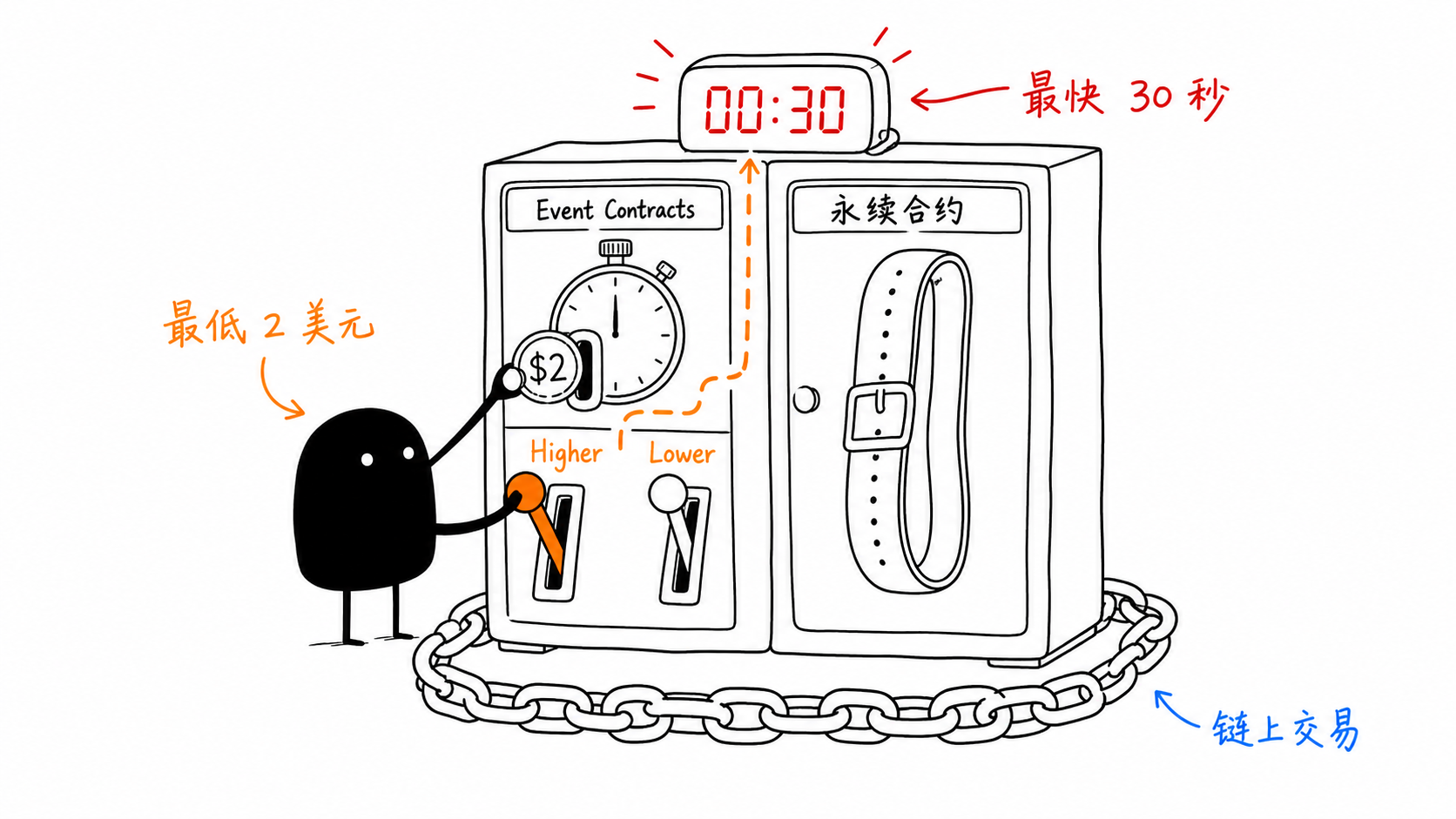
In TurboFlow’s event contracts, users can make a judgment about the price direction of assets such as BTC, ETH, and gold after a specified cycle. Participation starts at just 2 dollars, and one round of trading can be completed in as little as 30 seconds. Clear directional choices, a fixed expiration time, and pre-displayed potential outcomes lower the barriers to understanding and operation.
TurboFlow also places event contracts into a complete trading ecosystem. Based on market views, users can choose short-cycle Event Contracts, or use perpetual contracts to manage longer-term directional exposure.
At the market infrastructure level, TurboFlow introduces professional market makers to provide liquidity and supports a more market-driven trading experience through transparent on-chain execution. Its product direction continues the price discovery logic emphasized by Hayek: different participants’ judgments enter the market, and prices and odds change with supply, demand, and information.
TurboFlow and Polymarket show two typical use cases for event contracts. Polymarket lets users trade public events such as politics, economics, and culture, while TurboFlow further covers short-cycle market outcomes and connects event contracts with perpetual contracts. Event contracts therefore gain a broader time scale and reach more users with different levels of experience.
9. What still matters after event contracts go mainstream
Looking back at this history, the long-term value of event contracts comes from three elements.
First, the rules need to be clear. The underlying asset, observation time, data source, and settlement conditions should be clearly displayed before trading.
Second, the market needs liquidity. Participant numbers, market maker quality, and order-book depth affect whether prices can absorb information in a timely manner, and also affect the user’s actual trading experience.
Third, risk must be understood correctly. Binary outcomes mean gains and losses are concentrated at settlement, and short-cycle trading further amplifies volatility and timing effects. Market prices and odds express traders’ judgments under specific rules and liquidity conditions, and cannot be treated as a guarantee of outcome.
These principles connect IEM, Polymarket, Kalshi, and TurboFlow. While technology and interfaces keep changing, credible rules, transparent execution, and sufficient liquidity remain the foundation for event contracts to scale further.
Conclusion: from an information market to an everyday trading entry point
From the 1907 crowd guess, to Hayek’s explanation of the price mechanism; from the 1988 Iowa Electronic Markets, to Polymarket bringing prediction markets onto the blockchain, and then to TurboFlow integrating short-cycle Event Contracts and perpetual contracts into a single platform, event contracts have completed a long evolution from idea, to experiment, to market, to product.
This history also reveals why event contracts keep growing: people have always needed a simple way to express a view about the future. Today, event contracts can already cover political outcomes months away, as well as market direction 30 seconds ahead. The time scale has shortened, participation has become lighter, and the logic of price discovery continues.
If traditional prediction markets mainly aggregate participants’ views of the future through medium- and long-term event trading, then today’s short-cycle event contracts further extend that mechanism into trading scenarios with shorter time horizons and higher frequency. For TurboFlow, this evolutionary path points to a more concrete goal: enabling more ordinary users to participate in transparent, easy-to-understand on-chain trading supported by real market liquidity.
Information only. Not investment, legal, tax, or financial advice.