The Energy Bill Between Translation Jobs
A translation system’s energy use depends on its working rhythm. Include the waiting time before comparing devices.
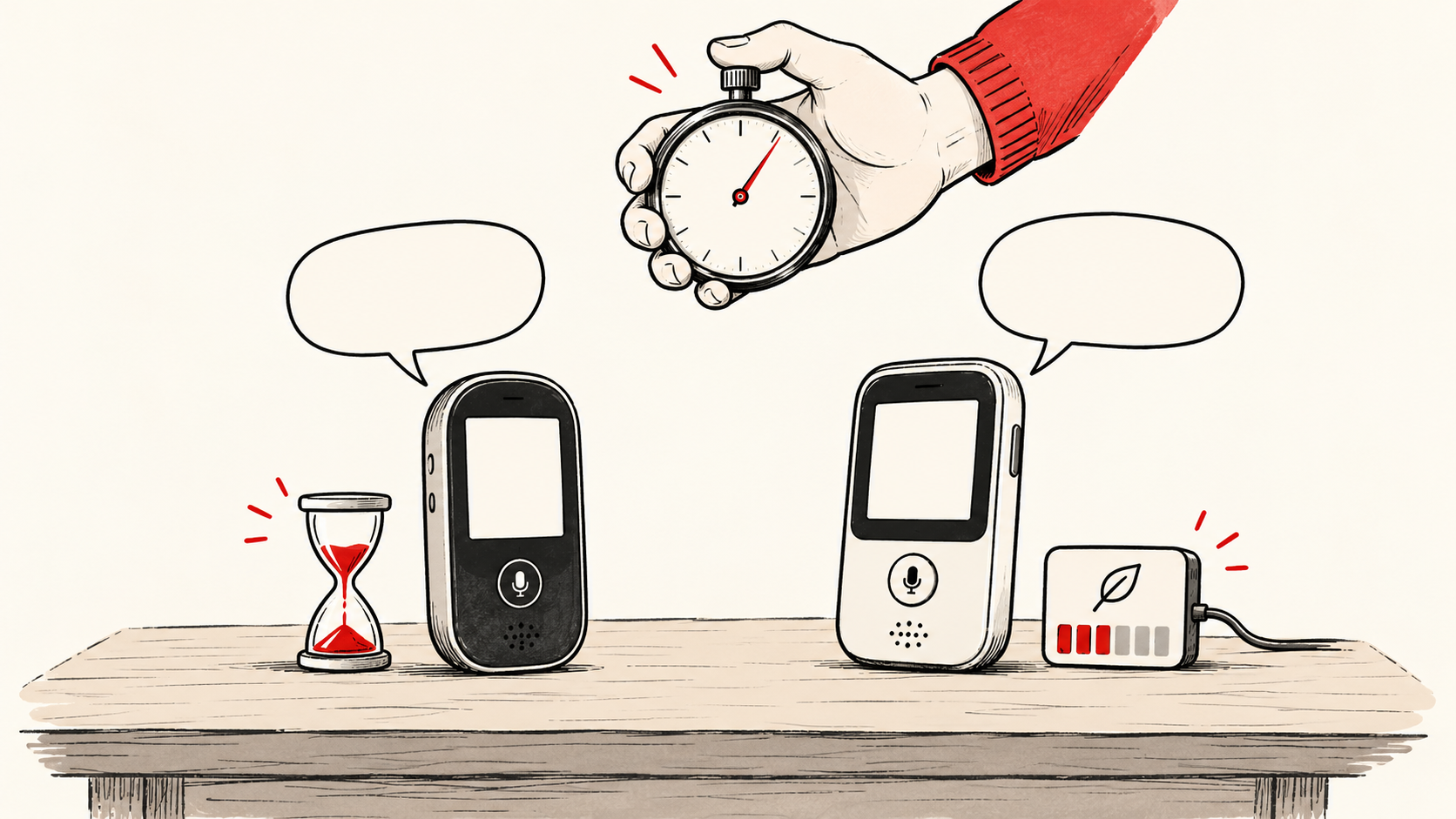
Arabic.AI’s October 17, 2026 technical note describes vendor translation tests at a 10-watt device cap, with a sample-based quality comparison. Report
That makes an accounting question timely: what does a deployment consume between completed jobs? Open Market Notes proposes a session-level test. The arithmetic below is hypothetical, not measured product performance or evidence of a new model release.
Follow the clock through the quiet periods
Assume two fictional devices produce the same acceptable translation. Device A draws a constant 8 watts for 20 seconds; device B draws 20 watts for six seconds. Their active energy use is respectively 160 and 120 joules, since a watt is a joule per second. B finishes with less active energy despite its higher power.
Now observe each device for ten minutes, with one translation at the start. Suppose A draws one watt while idle and B draws two. Both remain powered on, and we assume no other energy costs. A consumes 160 + 580 = 740 joules. B consumes 120 + 1,188 = 1,308 joules. Including the quiet period reverses the ranking.
This does not select a real product. It demonstrates why the interval between jobs belongs in the comparison. A continuous batch, a reception desk and an occasional offline query imply different schedules. A device that sleeps between requests introduces another variable: the energy and delay of waking it. Measure those transitions rather than assigning them zero by default.
Keep the boundary visible
For the proposed test, define where electricity is measured. A processor reading, a battery reading and power measured at the wall cover different components. Use the same boundary for both candidates. Disclose whether displays, storage, networking and conversion losses fall inside it.
Replay the same arrival schedule and document set. Preserve interruptions, retries and idle intervals. Record total energy, elapsed time and completed translations that pass a separately specified quality review. Raw token counts should not substitute for equivalent work: the test must establish that each device delivered the required meaning and terminology.
For a battery-powered workflow, retain unfinished jobs and shutdowns in the results. Reporting energy only for successful sessions can hide a device that repeatedly fails before completion.
Buy for the working rhythm
Repeat the experiment under sparse and busy schedules, with the intended sleep policy enabled. A useful comparison reports both session energy and response delay. Waiting longer to save energy may be acceptable for a queued document batch but unacceptable at a service counter.
The purchasing question is which configuration meets the workload’s quality, timing and energy requirements together. That requires a measured session with its quiet periods intact. A power ceiling supplies only one input to that decision.
Information only. No investment, legal, tax, or financial advice.