NVIDIA is taking on long-term lease and credit risk behind its chip sales
Guarantees, capacity commitments and direct leases have different triggers. Their duration matters as much as their headline size.
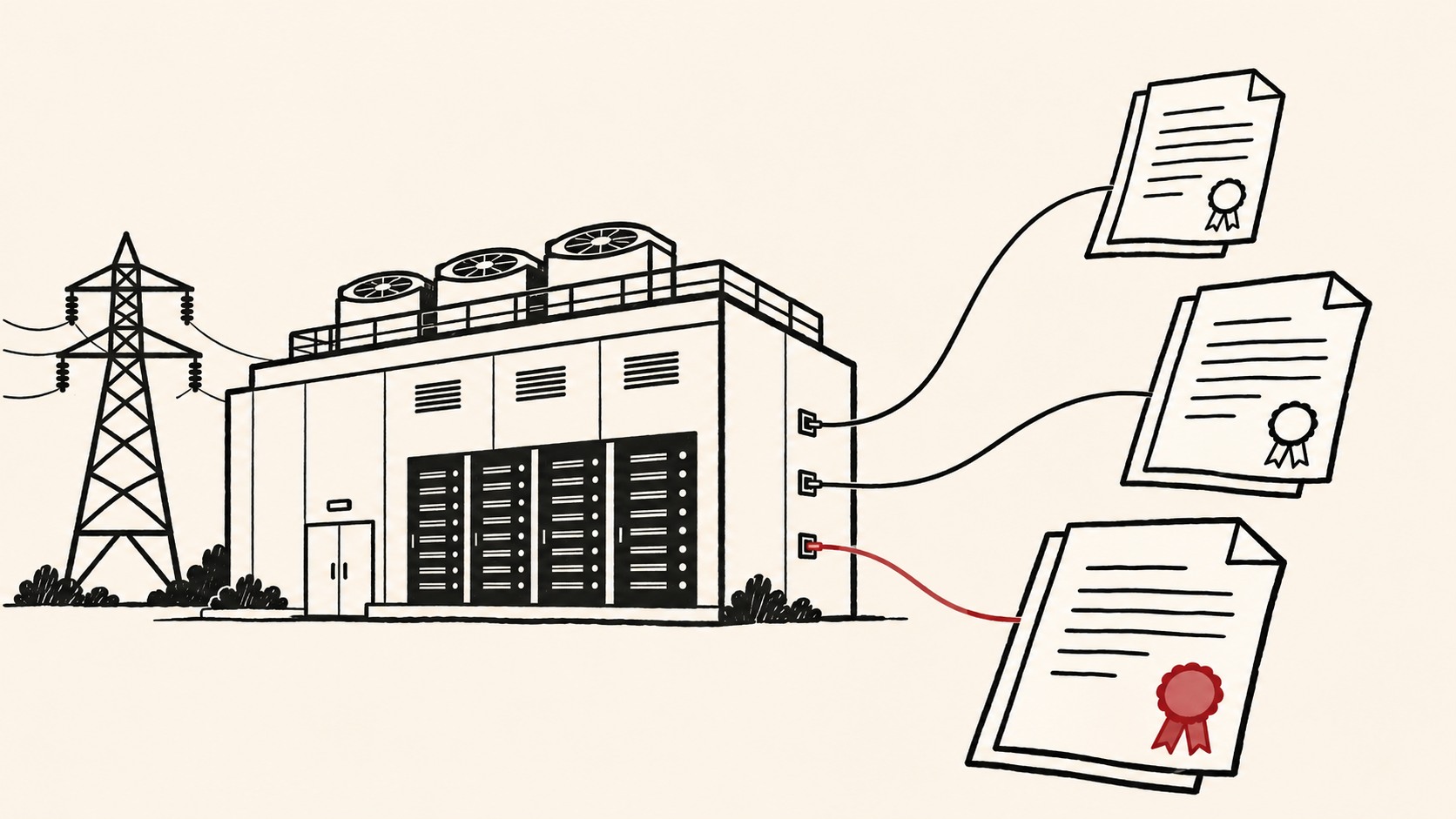
Selling a chip does not establish that the building housing it has land, electricity, financing and a durable tenant. NVIDIA’s latest disclosures show the supplier helping bridge those gaps. The analytical question therefore extends beyond sales to the obligations assumed to enable deployment. The task is not to manufacture one alarming total, but to identify who must pay whom, and under which conditions.
This article uses the November 17 third-quarter CFO commentary and the earlier second-quarter 10-Q. The commentary says the third-quarter 10-Q is planned for the coming weeks. It is therefore not treated here as an already available full quarterly filing. Third-quarter CFO commentary
Three arrangements, three triggers
At October 25, the disclosures list $32 billion of neocloud agreements, $118 billion of maximum gross guarantee exposure and $74 billion of uncommenced data-center leases. A separate $28 billion of cloud-service agreements brings cloud services plus leases to $102 billion. These appear in different tables; they are not all money already lent. Commitment and guarantee tables
Neoclouds specialize in supplying AI computing capacity. The agreements support deployment and use rather than unconditionally guaranteeing every debt of those providers. The latest disclosure makes effectiveness conditional on financing to purchase infrastructure, followed by deployment, operation and NVIDIA’s acceptance of the capacity. Failure to satisfy conditions on time can change timing or amounts and reduce or eliminate some commitments. Effectiveness conditions
That is an entry gate, not the end of commercial risk. Acceptance establishes that capacity can be delivered. It does not establish that end customers will keep buying it at an adequate price. Financing, construction and utilization must be assessed separately.
The second-quarter filing describes partners selling capacity to third parties, with commitments declining as third parties or NVIDIA use it. It also describes NVIDIA buying committed capacity that partners fail to sell. Second-quarter commitments and risk factors Such arrangements can give a project a financeable revenue base while returning part of the demand risk to the equipment vendor. They neither prove that equipment sales are fictitious nor allow all associated risk to be dismissed once a sale is recorded.
A guarantee ceiling is not today’s cash loss
Of the $118 billion maximum, $105 billion relates to SB Energy credit support, $3.5 billion to neocloud land, power and shell guarantees, and $9.5 billion to power and systems credit support. NVIDIA says it has made no guarantee payments. Guarantee breakdown
SB Energy support becomes effective in phases as buildings are completed and ready for service, with the first expected in fiscal 2029. It supports OpenAI’s twenty-year leases, with exposure declining as rent is paid. The second-quarter filing limits coverage to defined portions of lease and power payments, not the whole campus cost or every tenant obligation; specified events can terminate the guarantees. Phasing Coverage limits
Three quantities must remain separate: the contractual maximum, exposure already effective, and losses after allowing for default likelihood and recovery. Treating the ceiling as a current loss exaggerates the evidence. Treating the absence of payments as the absence of risk ignores a long-duration credit commitment.
The more interesting issue is duration mismatch. Hardware generations change while sites and power arrangements can remain relevant across several generations. A productive location may protect future sales opportunities. If utilization or tenant credit deteriorates, the vendor’s exposure may outlast the selling cycle of any single product. That is an inference from the contract structure, not a prediction that a particular customer will default.
A direct lease does not wait for someone else to default
Direct leases differ from guarantees. Once a lease commences under its terms, the tenant must perform without first waiting for another party’s default. NVIDIA’s latest uncommenced leases run for up to twenty years, with starts expected from the fourth quarter of fiscal 2027 through fiscal 2033. Some may be assigned to third parties. Lease disclosure
“May be assigned” is not equivalent to “obligations have been released.” Even if another user eventually occupies a site, the costs before assignment and any retained responsibility matter. An intention to transfer a lease cannot turn the original commitment into a harmless administrative step.
The comparisons also need consistent boundaries. The second-quarter main table had $29 billion of cloud services and $25 billion of uncommenced leases. An additional table separately contained $20 billion of uncommenced leases for third parties. Together they equal $74 billion, matching the prior-quarter combined figure cited in the latest commentary. Earlier classifications Comparing current leases of $74 billion with only the earlier main-table $25 billion omits the separately reported component. That arithmetic flags a classification issue; it is not a full roll-forward and does not prove every change represents newly signed contracts.
Similarly, the decline in neocloud commitments from $36 billion to $32 billion does not independently demonstrate stronger demand or released risk. A detailed bridge is needed to distinguish utilization, amendments and new arrangements. The second-quarter $108.5 billion guarantee total also already included the SB Energy agreement signed in August. It should not be presented as a pure July-end exposure snapshot. Earlier commitments and subsequent event
Follow the routes out of the obligations
Economically, these structures connect customers’ limited financing capacity with the supplier’s interest in expanding deployment. Credit support can move a project forward. It cannot create permits, electricity connections or paying end-user demand by itself. Risk is being conditionally reassigned, not eliminated.
Three exits deserve attention: when projects satisfy effectiveness conditions; whether third-party use and payments reduce NVIDIA’s obligations; and whether assignment, credit improvement or expiry actually releases responsibility. Correlation matters too. A common slowdown in demand could affect equipment purchases, capacity usage and tenant payments together. Different legal instruments do not establish independent economic risks.
NVIDIA is not simply turning from a chip company into a bank. It is linking product sales to longer infrastructure obligations. Quarterly revenue describes how products sold. Conditions, duration and release mechanisms explain how long the risks assumed to support those sales may remain.
Information only. No investment, legal, tax, or financial advice.