Prediction Prices Need Their Context to Travel
A percentage becomes useful outside its home exchange only when its contract, timing and settlement conditions travel with it.
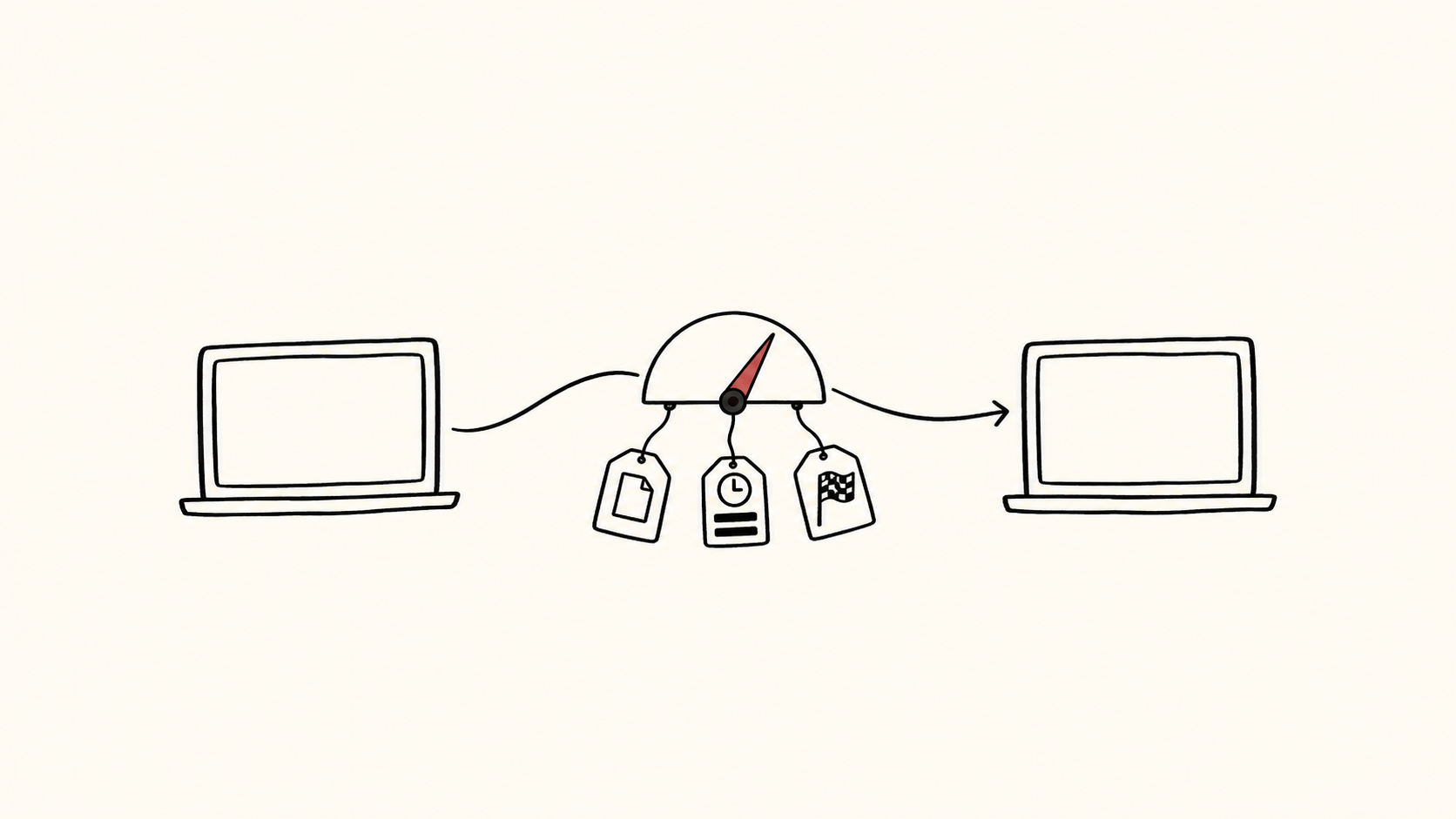
Embedding a prediction-market price in another app creates an editorial responsibility. A reader may see the number without ever opening the exchange. The distributor therefore decides which parts of the observation survive: the exact question, the time it was measured, the trading conditions and the route to a final result. Removing those details can make an attractive display harder to interpret.
Kalshi announced accuracy scores, low-volume labels and more visible trade feeds on October 6. Announcement. Our analysis asks what a distribution partner should preserve when presenting such market information elsewhere.
Preserve the question behind the number
Kalshi’s published CONTROL terms link payout to the chamber leader’s party and allow conditional accelerated resolution. Contract terms.
That specificity suggests a basic editorial rule: identify a market by its contract and rule version, rather than matching a familiar headline. A comparison engine should record the event definition, observation deadline, named evidence source and exceptional cases before placing two venues in the same chart. A disagreement between numbers is worth explaining only after checking whether they answer the same question.
The same discipline should govern translation. Shortening a headline for a mobile screen must not silently remove a deadline or change the meaning of “wins.” A translated summary needs a visible route to the complete governing text. If an aggregator cannot establish equivalence, it should show the markets separately and explain the uncertainty.
Make the observation inspectable
An NBA-contract preprint finds liquidity-related updating delays against a model benchmark; it does not establish election-market performance. Research.
For a distributor, our proposed response is to make the displayed observation reproducible. Is the number the latest trade, the middle of current quotes, or a model built from several markets? When did the underlying observation occur, and when did the app receive it? Those are different timestamps. A feed can arrive on schedule while carrying an old trade.
Consider a hypothetical display showing 63%. If the latest transaction occurred forty minutes ago, the label should make that age visible. If the number instead comes from two quotes, show their range and the amount available near them. The midpoint is a calculation; presenting it with extra decimal places does not create extra evidence.
A useful interface can keep the main display simple while putting these details one tap away. It should also have a clear state for missing data. Reusing the last number without marking it stale makes a transport failure look like unchanged opinion.
Carry the settlement state too
Polymarket documents a proposal-and-challenge process for resolving its international markets. Resolution process.
Our design recommendation is to give settlement its own status field. A market can have an apparent real-world answer while the venue is still completing its procedures. A distributor should distinguish trading availability, outcome determination and payout availability wherever the source exposes them. If a state cannot be observed, label it unknown instead of inferring it from the price.
This matters for readers who never trade. A news product that labels an outcome “settled” is making a stronger statement than one that reports a high market price. Its wording should depend on the relevant status, with a link to the source and any subsequent correction. A smooth animation should never substitute for that check.
Test what reaches the reader
An integration review should include deliberately awkward cases: a stale feed, an amended rule, a withdrawn quote, a disputed result and a contract with no recent trades. Product teams should inspect the exported card in each case, not merely confirm that an API returned a number.
Our proposed acceptance test is simple: can a reader reconstruct what was measured, when it was measured and what could still change? Wider distribution is valuable when those answers remain available. The quality of a prediction-market integration should be judged at the point where someone encounters the percentage, including when the underlying information is incomplete.
Information only. No investment, legal, tax, or financial advice.