Gentex’s cost-recovery lag: the capital tied up behind pricing
Recoverable costs can still tie up capital; timing matters as much as the eventual reimbursement.
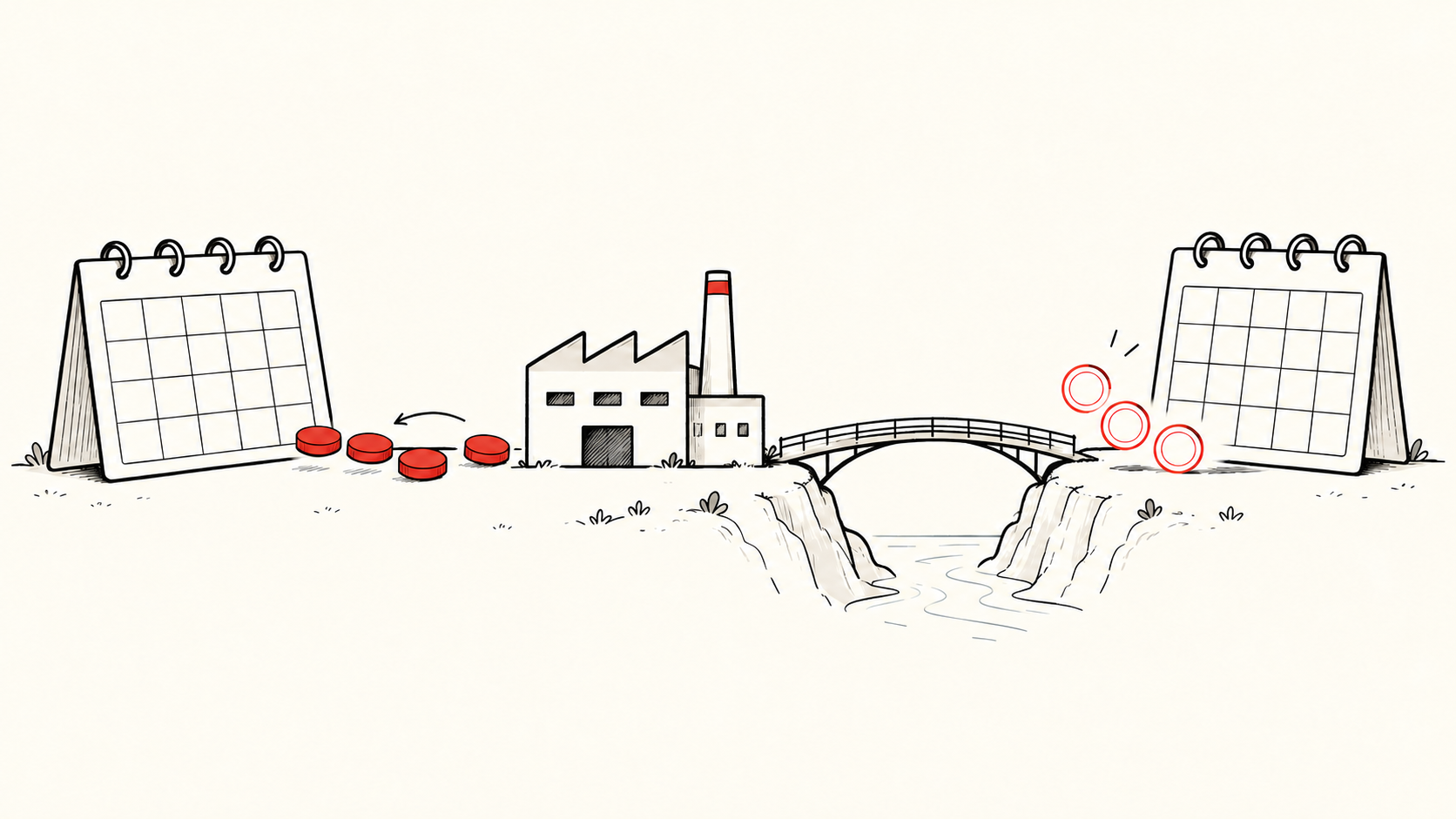
A supplier can eventually recover a cost increase and still have had an economically difficult period. The missing variable is time: whose money carries production while the selling price catches up, and what business opportunities that money cannot support in the meantime?
Gentex’s October 23, 2026 release expects $10–15 million of additional fourth-quarter costs, with related reimbursement not expected until first-half 2027. These are forecasts, not completed recoveries. Company release
That narrow disclosure is more useful as a question about industrial economics than as a shortcut to forecasting earnings. This article develops an analytical framework, not an estimate of Gentex’s undisclosed contracts, receivables or funding needs. A delayed recovery can be temporary in the income statement without being costless to the business. Equally, a difficult quarter does not by itself establish a lasting loss of pricing power.
Four dates, not one promise
Consider a hypothetical supplier that pays more for material, manufactures a component, negotiates compensation and eventually receives payment. Purchasing, accounting recognition, commercial agreement and collection need not happen together. A statement that costs will be recovered says little by itself about the distance between these dates.
The accounting distinction matters before any cash-flow arithmetic. Gentex’s 2025 annual report says that revenue subject to negotiated retroactive price adjustments relies on management estimates. Annual report This is background accounting policy, not evidence of how the particular forthcoming reimbursements will be recognized. One cannot infer from a reimbursement forecast that a matching receivable already exists, or infer from a future collection date that all related earnings recognition must also wait.
For analysis, start with the commercial right rather than an assumed calendar. Is reimbursement contractually determined, contingent on customer approval, or still being negotiated? Which production periods and cost categories qualify? Those questions determine what the expected recovery actually covers. Public information here does not answer every one of them.
Full reimbursement can still leave an economic gap
Imagine, purely for illustration, that a customer later pays back every unit of an extra material expense. Principal recovery removes that expense from the supplier’s eventual cumulative burden. It does not automatically compensate the time during which funds were tied up. Nor does it reimburse financing, administrative work or disruption unless the agreement specifically covers them.
The relevant capital burden is not automatically the entire extra cost from the day it appears in a forecast. Supplier payment terms may defer the initial outflow; inventory may be sold before or after the reimbursement is agreed; customers may provide advances. An estimate of financing cost would therefore require actual payment dates, balances and funding arrangements. None should be invented from the headline amount.
Even a company funding the interval from its own cash faces a choice. Money reserved for the operating cycle is unavailable for another use during that interval. That is an opportunity cost, not proof that it has borrowed, missed an investment or suffered financial distress. Keeping these distinctions separate prevents ordinary commercial timing from being exaggerated into a liquidity crisis.
The rebound can be real without being repeatable
A later quarter’s earnings may include recognition of catch-up compensation associated with earlier shipments; the actual cash may arrive at a different time. That earnings benefit may be genuine, yet tell us little about the margin on newly manufactured units. Conversely, a weak quarter bearing an unusually concentrated cost burden may understate the economics of future production. The two observations can coexist.
A useful comparison follows the same production cohort through time. Match its added costs with the compensation eventually attributable to it, then assess current production independently. This is a conceptual reconciliation, not a claim that Gentex has published such a schedule. Where disclosure is insufficient, the honest conclusion is that the split remains unknown, rather than that all improvement is organic or all weakness is temporary.
The harder question is whether the lag repeats. If each successive production period creates another reimbursement negotiation, collecting an older claim may merely replace one funded interval with the next. A business can report successful recoveries while maintaining a persistent working-capital requirement. Alternatively, a revised price formula could reduce future delays. The amount recovered and the design of the next contract are different evidence.
Bargaining power has more than one dimension
The ability to obtain compensation eventually is not identical to the ability to set its timing. A supplier may have valuable engineering and still accept a slow approval process; a customer may accept higher prices while resisting automatic adjustment clauses. Commercial power is distributed across price, coverage, timing, documentation and dispute rights, not expressed in a single margin percentage.
There is also a reasonable competing interpretation: delayed settlement can reflect routine coordination rather than weak negotiating power. Both parties may need to verify eligible volumes and costs, and predictable procedures can make a lag manageable. The evidence needed to distinguish these cases is contractual specificity and repeated delivery against expectations, not the mere presence of a delay.
For readers of future results, the important development is therefore not simply that a recovery arrives. It is whether its amount and timing become clearer, whether current-period profitability can be separated from prior-period catch-up, and whether the next cost shock is handled with less uncertainty. A settlement may repair an old gap without changing the mechanism that created it.
Gentex’s forecast offers a concrete reason to ask these questions, but not enough information to answer all of them. “Temporary” describes duration; it does not mean economically neutral. The sounder reading preserves both possibilities: a recoverable cost can still require funding and negotiation, while a timing mismatch alone is not evidence of permanent impairment or a reason to make an investment recommendation.
Information only. No investment, legal, tax, or financial advice.