Faster fab simulation changes the experiment budget
Faster models can improve experiment selection, but the economics depend on validation, reuse and the decisions they change.
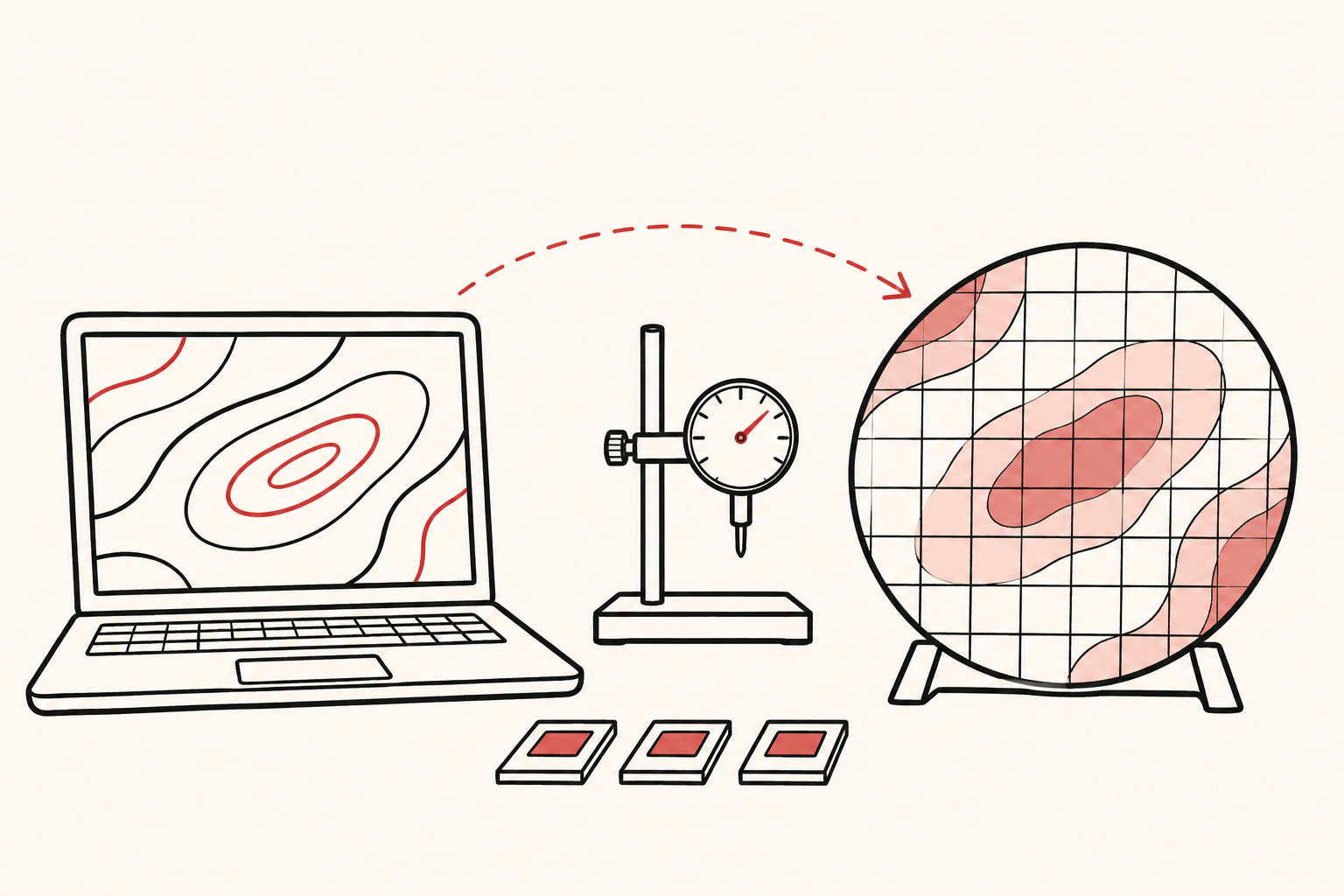
On November 3, 2026, NVIDIA described accelerated simulation and learned physics models for semiconductor manufacturing. Its examples include a Lam Research plasma model. These are supplier-reported capabilities, not a factory-wide yield study. Source: NVIDIA.
For a fab, the most consequential question is not how many predictions can be produced per second. It is which expensive physical experiment should happen next. A faster model can widen the search before that choice, but the savings depend on whether the additional search changes the choice. Open Market Notes sees this as a reallocation of the experimentation budget rather than a simple substitution of software for laboratory work.
A cheaper answer can create a more expensive queue
Consider a hypothetical process team comparing candidate recipes. Previously, a limited simulation budget forced it to discard many ideas early. A fast surrogate model, which approximates the output of a more expensive model, could screen a much larger candidate set. That is useful if it eliminates weak candidates or identifies a promising region that conventional screening missed.
But if every newly identified candidate is forwarded to the same constrained test line, the model has created a longer queue rather than a shorter development cycle. More recommendations can mean more engineering review, instrument time and interpretation. The benefit therefore depends on a selection policy: what evidence earns a candidate a physical trial, what uncertainty warrants further simulation, and what can be rejected without testing?
This distinction matters for procurement. Buying faster inference without changing the downstream selection process may increase analytical output without improving the pace of process learning. Conversely, a model that reliably removes unproductive trials can create value even if its headline speedup is modest. The useful unit is the cost and elapsed time of reaching a sufficiently supported process decision, not merely the runtime of one calculation.
Reuse is an asset with maintenance costs
A conventional solver and a learned surrogate distribute work differently. A surrogate may require a substantial initial effort to construct a useful training set and assess its limits. Its appeal is that this investment can be reused across later queries. That makes repeated, sufficiently similar questions an attractive setting; it does not make every new question cheap.
An illustrative comparison is a team repeatedly exploring a familiar operating region versus a team changing material systems. The first may spread validation work across many decisions. The second may need additional evidence before relying on the same model. This is not a claim about any named supplier's product. It is the economic consequence of asking whether yesterday's evidence still covers today's question.
A model portfolio should consequently be evaluated as maintained engineering infrastructure. Data preparation, specialist review, version control and periodic checks belong alongside compute in the cost estimate. Ignoring them makes the initial business case look cleaner while transferring the work to operations. A low per-query cost is important, but it is only one term in the lifetime cost of a dependable answer.
Accuracy needs a decision attached to it
A 2022 NIST paper treats verification, validation and uncertainty quantification as lifecycle credibility work. Source: NIST, December 16, 2022. That broad principle leaves a practical choice for a fab: which errors matter most in the task at hand?
For exploratory screening, a model that preserves the ordering of candidates may be useful even when it is unsuitable for authorizing a production setting. Near a process limit, a small error could change which side of an acceptable boundary a candidate appears to occupy. An average error score cannot, by itself, answer both questions. The intended decision determines the relevant test.
This also changes how uncertainty should be handled. Sending an ambiguous candidate back for a more expensive calculation is not automatically a failure of automation. It may be the intended behavior of a well-designed workflow. The economic aim is to spend expensive evidence selectively, where it can alter a decision, rather than to force every case through the cheapest computational route.
The opposing concern deserves attention: excessive conservatism can erase the benefit of a new tool. If every prediction requires the full old procedure, the surrogate becomes an additional cost. A credible deployment therefore needs differentiated uses, with broad exploratory use and narrower, separately supported decision authority. Neither blanket trust nor blanket duplication is a useful operating model.
The evidence must survive a changing process
A July 20, 2026 preprint examines drift detection, updating and validation in additive-manufacturing digital twins. It is research context, not evidence of semiconductor-fab performance. Source: Chen and colleagues.
For our analysis, its relevance is the distinction between building a model and maintaining a service. A fab's process team needs to know not only which model produced an answer, but which operating conditions and evidence supported that version. Otherwise a revised model can look like a software upgrade while silently changing the meaning of a comparison with earlier trials.
A useful evaluation would track how many physical trials were avoided, which decisions improved, where escalation was necessary, and how much maintenance effort was required. These are proposed evaluation questions, not reported outcomes from NVIDIA's announcement. They would help distinguish a demonstration that runs quickly from a workflow that learns economically.
The opportunity is substantial without assuming that simulations replace production evidence. Faster screening can make scarce experiments better targeted. Whether that opportunity becomes a business result depends on the full loop from question selection to measured outcome. Until comparable operational evidence is available, supplier acceleration claims should be read as promising inputs to that loop, not as a calculation of yield, capacity or financial return.
Information only. No investment, legal, tax, or financial advice.