Antigravity’s research results put the acceptance test in focus
Multi-agent research becomes useful when independent tests can reject an attractive but incorrect result.
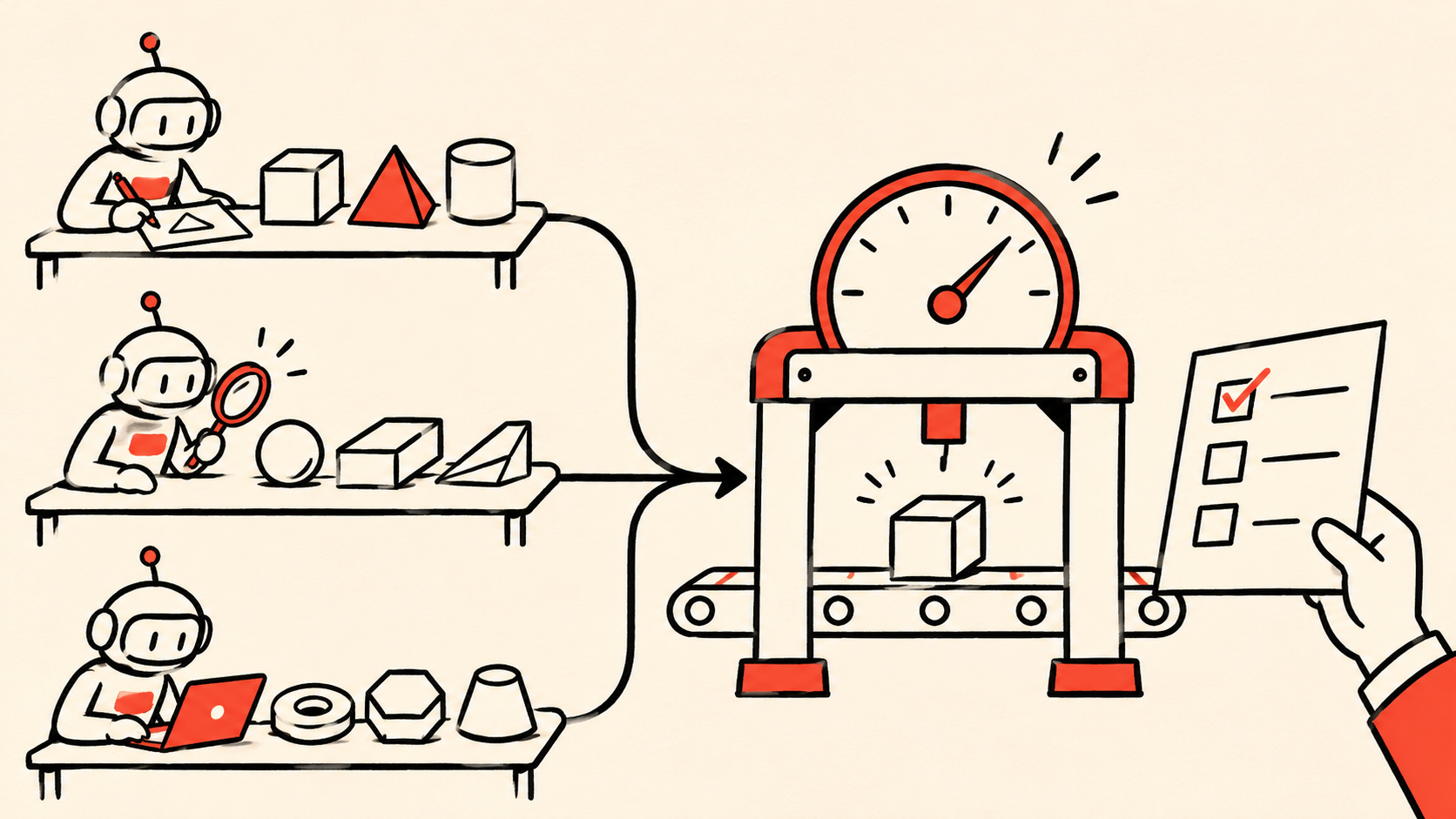
On November 13, 2026, Google Research reported new Antigravity /teamwork research and engineering results. It describes human collaboration and external evaluators, including proof checkers and unchanged test suites. These are the developer’s reported results, not our independent reproduction. Google Research
This is not a first launch: Google’s August 27 article already described a preview. Earlier announcement The useful question now is not how many agents can work together, but what allows a team to accept what they produce. The discussion below is Open Market Notes’ analysis of that question, not a claim about undisclosed product behavior.
An answer needs a standard outside itself
A long, coherent explanation can make a proposed solution easy to understand without making it correct. Adding another agent to critique it may reveal a problem. Yet agreement between generators does not itself settle the matter: reviewers can share an assumption that nobody has tested. A separate acceptance procedure matters because it can reject work that remains persuasive in conversation.
Consider a hypothetical rewrite of an internal data-processing service. Matching ordinary outputs is necessary, but the business may also require stable behavior on malformed input, bounded memory use and compatibility with downstream systems. A candidate that is faster on the familiar workload might fail one of those conditions. Calling the whole exercise successful because the headline benchmark improved would quietly replace the original job with an easier one.
The acceptance test therefore has to be part of the assignment, not a celebration written afterward. A useful record identifies which version was tested, on which environment, against which criteria, and what remains outside coverage. Without that connection, a green test result can become detached from the artifact eventually delivered.
Formal checking does not choose the question
Lean’s documentation distinguishes a valid proof from the meaning of the statement proved. It also explains checking a proposed proof against a separately trusted statement. Lean reference
That distinction offers a practical way to read impressive demonstrations. Solving the formal problem and selecting a meaningful formal problem are different contributions. Suppose a team defines reliability as completion on a clean dataset. A proof or test under that definition cannot settle behavior on incomplete records unless those records were within scope. This is not a criticism of formal methods. It is a reason to make the relationship between business requirements and formal conditions explicit.
For an organization, the person approving the specification need not perform every experiment. But someone must remain accountable for whether the specification represents the intended task. Delegating execution does not remove that responsibility; it changes where the human work is concentrated.
More attempts need a stopping rule
Parallel exploration can produce more alternatives, including approaches a single worker would never try. Its cost is not limited to model usage. Someone must compare outputs, investigate conflicting evidence and maintain the test environment. A large collection of plausible candidates can be less useful than a smaller collection with clear reasons for rejection.
An editorially useful measure would be accepted work per total cost, with review and failed attempts included. That is a proposed evaluation lens, not a disclosed Google metric. It avoids treating time spent running as time saved for the customer. A team also needs a reason to stop: the target has been met, the budget has been exhausted, or new evidence shows the assignment should change. Quietly relaxing the target to obtain a result undermines the comparison.
Keep the final test out of the search loop
A further problem arises when candidates repeatedly receive detailed feedback from the same test. They may improve at that test without improving on the wider job. For our hypothetical rewrite, development cases could guide iteration while a separately maintained set of cases informs final acceptance. This is a proposed safeguard, not a claim about Google’s implementation. Its purpose is to preserve some information the search process has not already optimized against.
Separation has a cost: withheld cases are harder to use for diagnosis, and no finite set can cover every operational failure. It is therefore not a universal guarantee. A team should distinguish failure discovery from the final decision, keep the evaluator’s rules outside the candidate’s editing authority, and investigate unexpected gains rather than automatically reward them. A result that improves because the test became easier is not equivalent to a better implementation.
The optimistic reading of multi-agent research is that more exploratory work can be performed before scarce expert review. The cautious reading is that review and specification may become the bottleneck. Both can be true. A system can increase productive exploration while making the quality of its acceptance process more important.
The November update warrants attention as a developer account of research progress. It does not establish a universal success rate, total customer cost or readiness for every workflow. The stronger adoption question is whether a particular team can define, preserve and independently apply an adequate acceptance test. Until it can, additional agent activity should be treated as investigation rather than a completed outcome.
Information only. No investment, legal, tax, or financial advice.