AMD’s larger growth engine changes the sensitivity of profit
AMD’s scale invites a closer look at deployment timing and the repeatability of operating leverage.
AMD's November 3, 2026 results put quarterly revenue at $13.377 billion, including $8.5 billion from Data Center. GAAP operating margin reached 21%, versus 14% a year earlier. AMD results
Those figures invite a question more useful than whether AI is growing quickly: what happens to the shape of the company when its largest engine carries more of the load? Our interpretation is that scale can improve profitability while making the timing of a particular class of projects more consequential. Better operating leverage and greater dependence on coordinated infrastructure spending can coexist. Neither proposition cancels the other.
A business mix is not a customer map
A segment is an accounting boundary, not a list of independent demand sources. Several buyers can purchase different products yet respond to the same constraint, such as when a facility becomes ready. Conversely, one large segment can contain workloads with different replacement cycles. Its size alone therefore proves neither dangerous customer concentration nor durable diversification.
For analysis, three questions should remain separate. Which business contributes revenue? Which customers ultimately finance the purchases? Which events determine when systems can be put to work? The first is visible in a segment table. The other two require different evidence. Treating the first as an answer to all three turns a useful disclosure into a false measure of resilience.
This distinction also changes how to read strength elsewhere in a portfolio. A smaller business may contribute valuable earnings without being large enough to offset a change in the main engine. That does not make the smaller business unimportant. It means that diversification should be evaluated by the shocks it can absorb, rather than by counting product families.
The rack creates a chain of economic decisions
AMD describes Helios as a reference design that partners use to build their own branded systems, rather than a finished product sold directly. Helios product explanation HPE separately announced a $1.2 billion Vultr order on September 30, 2026. HPE announcement
The order offers an example of the chain, not a shortcut for estimating AMD revenue. A system purchaser, a systems supplier and a component designer occupy different contractual positions. An order at one layer cannot simply be copied into another company's revenue line. Nor does it establish the final customer's utilization or economic return.
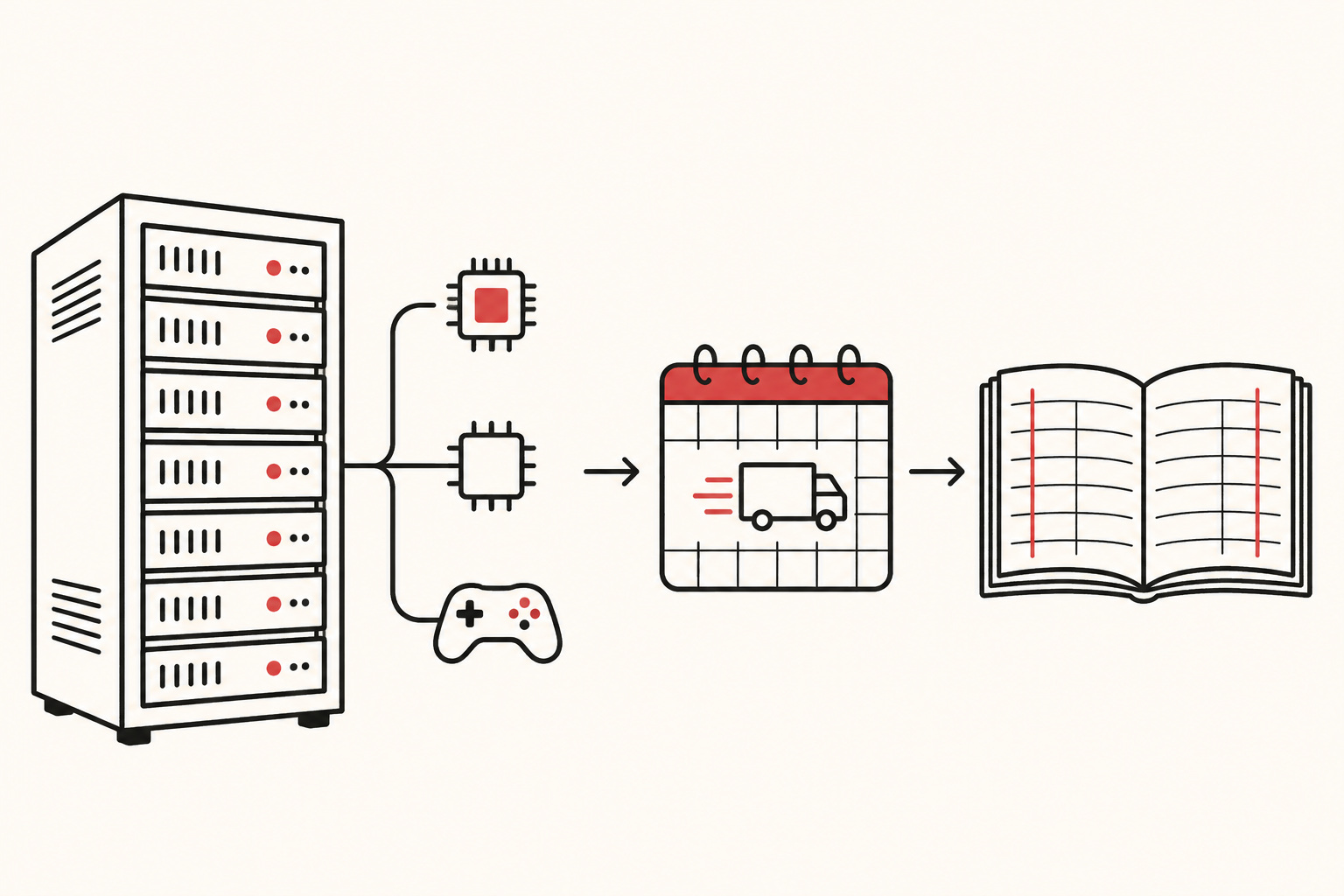
Consider a hypothetical deployment in which processors arrive on schedule but a facility is not ready. The supplier might still have a valid sale, while the operator's useful capacity arrives later. Reverse the problem, and a ready facility can wait for a critical component. These examples are not reports of delays at AMD, HPE or Vultr. They show why hardware demand, delivery, accounting recognition and productive use must be traced separately.
A favorable interpretation of the shift toward larger systems is that repeatable designs can spread engineering and support work over more deployments. Partners need not solve every interface from the beginning. The competing interpretation is that a larger project has more conditions to coordinate before it becomes useful. Both can be true: standardization can reduce work per installation while the remaining bottleneck becomes more important to the calendar.
Operating leverage is conditional, not a permanent discount on costs
Operating leverage means that revenue and operating expenses need not move in lockstep. It does not mean that expenses become optional. Engineering teams, software maintenance and customer support are capabilities built over time. A company can benefit from spreading those capabilities over a larger revenue base, but cutting them rapidly during a slowdown could damage the next product cycle.
An illustrative comparison clarifies the issue. Two suppliers can report the same margin today. One gets there through a repeatable workload and predictable rollout cadence; the other through a cluster of large deliveries near period end. Their reported ratios can match while their sensitivity to a scheduling change differs. This is not a claim about AMD's shipment pattern. It is a reason to ask what operating process produced a ratio before extending it into the future.
Accounting definitions also matter. The SEC's reporting manual defines non-GAAP measures by adjustments relative to comparable GAAP measures. SEC framework For this argument, comparing a consistent operating-profit basis is more useful than switching measures to obtain a smoother narrative. Adjusted profitability, cash generation and shareholder economics answer related but different questions. None can independently certify the stability of demand.
What would make the argument stronger
The next useful evidence would connect expansion to repeatability: recurring deployments across distinct buyers, consistent delivery cadence, and support work that does not grow proportionately with each installation. Contrary evidence would be greater dependence on synchronized project dates or rising work required to reproduce an earlier deployment. These are tests of an analytical hypothesis, not claims that either outcome has already occurred.
AMD's results are a reason to examine how the company scales, rather than merely extrapolate a growth rate. The central uncertainty is whether a larger revenue engine also becomes a more repeatable operating system. If it does, scale can reinforce execution. If the engine becomes more calendar-sensitive, a strong quarter may say less about the stability of the next one. Public results establish the starting point; they do not yet settle that distinction.
Information only. No investment, legal, tax, or financial advice.