Alphabet’s cash outlay needs a commissioning test
Negative quarterly free cash flow makes the path from purchased capacity to useful output more important.
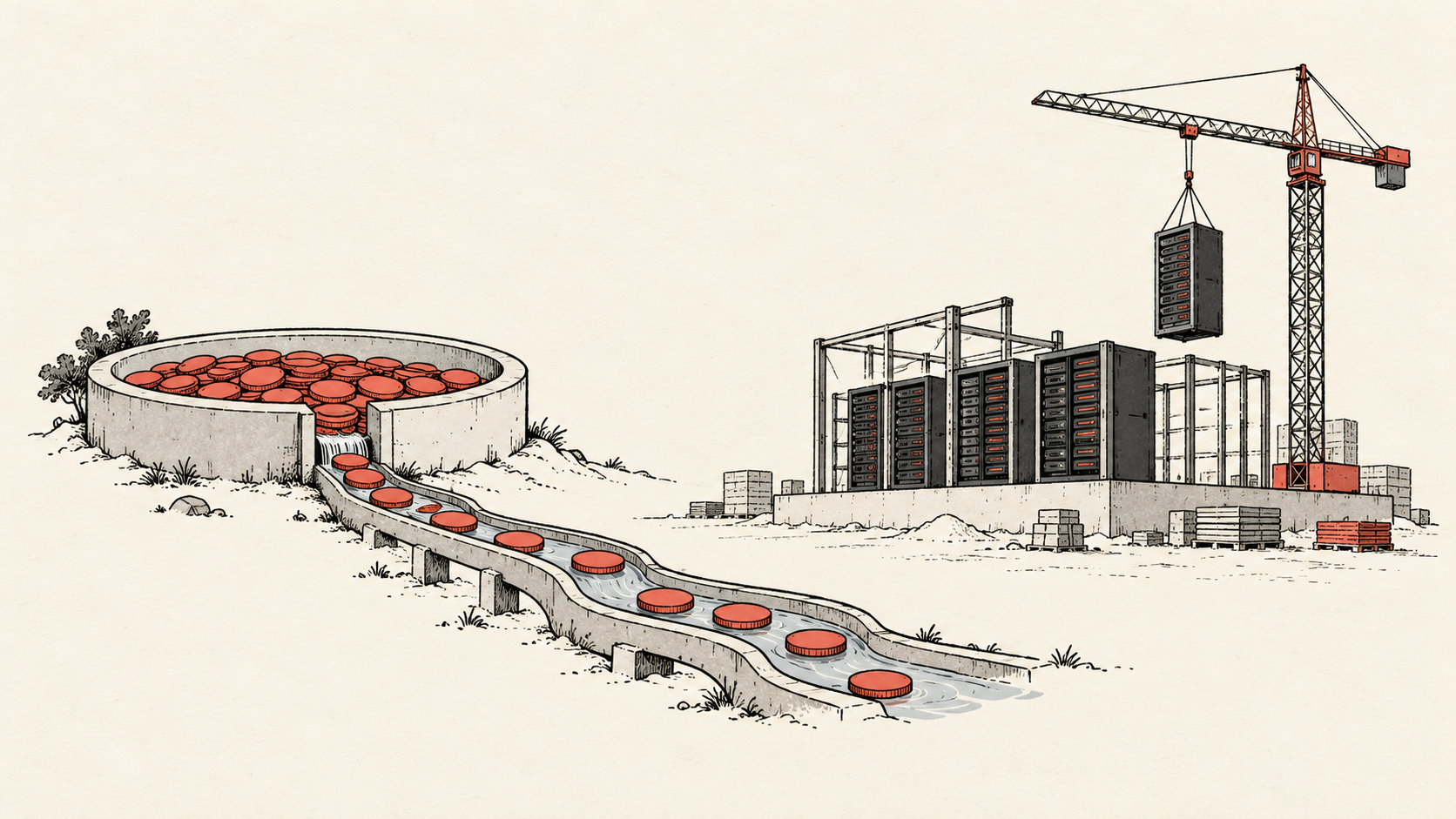
Alphabet’s October 28, 2026 release reports third-quarter operating cash of $42.290 billion and property-and-equipment purchases of $51.355 billion: free cash flow of negative $9.065 billion, unaudited. Original release
That subtraction raises a productive question about the next stage of the investment program. What evidence would show that the capacity being purchased is becoming economically useful? This article offers an analytical framework, not a forecast of Alphabet’s returns or a claim about undisclosed projects.
Following a cohort rather than a spending total
A quarterly spending figure groups together payments associated with different facilities, hardware generations and stages of completion. Evaluating the whole amount against the same quarter’s revenue would require an implausibly neat match between payment and use. Conversely, treating every payment as future growth gives management’s ambition the status of a completed result. A better unit of analysis is a cohort of projects approved for a defined purpose.
For each cohort, an analyst would want the original service requirement, the expected readiness date and the conditions needed to start delivery. The question is whether that requirement is still relevant when the capacity becomes available. A training installation and an interactive service can put different demands on scheduling, networking and latency. A generic quantity of computing equipment cannot establish that either requirement has been met.
This distinction has an accounting anchor. Alphabet’s 2025 annual report says depreciation starts when assets are ready for their intended use. It separately describes assets still under construction or assembly. Annual report, property and equipment Readiness therefore deserves attention alongside expenditure. The public accounts do not give readers a project-by-project acceptance ledger; the framework below is a request for evidence, not a reconstruction of such a ledger.
The acceptance gate needs an economic purpose
Consider a hypothetical service team accepting a new installation. Passing an equipment test would be necessary, but the team should also reproduce its actual workload, including peak traffic, recovery after a failure and the quality standard promised to customers. If the system meets a throughput target only by relaxing that quality standard, the accepted asset is providing a different service from the one originally justified.
An economic acceptance test would connect those results to the resources consumed. Useful output should be defined before choosing the denominator: completed customer jobs, for example, rather than all attempted jobs. It should include the cost of retries and the support needed to keep a workload running. This is not a claim that Alphabet omits these controls. It explains why an outside reader cannot substitute equipment purchases or nominal utilization for evidence of productive deployment.
The same care applies to spare capacity. A system with low average use might be poorly allocated, or it might be carrying a deliberately purchased reliability reserve. Eliminating that reserve could improve a utilization chart while making the customer service worse. To distinguish the cases, the analyst needs the service commitment that justifies the reserve and evidence that it remains proportionate. A single percentage cannot make that judgment.
Cash pressure has competing interpretations
A heavy construction phase can absorb money before the associated service earns it. Under that interpretation, the relevant follow-through would be commissioning progress and commercially useful output from the same project cohort. A less favorable interpretation is that spending commitments were made against demand or technical assumptions that have changed. That interpretation would require evidence of persistent delays, unsuitable capacity or weaker economics, rather than the cash-flow sign alone.
The SEC guide distinguishes profit from cash flow. For this analysis, that distinction prevents a second shortcut: a favorable earnings figure cannot settle how much cash a build-out needs. Equally, a financing inflow would help fund commitments without itself demonstrating that the new assets have earned a satisfactory return.
A useful follow-up would separate an investment decision from its funding decision. Management might reasonably arrange financing early to avoid interruptions. Whether the financed project remains worthwhile is a separate question about demand, service quality and incremental costs. Combining both decisions into one “confidence” story makes it harder to see which assumption later changed.
This distinction also changes how an adjustment should be interpreted. If a project is simply late, the task may be to remove an obstacle to delivery. If its intended use has materially changed, the relationship between investment and demand needs to be reassessed. Continuing payments cannot replace that assessment, while stopping them need not be optimal in every case. The original economic purpose is a more useful reference than choosing a position from a single quarter.
What would improve the next reading
The strongest evidence would preserve continuity from approval through operation. A revised readiness date should be compared with the original date, not quietly replace it. A change in the intended workload should carry a revised economic case. A claim of improved efficiency should use a consistent output standard and explain any change in service quality or reliability reserve.
Public disclosures may never offer that granularity for every facility. Readers can still ask whether later explanations connect spending to identifiable deployment progress, rather than simply repeat an expanding market opportunity. They should also distinguish a delay that postpones value from a change that undermines the original use case; the remedies would be different.
The present cash-flow observation identifies a funding gap within one reported quarterly measure. It does not establish the value of the projects behind it. The next useful test is how convincingly their deployment evidence can narrow that uncertainty. Until then, an assessment should leave room for both successful advance investment and a more costly adjustment path.
Analysis by Open Market Notes. Figures are from the issuer’s unaudited release; hypothetical examples are not descriptions of Alphabet’s internal operations.
Information only. No investment, legal, tax, or financial advice.