Workspace skills make the update process part of AI adoption
Reusable AI instructions need owners and update paths as teams adapt their own copies to changing business rules.
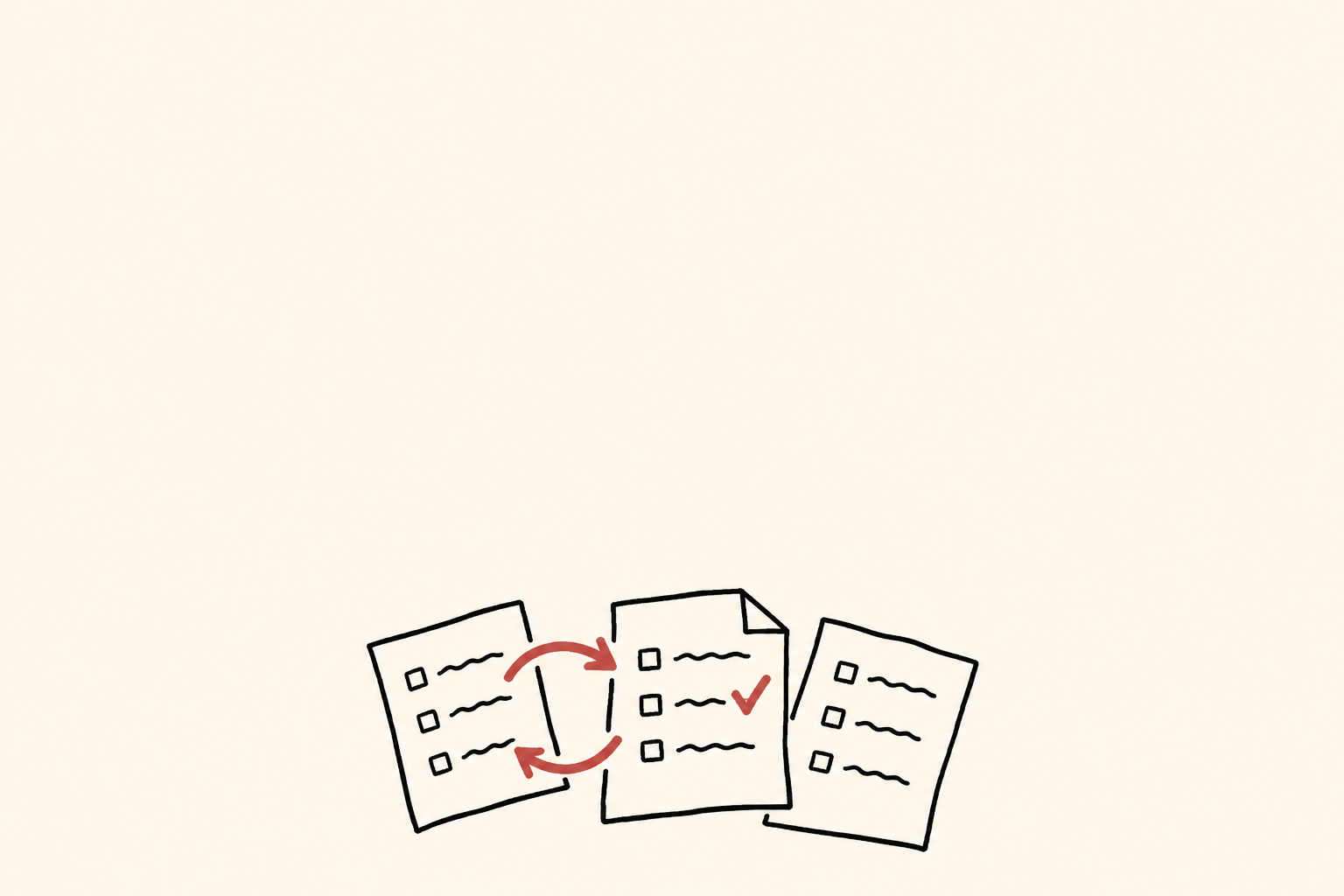
Google’s gradual Workspace skills rollout starts November 9 for Rapid Release and November 30 for Scheduled Release. Shared copies do not inherit later author edits. Rollout announcement
That distribution choice deserves attention from anyone trying to turn a useful personal AI routine into a team practice. A copied instruction can preserve local flexibility and make adoption easy. Once the underlying business rule changes, however, somebody has to decide which copies should change, what customization should survive and when the new behavior takes effect. Our analysis concerns that maintenance problem.
A useful copy can become an outdated instruction
Consider a hypothetical company using an AI skill to prepare expense claims. Finance changes the supporting documents required for a particular reimbursement. One department has already customized its copy to produce a shorter checklist; another has added instructions for a regional approval route. The original author can revise the common instruction, but the organization still needs to reconcile those local versions.
There are legitimate reasons to preserve differences. A regional approver may need a different handoff, and a concise checklist may be easier to use on a phone. The difficulty is that presentation choices and mandatory rules can occupy the same block of natural-language instructions. A colleague making a harmless edit to tone could accidentally preserve an obsolete requirement. A blanket replacement could remove a useful local adaptation.
A practical design would distinguish the rule owner from the local editor. The finance team would own eligibility and evidence requirements; departments could adapt wording and routing within an agreed boundary. The skill should identify its intended use, owner and effective date. These are proposed operating conventions, not claims that the product enforces such a separation. They make a later change easier to discuss because the team knows which disagreement concerns policy and which concerns presentation.
The effective date matters as much as the latest revision. An expense incurred before a policy change may require a different treatment from a new claim. Automatically choosing the newest instruction would not settle that question. The test case should include the date and circumstance that determine which rule applies.
Keep the instruction and its references together
Google documents manual syncing from a linked Google Doc. Recipients also need separate access to referenced Drive files. Skills documentation
This provides a route for updating instructions, while leaving a team decision about when to adopt them. Before replacing a working version, a recipient should understand what changed and whether a local adjustment conflicts with it. A short change note can be more useful than asking every colleague to compare two long instruction files. For material rules, someone should be responsible for confirming that the intended users have made the transition.
There is also a two-part dependency to manage. A copied instruction may point at a reference document that continues to change. The copy could remain the same while its supporting material moves forward. Conversely, the instruction could be updated while the user cannot open the reference it now requires. Teams therefore need to test the combination that a person will actually use, rather than approving the instruction in isolation.
In the expense example, a sensible trial would include an ordinary claim, a claim spanning a policy change and a claim whose required evidence cannot be accessed. The expected behavior for the last case should be explicit: explain what is missing and seek review, rather than fill the gap with a plausible requirement. This is a proposed acceptance test, not a reported product failure or a result from testing Workspace.
An activity record needs a business interpretation
Google’s logging documentation lists source-document and skill revision identifiers, plus copy, update and execution events. Access depends on Workspace edition and administrative privileges. Log documentation
Those records can help a team reconstruct which instruction was involved. A record of execution cannot establish whether an expense was classified correctly. That judgment needs the applicable policy and a review of the output. Operational evidence and business acceptance should be connected, with enough information to investigate an error without routinely collecting every detail of an employee’s claim.
For a pilot, the most useful measures may be modest: how often reviewers correct an answer, how long a material update takes to reach its intended users, and whether people can identify the version they are using. Adoption counts alone miss a quiet divergence between copies. Review time also belongs in the cost calculation. A routine that saves drafting time but creates more reconciliation work may still be worthwhile, but its benefit needs to be measured after both are counted.
Sharing deserves a separate review. Google notes that copies can include entered text and email addresses, while underlying file permissions remain unchanged. Sharing controls
A team should therefore inspect what it has written into the reusable instruction itself. A restricted reference file and a paragraph copied out of that file are different objects. For example, an internal escalation address or a commercially sensitive discount rule could travel inside an otherwise generic template. Sharing a sanitized instruction for external collaboration may be preferable to distributing the version used internally.
Maintenance should match the consequence
None of this requires a release committee for every personal writing preference. A small, low-stakes routine may need only an owner and a clear revision note. A widely distributed skill that shapes reimbursement, customer promises or purchasing decisions deserves a more deliberate update process. The useful dividing line is the consequence of an outdated answer and the effort required to correct it.
Continuity also needs a plan for the original author moving to another role. A popular skill can keep circulating after the person who understood its exceptions has stopped maintaining it. A successor needs the reasons behind important instructions and the small set of cases that justify them, alongside the latest text. If nobody can explain why a rule is present, the team has inherited an unresolved maintenance question. Preserving those reasons also reduces repeated investigation by the next owner.
A manageable first deployment would choose one bounded workflow, keep a common source, record approved local variations and rehearse one policy update before expanding. That rehearsal tests something an impressive first demonstration cannot: whether the team can change its shared practice without losing track of the copies already in use.
Workspace’s rollout makes reusable instructions easier to distribute. Their lasting value will depend on whether organizations also make them maintainable. A team gains a durable AI capability when a useful routine has an owner, an update path and a way to recognize when its assumptions no longer apply.
Information only. No investment, legal, tax, or financial advice.