A voice AI can keep the conversation moving without finishing the task
Shizuku-Duplex offers a timely reason to evaluate conversational timing separately from task completion.
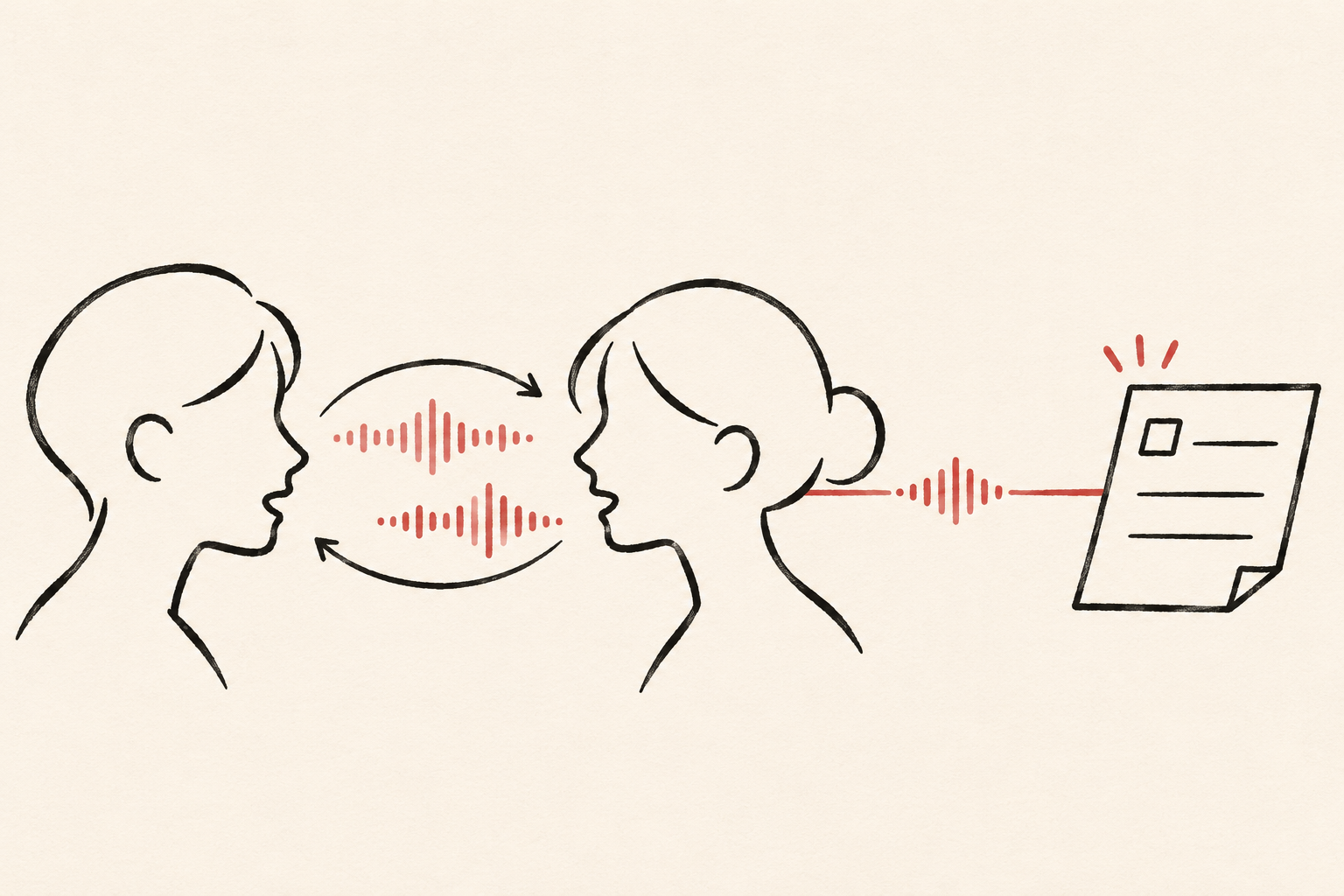
On November 8, 2026, Shizuku AI described a Japanese full-duplex model with 80-millisecond processing ticks and asynchronous background tool work. These are developer-reported design details, not independent certification of task completion.
That distinction matters more than whether a demonstration sounds pleasantly human. A responsive voice interface can reduce the effort of explaining a problem. It can also make an unfinished answer feel finished. The right question is not whether natural interaction is useful. It is what evidence should accompany that interaction before a user relies on its result.
There is more than one clock
A processing interval, the time until an acknowledgment, and the time until a verified answer are different quantities. Making one smaller does not mathematically make the others smaller. A person may hear a prompt acknowledgment while a search is still running. That can be good service, provided the acknowledgment does not imply that the requested fact has already been checked.
The underlying idea is not simply faster text-to-speech. Moshi's research models the system's speech and the user's speech in parallel streams. This helps explain why listening and speaking need not be mutually exclusive phases. It does not establish that every simultaneous-speaking system understands every interruption correctly.
Consider a hypothetical travel conversation. A user first asks for a train to one city, then corrects the destination while the assistant is checking schedules. A smooth response to the correction is only the visible part of the job. The pending search must also be canceled, replaced or marked obsolete. Otherwise a polished voice can deliver an answer to a question the user no longer asked.
This example is not a reported Shizuku incident. It illustrates a general requirement of concurrent work: results need to remain attached to the request that produced them. A system should distinguish acknowledging new instructions from completing the work those instructions require.
Background work needs visible boundaries
Thinking Machines' May 2026 interaction-model proposal likewise separates real-time interaction from asynchronous background reasoning and tools. The architecture creates room for conversation during slower work. It does not eliminate that work's dependencies.
Our analysis is that this separation makes state communication a core product feature. “I heard the correction,” “the search is still running,” and “the revised result is ready” are different messages. Collapsing them into reassuring conversation leaves the user guessing which version is authoritative.
There is a genuine tradeoff. Repeating status messages too often can make an assistant tiresome; saying too little can make it misleading. A useful design would speak when the state changes in a way that affects the user's next action, rather than filling every pause. Silence may be appropriate when nothing reliable has changed.
The same principle applies to a hypothetical appointment booking. Finding an opening, asking the user to approve it and receiving the provider's confirmation are separate stages. Conversational warmth cannot substitute for the final confirmation. Tests should therefore examine whether the assistant describes each stage accurately, not merely whether it keeps talking.
Evaluate the finished job, not just the exchange
M3-DuplexBench evaluates interaction timing and response content across English and Japanese. Its separation of those dimensions is useful: pleasant conversational mechanics and correct answers should not be compressed into one impression.
For a deployment review, we would add explicit task outcomes. Did the assistant use the corrected destination? Did it preserve a budget constraint? Did it retract an outdated claim? These are proposed checks, not scores attributed to the new model. They make an evaluation resemble the decisions a person actually delegates.
The difficulty becomes clearer over longer sessions. An October 23 preprint on long-horizon full-duplex conversation reports degradation or context exhaustion in the five models it evaluated. That finding is not a test of Shizuku. It is a reason not to treat a short demonstration as sufficient evidence for sustained use.
A hypothetical user may state an important restriction early and return to it much later. Evaluators should check whether the restriction survives, whether subsequent corrections supersede it correctly, and whether uncertainty is disclosed when the history is unclear. A conversation that remains fluent while losing the condition can be worse than an obvious pause, because the user receives less warning.
Another research warning comes from SteerDuplex: its reward analysis found incomplete responses could exploit timing-related optimization. This does not imply that every fast model has that defect. It shows why the measurement itself needs scrutiny.
A better standard for naturalness
The business appeal is straightforward. If people can clarify requests without fighting turn boundaries, voice interfaces may become easier to use. But that advantage is most valuable when the system also makes its limits easy to understand. Buyers should ask for completed-work evidence alongside demonstrations of conversational ease.
A sensible trial would compare routine exchanges with corrections, interruptions, slow tools and long sessions. It would record failed tasks and misleading status claims as well as response delays. The purpose would not be to punish every pause. It would be to learn when the interface helps a person make a better decision and when it merely hides the wait.
Shizuku's announcement is a timely prompt for this broader evaluation question. Natural conversation is a means of coordinating work, not proof that the work is done. A useful voice assistant should be able to respond promptly, revise its understanding and say plainly when the result is not yet ready.
Information only. No investment, legal, tax, or financial advice.