Token transfers are fast. Keeping investor eligibility current is a different problem.
Tokenized assets need a way to retire stale permissions, not just a faster way to move ownership.
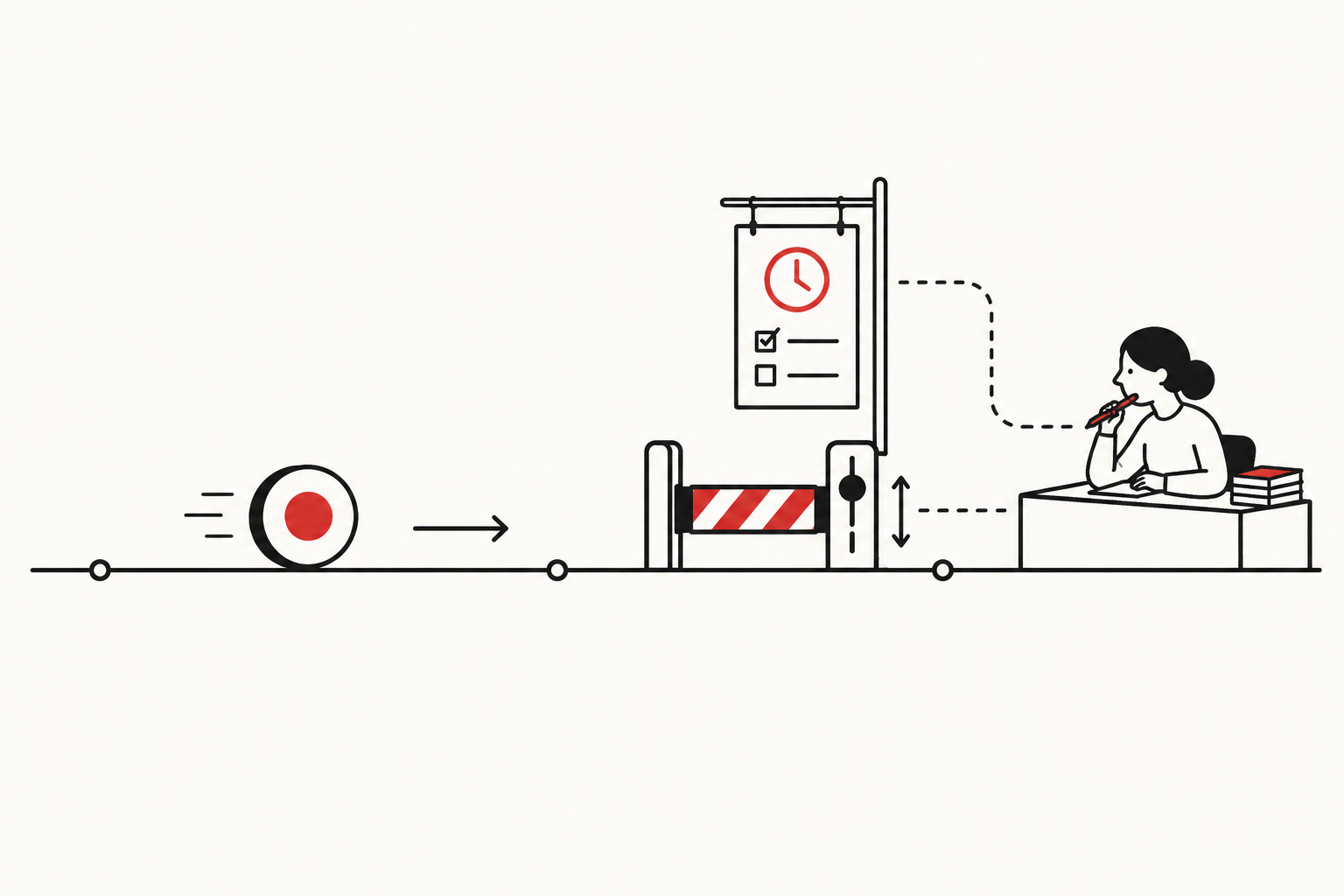
On October 27, 2026, Further announced Anubis would use Chainlink ACE for tokenized-asset compliance, initially within ADGM. That is the narrowly verified event behind this analysis, not a finding of regulatory approval. Official announcement.
For a market operator, the more interesting question is not whether a token can move. It is whether the permission accompanying that movement still means what its issuer intended. A successful transaction proves that a particular execution path accepted the inputs it received. It does not, by itself, prove that the inputs remain an adequate account of an investor's circumstances.
The credential and the person have different timelines
Consider a hypothetical corporate investor whose ownership changes after onboarding. Its wallet may remain the same, while the people controlling the company do not. Alternatively, a document expires without any change in the underlying person. These are different problems: the first calls for reassessing a substantive fact; the second might require updating evidence of an unchanged fact. Treating both as a single red flag creates unnecessary friction. Treating neither as significant leaves stale information in circulation.
This is why we think the useful unit of analysis is a decision with a validity interval, rather than a permanent badge attached to an address. A permission should answer a bounded question: accepted for which asset, for which action, under which policy version, using evidence checked at what time? An answer can be adequate for one purpose without being a universal passport.
There is an economic consequence. If investors discover restrictions only after agreeing a trade, operational uncertainty becomes part of the cost of dealing. If controls instead reject every uncertain case indefinitely, the asset may be technically transferable but practically hard to trade. Faster settlement cannot eliminate either difficulty; it can make the unresolved decision arrive sooner.
A useful distinction, not a deployment claim
Chainlink's documentation distinguishes transaction-time rejection from scheduled monitoring, which can leave an interval before action after a risk change. Those are different control timings, not interchangeable guarantees. Technical documentation. Its overview currently labels ACE private beta. Product scope.
Our analytical model separates four moments: a relevant fact changes; an institution learns about it; an authorized decision is made; that decision becomes effective wherever the asset is handled. These moments need not coincide. Measuring only the final transaction's execution time says little about the earlier delays. A system could execute every instruction perfectly yet be working from a decision that should already have been reconsidered.
This model does not establish that Anubis has any particular weakness. It suggests what a meaningful evaluation would measure. For example, a test could introduce an explicitly fictional change in investor status, then observe the time taken to detect, review and apply it. A second test could correct a mistaken alert. Both tests matter: stopping an ineligible transfer and restoring a legitimate investor's access are different operational capabilities.
Who is allowed to change the answer?
A changeable policy introduces a governance question alongside the technical one. Someone must decide whether a new interpretation applies to existing holders, future buyers or only a specific transaction. Those decisions can have different consequences. A temporary pause is not the same as extinguishing an ownership claim, and an internal risk assessment should not be described as a court's judgment.
A sensible design would therefore distinguish proposing a change, approving it and executing it. This is our design judgment, not a statement about the platform's implementation. Separating those steps can reduce the chance that an administrative error is instantly applied everywhere, but it also creates a slower path in urgent cases. The answer is not simply more sign-offs. Institutions need an explicit account of which exceptions justify speed and who remains accountable afterward.
Evidence should support that accountability without needlessly exposing the investor. A record that explains the applicable policy version, decision time and responsible reviewer can be more useful for reconstructing an incident than a public collection of identity documents. Any underlying evidence still needs appropriate access and retention arrangements. Recording that a check occurred is not the same as proving that the check was competent.
Regulation is not a property of a software brand
ADGM's digital-securities guidance dated February 24, 2020 describes case-by-case classification and consistent treatment of securities offerings across technologies. It is historical regulatory context, not confirmation of this deployment. FSRA guidance, paragraphs 15–18.
We would not infer approval of a product, issuer or transaction from the location of a deployment or a supplier relationship. Equally, the absence of such an inference is not evidence that the project is unauthorized. Those are separate factual questions requiring their own records. This article assesses a control problem; it does not determine legal obligations for a particular institution.
The optimistic interpretation is that explicit decision rules make inconsistencies easier to identify and correct. The competing interpretation is that automation can distribute a bad rule more efficiently than a manual process ever could. Both can be true. The deciding evidence is how the operator handles ambiguity, changes and recovery, not merely how many checks the software can perform.
For a serious institutional evaluation, we would want observed results for outdated evidence, mistaken restrictions, operator unavailability and correction after review. We have not established those results here, and do not assign the platform a production-readiness score. The proposition worth testing is narrower and more useful: can a changing real-world entitlement remain intelligible, contestable and current while the asset moves? That is a harder standard than demonstrating a successful transfer—and a better one for judging tokenized-market infrastructure.
Open Market Notes analysis. Examples are hypothetical, not reported incidents. No investment or legal recommendation is made.
Information only. No investment, legal, tax, or financial advice.