When agents schedule the telescope, what does an empty search mean?
Adaptive observing can save scarce telescope time, but interpreting a non-detection requires knowing which opportunities the system passed over.
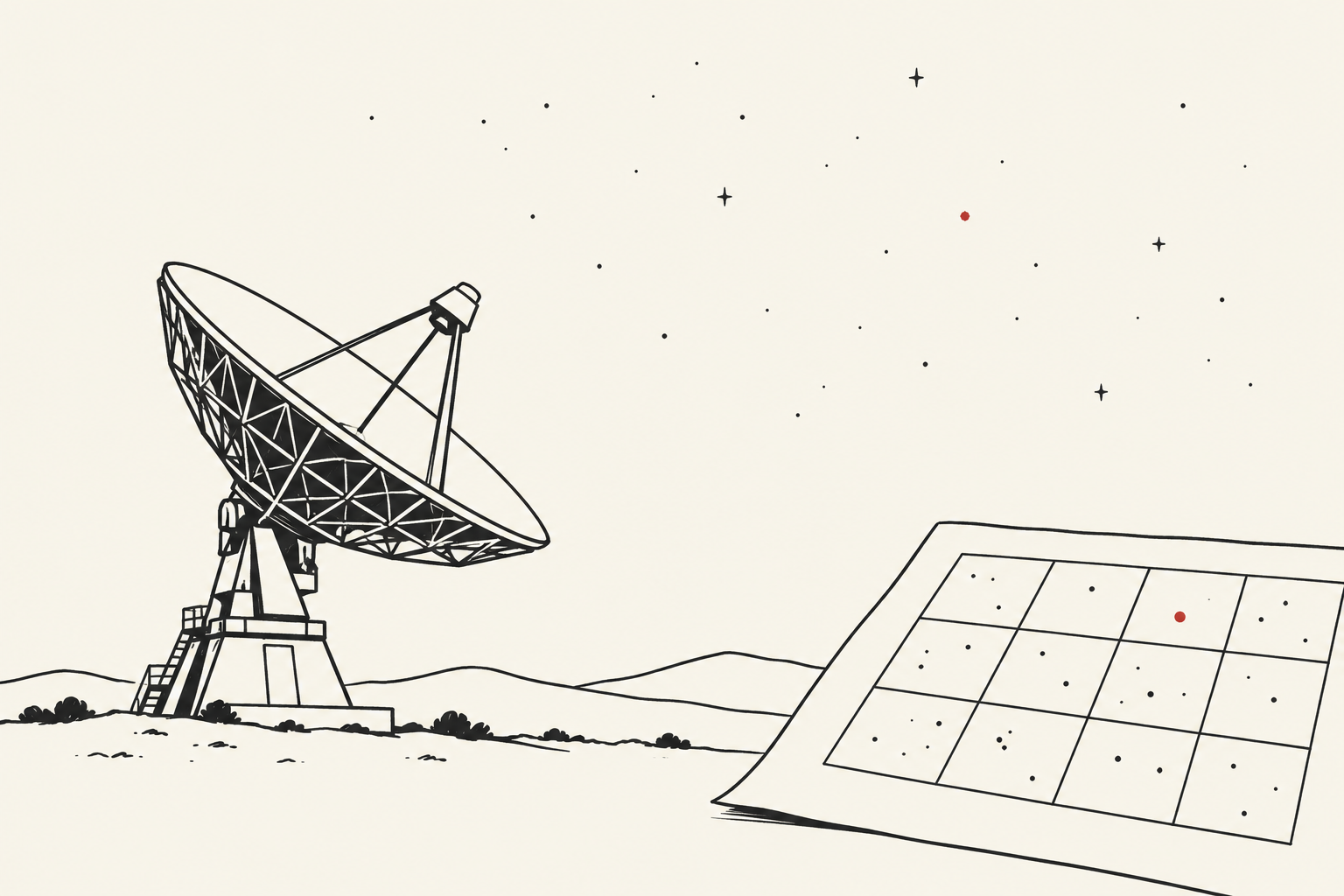
On October 30, 2026, NVIDIA reported agent-directed observing at the Allen Telescope Array and a pulsar demonstration—not an extraterrestrial discovery. The interesting question is how such automation might change the meaning of an observing programme's results.
An agent that helps choose the next observation is doing more than accelerating a calculation. Its choices can influence which evidence ever reaches the calculation. That is potentially valuable: an instrument can spend less time waiting for a human to assemble the next operation. It also makes a familiar scientific question more demanding. If a search produces no candidate, what exactly has been searched?
The analysis below concerns evaluation design. It does not assert that the ATA team lacks these safeguards or that its published system has demonstrated autonomous scientific judgement.
The opportunity cost lies in the observations not taken
Imagine a proposed observing programme with two ways to allocate the same night. One follows a previously specified sequence. Another lets an agent reconsider the next target after each result. The second could use changing conditions more effectively. It could also repeatedly prefer targets that resemble its previous successes, leaving less familiar conditions underexamined. Both possibilities can coexist.
A count of completed observations would not settle the comparison. The observations may differ in duration, usable sensitivity and the kinds of signals the processing is designed to recover. Nor would more candidates necessarily establish improvement: additional interference or a more permissive selection rule could increase the review workload without adding useful evidence. These are possible mechanisms, not measured outcomes at this observatory.
The scarce resource is not simply machine time. It is an opportunity to gather evidence under a particular set of conditions. Once that opportunity passes, rerunning a model on stored data cannot recreate a direction or time interval that was never observed. The practical evaluation therefore needs to connect resource use with the search opportunities actually covered.
Connecting those quantities also shows where an efficiency gain occurs. Reducing the wait for an operation and extending the search for a particular kind of signal are both worthwhile, but require different evidence. Separating them gives engineering work more precise credit for what it has achieved.
A replay and a live decision face different information
A separate ATA imaging preprint submitted October 5 uses recorded observations; its authors identify estimation from data available at that moment as necessary for live operation. It is not an independent validation of the October 30 agent announcement.
That distinction provides a useful design question. At the moment a controller chooses an action, which information could it legitimately have had? An offline comparison can accidentally give a decision rule knowledge available only after the observing period ended. Such a test may still be useful for developing signal processing, but it cannot by itself establish the value of the live decision rule.
A fair comparison would preserve the time at which each input became available. It would distinguish information used to choose the next observation from information used later to assess its quality. There need not be one frozen algorithm forever. Rather, the comparison must make changes visible enough that an improvement cannot be attributed to a different information advantage.
The Stelline project site lists separate processing and orchestration components. That separation suggests another analytical distinction: a faster processing stage and a better allocation policy deserve separate tests. Success at one need not imply success at the other.
Keep a window on what the policy would otherwise ignore
One possible evaluation design is to reserve some observing opportunities for a predeclared comparison policy. The adaptive policy can explore the remainder, while the comparison stream provides a less selectively chosen view. This is a proposed method, not a description of the ATA deployment.
Such a reservation has a real cost. Time allocated to comparison cannot simultaneously pursue the adaptive policy's highest-ranked opportunity. A small research team may reasonably prioritise a specific discovery objective over a broad survey. The appropriate balance depends on the scientific question; insisting that every programme maximise comparable coverage would itself impose a questionable objective.
But the choice should appear in the conclusion. A targeted programme can say which hypothesis it tested. A broad survey can describe its defined coverage. Neither should quietly borrow the interpretive reach of the other. A useful non-detection is bounded by an explicit search, not made universal by a sophisticated controller.
A different October 5 anti-solar-point survey preprint distinguishes observing coverage, analysis progress and planned re-observations. Those are useful categories, not proof of an extraterrestrial signal or of the agent system's effectiveness.
The result includes the unfinished work
For an agent-assisted search, a useful account would connect the intended opportunities, the observations that yielded usable data, the material analysed under a specified procedure and the candidates awaiting follow-up. A gap between those stages need not signify a fault. It may reflect weather, resource priorities or deliberate research choices. What matters is preserving the meaning of the gap.
This changes how a team might judge productivity. Faster control can be valuable even before any discovery: it may release researchers from repetitive coordination. Yet claiming a stronger scientific constraint requires a further argument about what the resulting observations could have detected. Operational convenience and evidentiary reach are complementary achievements, not interchangeable measures.
The most useful next evidence would therefore explain how adaptive choices affect coverage and follow-up, not merely how quickly commands execute. An observatory that can show why it looked where it did—and what remained outside that choice—makes its positive findings easier to investigate and its quiet nights more informative.
Information only. No investment, legal, tax, or financial advice.