Synthetic driving worlds must not generate away the hard part
More generated driving footage is not equivalent to more test evidence if the difficulty the test was meant to preserve disappears.
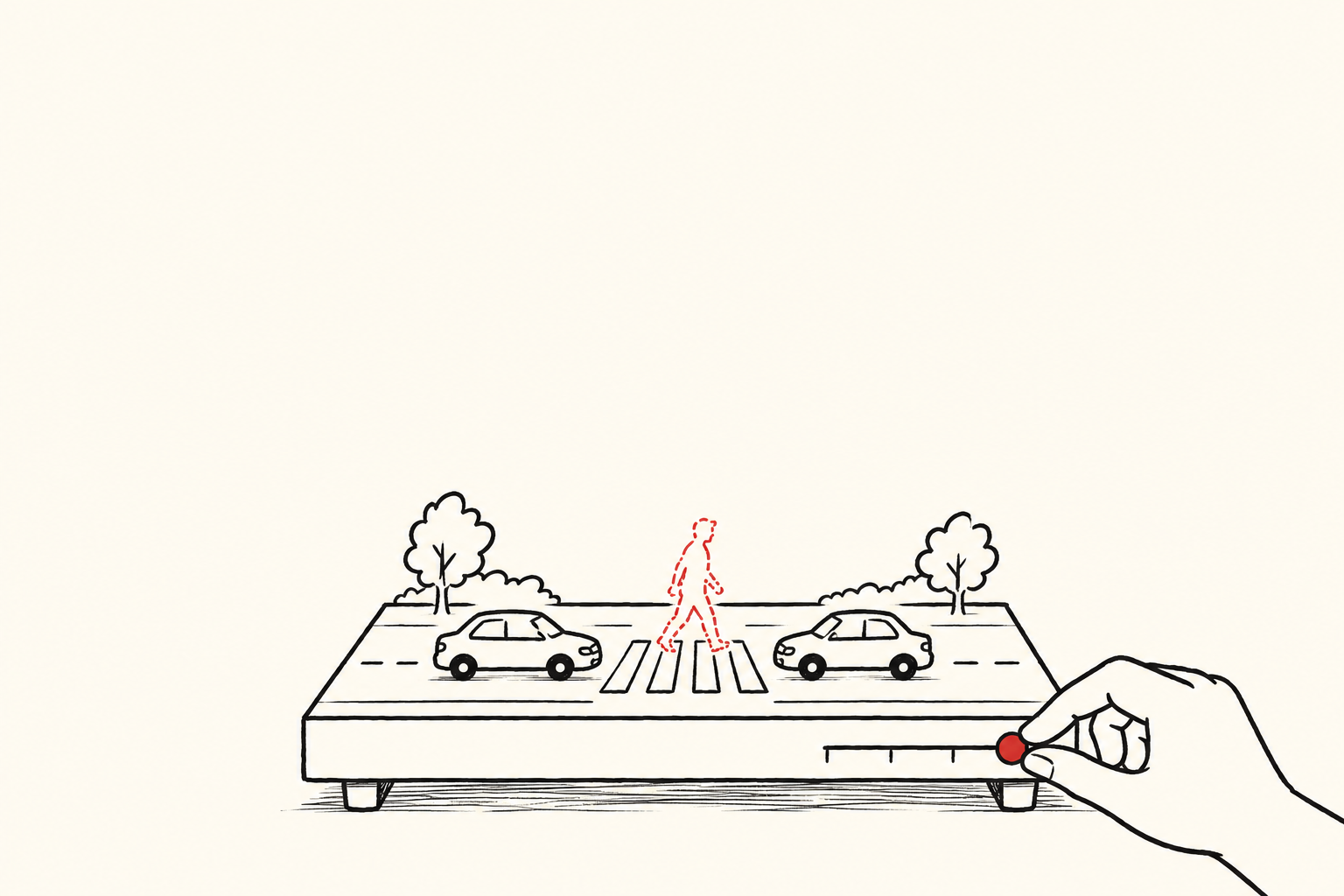
Princeton’s October 26, 2026 article revisits ScenarioControl research disclosed April 18. Its paper notes that inferred actor counts can omit hidden participants, reducing both placement accuracy and geometric overlaps. Research introduction; paper, section 5.4.
That detail deserves attention: removing obstacles from a virtual world can make a test easier without improving the driving system. This article examines the interpretation of generated scenarios, not whether the research or any company’s vehicles are safe. Our central argument is that richer generation increases the need to record the difficulty each scenario was intended to retain.
Missing difficulty can be harder to notice than an unrealistic sky
Consider a hypothetical test. A delivery van conceals a cyclist as an autonomous vehicle approaches. Researchers want to compare sunshine with overcast conditions while holding the cyclist’s departure time and trajectory, and the van’s position, constant. If the generated cyclist disappears, the video might remain smooth and the vehicle might pass uneventfully. But this is no longer the same question under different weather. An essential condition has been deleted.
A reviewer may notice an odd sky, road texture or vehicle outline more readily than an object that should exist but does not. Attractive footage can therefore conceal a change in test intent. This is not an allegation that a generator deliberately avoids hard cases. It means visual-quality review and scenario-validity review do different jobs; passing one cannot replace the other.
Geometric overlaps between objects also differ from the outcome after a driving policy acts. Reducing implausible overlaps during generation can be useful. A generator’s metric cannot simply become a safety conclusion about a driving system.
Completing an unknown world and setting a specified test are different tasks
There is a reasonable competing interpretation. A camera cannot observe an occluded region, so a model need not reconstruct one uniquely correct hidden world. Several arrangements may be plausible given the same image. If the purpose is to explore possibilities, insisting that only one completion is correct misunderstands the tool.
But if the purpose is to test a specified cyclist-emergence event, the cyclist is no longer optional speculation. The test designer has made it a condition. These uses can share a tool without sharing undifferentiated acceptance rules. One must represent a range of uncertainty; the other must preserve the stipulated event.
That distinction determines where failures belong. A scene that misses a required condition should first count as a generation failure, rather than enter the driving policy’s pass-rate denominator. Keeping only attractive, easy-to-run scenes makes it impossible to know whether rejected outputs contained the harder tests. Recording rejected generations makes the selection process visible, rather than merely making the model look worse.
Controlled variation makes additional footage comparable
Waymo’s February 2026 world-model description separates driving-action, scene-layout and language controls, with camera and lidar outputs. Company description. This is industry context, not evidence that Waymo uses ScenarioControl or that any particular test is sufficient.
The useful question is what actually changed within a comparison. If replacing sunshine with rain also changes traffic positions, speeds and road width, attributing the result to weather becomes difficult. Locking every variable too tightly creates the opposite problem: stable performance within a very narrow example. Evaluation need not choose between total randomness and total fixation. It should explain which conditions vary, which remain fixed and why.
We call this record a scenario-difficulty ledger: an editorial proposal, not a product named in the paper. It compares intended conditions with generated content. Are required participants present? Is the occlusion retained? When does conflict become possible, and what choices does the vehicle face? Its purpose is not to force every scene into a universal difficulty score, but to prevent different questions from being compared as though they were identical.
Versions belong alongside results. Updating a generator can change its scenario distribution even when prompts remain unchanged. Updating both generator and driving policy makes an improved pass rate reflect two moving parts. A retained reference set, alongside an examination of what newly generated scenes reveal, can help separate better driving from different questions. This is an evaluation-design suggestion, not a description of an existing operator’s process.
The final object of explanation is the vehicle’s choice
NIST’s ongoing measurement project combines simulation with physical-vehicle validation and compares decisions with counterfactual alternatives; acceptance thresholds remain for regulators and industry. Research plan. It is ongoing research, not a completed certification regime.
Following that direction, a virtual test need not ask only whether a crash occurred. In our hypothetical cyclist scene, it could ask why the vehicle slowed, whether it preserved a margin, and whether another action was preferable. An uneventful outcome might reflect successful handling or simply the absence of the critical participant. Excessive caution might avoid conflict without establishing that the situation was understood. The appearance of the final video cannot answer these questions alone.
None of this diminishes generation’s potential value. Making valid scenes cheaper to produce could let researchers explore more hypotheses with the same authoring resources. The bottleneck may shift from producing footage to confirming that footage still tests the intended question. Generation supplies material; preserving intent and difficulty, and explaining behavior, turns that material into evidence.
We have not independently replicated these experiments or inferred public-road readiness. The narrower conclusion is practical: virtual worlds can grow richer, but if the hard part disappears with generation, passing the test loses its original meaning.
Information only. No investment, legal, tax, or financial advice.