Who stays after the match? Measuring streaming cohorts
Event-driven growth needs consistent cohorts, clear activation boundaries and enough time to observe renewal.
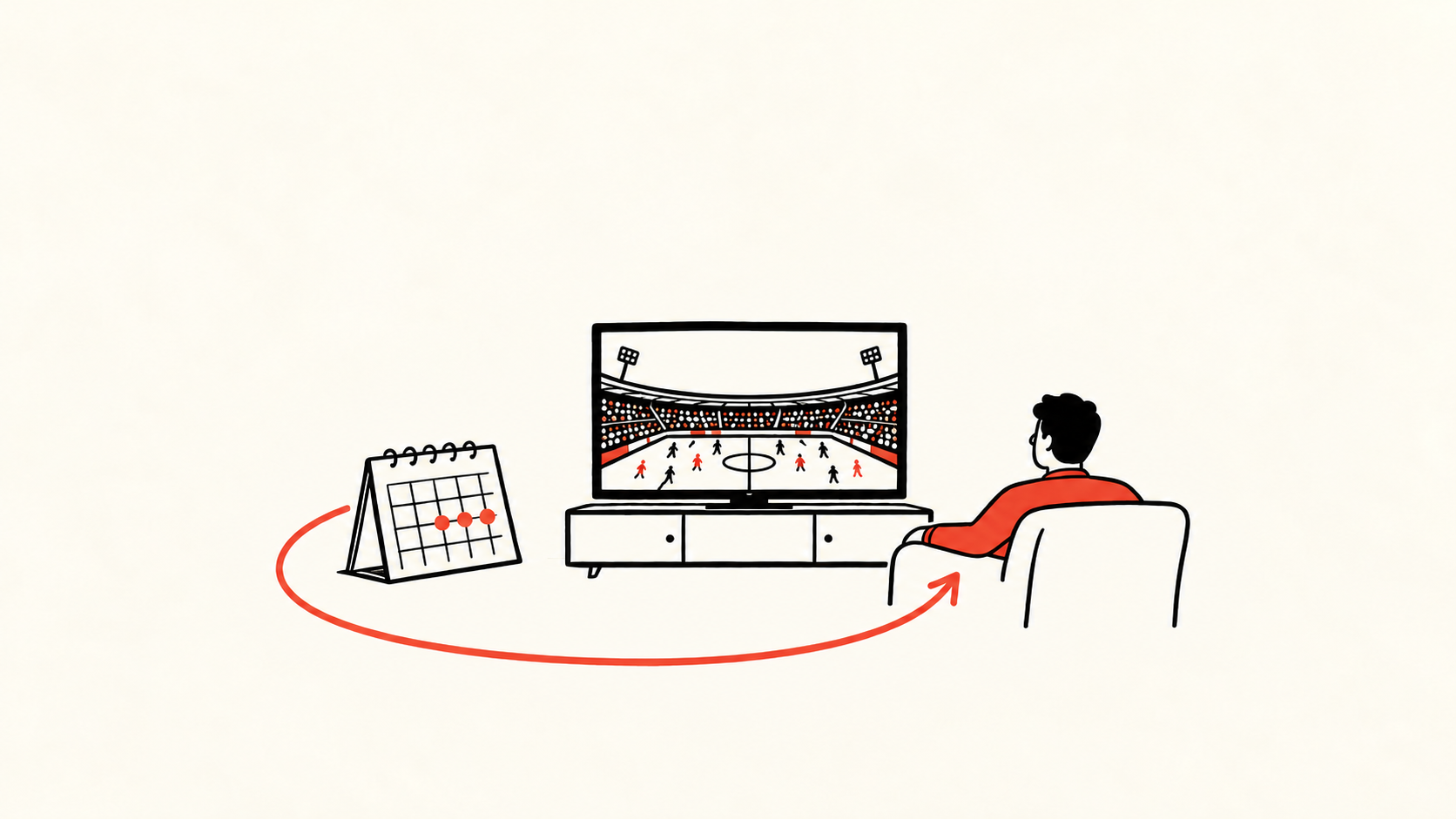
Sport can bring viewers into a streaming service. Once the match ends, a different operating question begins: who remains at the next billing date, why do they stay, and what must the service spend to maintain that relationship? Those questions get closer to the long-term value of sports rights than a quarter's account additions alone.
On October 22, 2026, Comcast reported Peacock's second consecutive quarter of positive adjusted EBITDA, at $261 million in Q3. That is meaningful progress, but it cannot by itself establish whether event-acquired customers have developed durable consumption habits. The framework below is Open Market Notes analysis, not an estimate of Peacock's undisclosed operating data.
Start retention with the same people
Consider a hypothetical service attracting customers with a sporting event. Registrations on the night demonstrate that the entrance works. They do not distinguish a purchase of one night's viewing from a purchase of an ongoing entertainment service. Confusing those intentions can make a content team overvalue rights. It can also make an operations team mislabel perfectly reasonable short-term consumption as failure.
A more useful unit is a cohort joining in the same acquisition window, through similar channels and at comparable prices. Observe its first full paid cycle, renewal after the offer expires, and the next period without a similar event. Give each cohort the same observation time. People who joined last week have not yet faced the renewal decisions experienced by customers who joined six months ago; their churn rates are not directly comparable.
Continuous subscription, return after cancellation, and mere eligibility through a package should remain separate. A fan who returns every season can be a good customer. But if each return requires expensive advertising or discounts, the business has repeat purchases, not a stable annual fee that can be projected indefinitely. The cost of bringing people back matters alongside the number returning.
More kinds of viewing do not automatically mean more value
When a sports viewer begins watching drama or news, the service may have expanded its role in that person's life. Yet longer viewing time does not replace contribution analysis. Would the customer have subscribed anyway? How much net subscription or advertising revenue does the additional relationship generate? What extra content, promotion and service spending is needed to keep it?
The counterfactual is difficult. Sports audiences are not randomly selected: their interests, willingness to pay and acquisition channels may differ from those of other viewers. Comparing them with all non-sports customers can misidentify audience differences as the effect of the event. Where internal data permits, comparable channels, prices and past behavior offer a better starting point, while unobserved differences must remain explicit. An outside reader should identify missing evidence rather than derive causation from the total subscriber count.
Product choices add another trade-off. Aggressive recommendations or extra cancellation friction might improve a short-term retention measure without demonstrating active customer preference. More informative evidence would include renewal at ordinary prices, deliberate use across content categories and contribution that survives reduced incentives. These are evaluation criteria, not allegations about any particular platform.
From entitlement to actual use
Comcast's 2025 annual report says some bundled customers count as paid Peacock subscribers when access becomes available, without activation. This is an existing measurement definition, not a new October 2026 change.
Becoming a subscriber and first choosing to use the service can therefore be different events. A retention study should separately record eligibility, activation, first viewing and first independent renewal. Imagine a household receiving access through a package, first opening the service for a match, then paying separately after the package ends. Choosing just one of those dates produces different answers to different questions. Eligibility measures distribution reach; post-activation use speaks to experience; independent renewal comes closer to an explicit payment choice. One should not quietly be renamed as another.
The denominator is particularly vulnerable to change. Keep only activated users and report their high renewal rate, and everyone who never used the service has disappeared. That can answer whether activated users stayed, but not whether all accounts obtained through the distribution effort were valuable. Similarly, viewing per remaining paying account can rise because light users have left. More active survivors do not automatically mean a healthier original cohort.
Returning customers also require a stable identity boundary. A changed email, a purchase through a different channel, or a move from a household package to an individual plan should not automatically become evidence of new demand. Nor should analysis justify gathering unnecessary personal information to reconstruct identities. Within lawful, minimum-necessary data practices, a company can explain deduplication and coverage gaps. Outside readers should accept that some returns cannot be identified precisely. Knowing which part of the journey is visible is preferable to pretending the complete path is known.
Finally, customers who have not reached the defined renewal opportunity and have made no observed choice should not be counted as retained simply because they have not yet left. Known early cancellations can be recorded separately. Just after an event, some accounts have not reached their next billing date. Separating 'not yet required to decide' from 'already chose to renew' prevents an early favorable signal from becoming a long-term conclusion. Waiting here is not analytical delay; it is a condition for the inference to be valid.
Where conclusions should stop
The SEC's January 30, 2020 metrics guidance emphasizes definitions, calculation and purpose. It provides background for reading disclosures, not a requirement to publish every cohort table proposed here.
An outside reader should distinguish three layers: the quarterly result the company reports; customer behavior it explicitly discloses; and unanswered questions an analyst proposes to assess durability. Do not use the third layer to fill the second and then present it as the first. Missing public cohort data does not mean poor retention. It means that dimension cannot yet be verified.
There is room for a reasonably optimistic interpretation. If comparable acquisition cohorts contribute after discounts end, customers return without ever-increasing incentives, and the denominator includes inactive as well as active accounts, sport may support both acquisition and an ongoing service. Conversely, if growth depends mainly on constantly replacing viewers and buying their attention again at the next event, projections of stable subscription income deserve greater restraint.
Peacock's quarterly profitability progress is a starting point. The deeper task is not to demand that one quarter prove an entire business model. It is to make the next disclosure test specific hypotheses: how long the event-created relationship lasts, what maintaining it costs, and whether the same conclusion holds when returning and bundled customers are counted consistently.
Information only. No investment, legal, tax, or financial advice.