Singapore’s planned agentic-money sandbox needs an unbroken authorization record
Moving money and having authority to move it are different tests. The planned sandbox puts revisions and accountability in focus.
On November 18, Singapore's Monetary Authority (MAS) and Future of Finance Institute (FFI) announced that FFI will establish an Agentic Money Sandbox, initially exploring agent-initiated payments and treasury management across participating institutions. The announcement describes a planned controlled testing environment, not an operating sandbox or a newly enacted payment rule.
The important question is not how quickly an agent can send a payment message. It is whether an institution can demonstrate that the final money instruction still falls within the authority a person or enterprise approved. Funding, payment rails and permission are separate concerns. An available balance does not authorize selection of a payee, and technical completion does not prove valid approval.
Gate one: separate a goal from payment authority
Consider a hypothetical company asking an agent to source supplies for next week's event within S$1,000. That might authorize searching and comparison, not payment. Even where payment is permitted, the treatment of tax, delivery, substitute suppliers and non-refundable goods needs clarification.
Keeping the conversation alone is not enough. More useful evidence is a structured scope confirmed by an appropriate authorizer: purpose, total amount, currency, payee boundaries, expiry and circumstances requiring renewed approval. Natural language expresses the goal; checkable conditions constrain the money movement. This is an editorial testing framework, not a claim about published MAS sandbox admission requirements.
Gate two: compare each revision with the same authority
Suppose a quote rises from S$900 to S$980. It appears below the cap, but S$40 delivery would take the total over it. A substituted payee may breach approval even at a lower price. Neither “cheaper” nor “budget remaining” should become a universal exception.
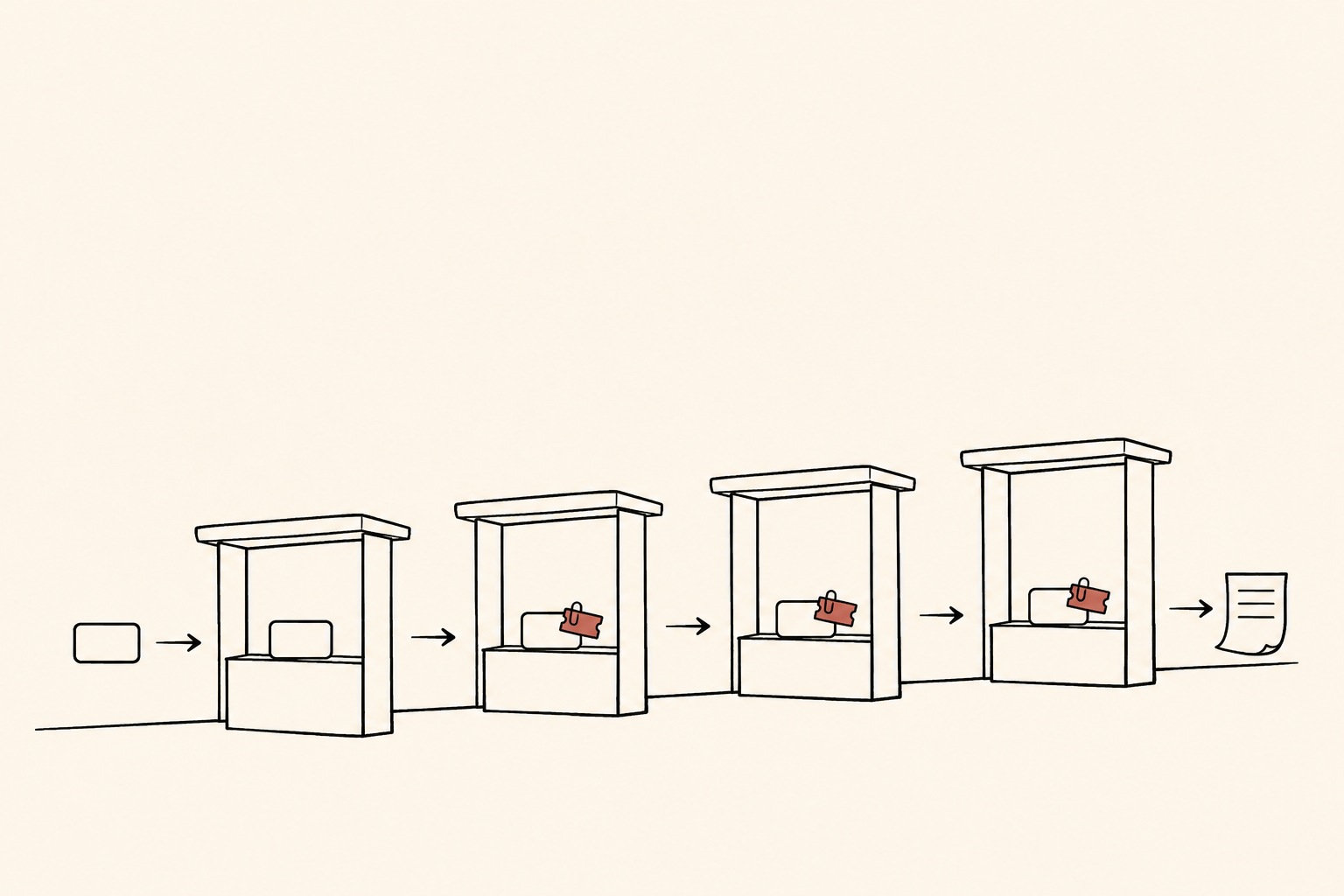
The acceptance question is whether a reconstructable version chain connects the original request, revised quotation, final approval and payment instruction. Material changes should invalidate stale approval or be handled by rules explicitly permitted in the existing authority. The paying institution should identify the precise version it relies on, rather than accepting the agent's statement that the user agreed.
Parallel work adds an aggregate-limit problem. Two individually affordable proposals may exceed total authority together. Evaluation needs to include amounts committed but not completed, not just settled balances. Implementations may differ, but splitting a task must not erase the meaning of its overall cap.
Gate three: define what the protocol proves
A useful comparison is the AP2 v0.2 specification, which distinguishes Checkout and Payment Mandates and requires specified verification to use deterministic code. This is a comparison of evidence design, not an assertion that MAS or FFI has selected AP2.
The AP2 authorization framework requires constraints from open mandates to be checked against concrete mandate content, treating unknown constraints as failures. The lesson is that receiving an apparently complete authorization artifact should not approve every roughly similar action.
Technical proof and business judgment remain different. A signature can help establish integrity and provenance; it does not independently establish that a purchase benefits the company or that goods were actually delivered. If payment depends on accepted delivery, the test must establish who can confirm acceptance, what evidence supports it and who corrects an erroneous record. Satisfying a trigger does not create additional authority.
AP2's implementation considerations also discuss management of active mandates, their duration and user notifications. Authorization should not be treated as a permit that never changes after issuance. Employee departure, project cancellation and a frozen budget all raise questions about pending instructions.
Gate four: approval is not settlement
A payment journey may time out after approval. No receipt does not prove no payment occurred; an acceptance notification does not prove final receipt of funds. A sandbox showing only successful transactions would miss states most likely to produce duplicate spending and disputes.
Simulated evaluation can cover ordinary operational exceptions: delayed confirmation, partial completion, rejection, and cancellation and completion messages arriving in different orders. Each requires an explicit business state, a reconciliation owner and a recovery condition. When uncertain, establish the outcome of the existing instruction rather than interpreting silence as permission to pay again.
Reconciliation should connect the authorization version, payment instruction, institutional receipt and final accounting state. A refund should not erase the original transaction. Preserve an explainable chain of approval, actual debit, refund and unrecovered fees. Reconciliation checks not only matching amounts, but whether payee, purpose and timing still match the approval.
Accountability belongs with institutions that can resolve disputes
In his November 18 keynote, Gan Kim Yong emphasized bounded authority for agents and continuing accountability for institutions and enterprises acting through them. That is a useful direction for evaluating trials, not an invitation to transfer responsibility to a model or protocol provider.
A useful trial report should identify who approved what, who verified the conditions, who can pause pending operations, who owns reconciliation and customer complaints, and how cross-institutional evidence is retrieved. Security teams, business owners and payment institutions cannot each keep a fragment of a successful log while nobody can explain the whole transaction.
Begin with simulated funds and limited scenarios, comparing three outcomes: whether out-of-scope proposals are stopped, whether revised approvals correctly replace stale versions, and whether failures can be reconciled to a consistent account. Speed and autonomous completion rates can be measured afterward; they cannot offset unclear authority or unassigned responsibility.
The planned sandbox's value will depend on turning these boundaries into repeatable evidence. A system worth scaling must do more than pay when a condition is met. It must explain where the condition came from, when it changed and who finishes resolving the consequences when something goes wrong.
Information only. No investment, legal, tax, or financial advice.