Securitize: The Gap Between Assets on a Platform and a Durable Business
Tokenized balances measure adoption. The harder question is which activities generate repeatable revenue and who pays for them.
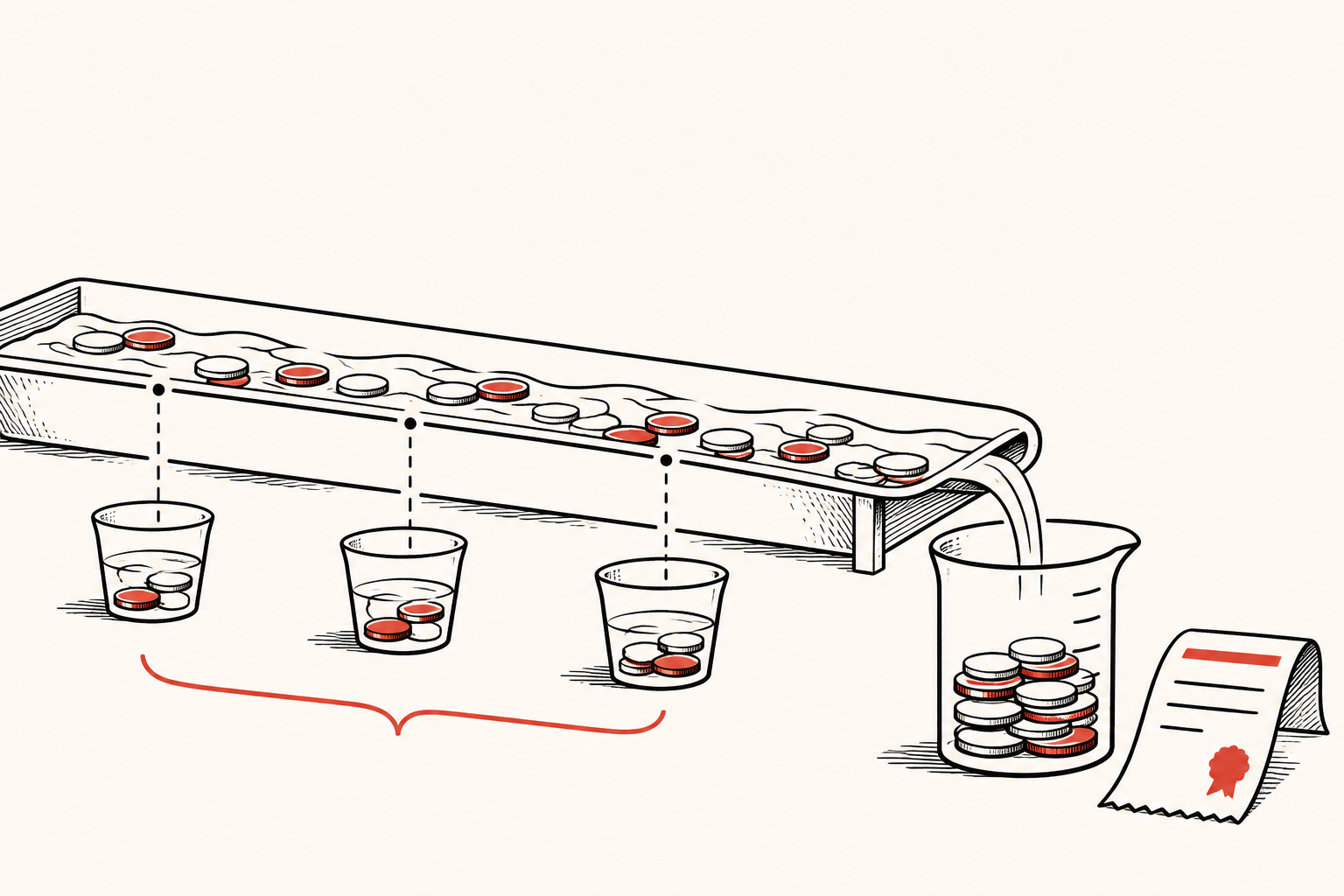
Securitize’s November 9, 2026 third-quarter release reported $5.0 billion in average tokenized assets, $4.8 billion at September-end and $18.6 million in revenue. Source
These figures describe three different things: exposure over time, a snapshot and income earned over a period. Treating them as interchangeable turns a useful adoption indicator into an unreliable business model. The central question is not whether assets can be represented on a blockchain. It is what the operator can charge for, how often it can charge, and what it costs to deliver that service.
A photograph cannot replace the whole quarter
An average reflects the path through a reporting period; an ending balance captures one date. A large subscription early in a quarter contributes more to the average than an equally large subscription on its final day. Conversely, a late redemption may reduce the closing balance while leaving much of the period’s fee-generating exposure intact.
A closing balance below the average therefore does not, by itself, establish persistent outflows, customer dissatisfaction or a weakening competitive position. Several paths can produce that result. Nor does a high average guarantee a strong starting point for the next quarter. The missing evidence is a bridge separating subscriptions, redemptions, valuation changes and changes in the set of products counted.
That bridge matters operationally. Temporary cash allocations and long-duration investments can create similar headline balances while requiring different sales efforts and producing different retention patterns. For a platform, duration can matter as much as size. A smaller balance that remains for years may support more predictable economics than a larger balance that repeatedly moves between providers.
The denominator must match the business
Dividing total revenue by tokenized assets looks like a shortcut to a fee rate. It works only if the numerator and denominator describe the same services, customers and period. A business can combine asset-based charges, issuance work, administration, transaction fees and minimum contractual payments. These are possible revenue mechanisms, not a description of undisclosed Securitize contracts.
Suppose an illustrative platform charges an annual servicing fee on average balances and also receives a one-time implementation payment. A quarter with several launches can show a higher revenue-to-assets ratio even though no recurring fee changed. Another quarter can add a large, discounted institutional mandate and show a lower ratio while increasing contribution profit. Neither movement can be diagnosed from the ratio alone.
The practical approach is to separate recurring balance-linked income from activity-linked and project-linked income. Each deserves its own denominator: serviced assets, billable transactions, active contracts or completed implementations. Only after those components are reconciled does a blended ratio become informative. Otherwise it is a scale comparison wearing the disguise of a contractual price.
A larger network does not automatically mean higher margins
Tokenization can reduce repetitive recordkeeping and reconciliation. But the economic benefit depends on whether an additional customer uses an existing workflow or requires a new legal structure, technology integration and operating process. Reusable infrastructure produces operating leverage. Bespoke service work can consume much of the value created by a new mandate.
This makes the distinction between capacity and utilization important. Adding a product to a platform establishes capability; attracting funded accounts establishes use. More transfers can create billable activity, but they can also increase support, monitoring and settlement work. A sensible assessment asks how incremental revenue compares with incremental delivery cost, rather than assuming digital delivery has negligible cost.
Competition introduces another trade-off. A major institution may provide credibility and distribution while negotiating low prices. That can be an attractive entry point if it leads to additional paid services. It is less attractive if the platform continually subsidizes integrations without expanding its share of the customer’s spending. Customer scale and supplier pricing power are not the same thing.
The BIS’s 2026 Annual Economic Report notes that shared records can reduce reconciliation, while proliferating networks complicate interoperability and governance. Our business interpretation is that technical savings must be assessed against the cost of connecting and overseeing the complete service. This is industry context, not a BIS assessment of Securitize.
What would make the economics easier to judge?
Four disclosures would be particularly useful: a consistent balance bridge; recurring revenue separated from implementation work; customer concentration measured by revenue as well as assets; and evidence that new cohorts become cheaper to serve over time. These are analytical requests, not claims that the company has promised to publish them.
Retention should also distinguish assets from customers. An institution can remain a customer while moving most of its capital elsewhere. Conversely, a customer may withdraw a maturing investment yet return with a new mandate. Contract renewal, net flows and spending across services answer different questions and should not be collapsed into a single retention percentage.
Finally, revenue recognition and cash collection deserve separate attention. An implementation can be recognized before payment arrives; an advance payment can precede recognized revenue. A durable infrastructure business ultimately needs repeated collections that fund its operating obligations, not merely an attractive trajectory in balances.
Securitize’s reporting offers a starting point for this investigation, not a shortcut around it. Tokenized assets establish the scale of activity touching the platform. The harder test is whether that activity produces repeatable, appropriately priced income without a matching increase in complexity. That is a business-quality question, not a forecast of the share price or a recommendation to trade.
Information only. No investment, legal, tax, or financial advice.