What an evaluation purchase changes in a robotics procurement decision
A sensor trial can narrow a buyer’s uncertainty without yet settling the economics of a fleet.
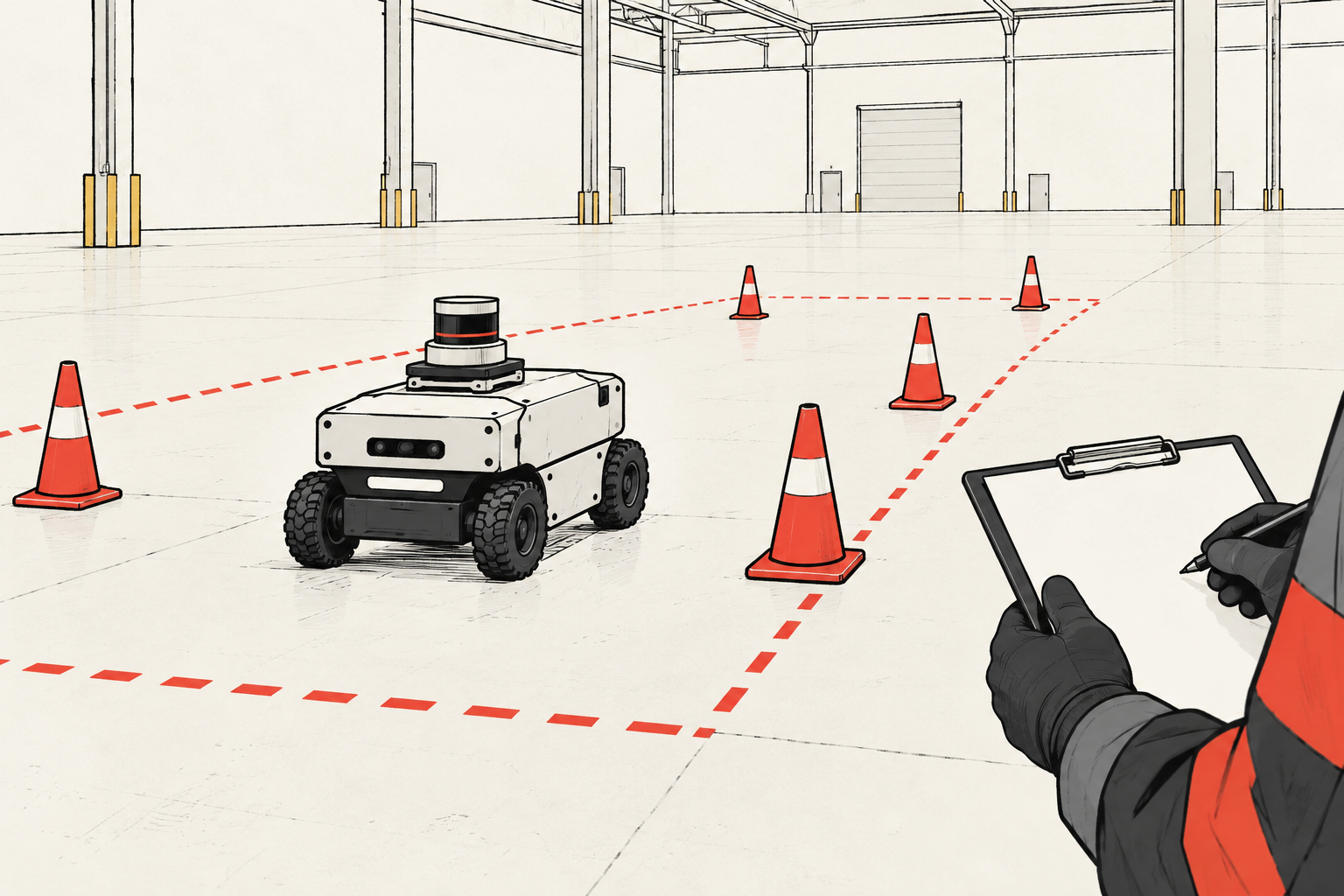
MicroVision’s November 1, 2026 announcement says FieldAI bought MOVIA sensors for development and evaluation. The expanded collaboration is a useful occasion to examine what this stage of procurement can establish. The analysis below concerns decision design, rather than a forecast of either company’s sales.
An evaluation purchase gives a buyer something a demonstration alone cannot: the opportunity to frame its own questions. The important change is who chooses the conditions, keeps the records and decides which result would justify the next expenditure. A device can impress in a demonstration while leaving the customer’s hardest purchasing question unanswered. Conversely, a modest trial can be valuable if it removes a specific uncertainty that previously prevented a decision.
Buying information before committing capacity
Consider a hypothetical operator comparing sensing arrangements for an industrial vehicle. Its initial uncertainty might be whether a particular obstruction can be detected reliably enough in its intended operating conditions. The first purchase need not resolve maintenance staffing, replacement inventory or the cost of equipping every vehicle. It should produce information that lets the operator decide whether those larger questions are worth funding.
This gives a practical way to judge the trial budget. The relevant comparison is between the expense of learning now and the cost of committing while uncertainty remains. A trial that recommends stopping can therefore be productive. It may prevent a much larger integration commitment. Counting only trials that progress into deployment would conceal this benefit and encourage teams to reinterpret an inconclusive result as success.
The supplier and customer can nevertheless value the same trial differently. The supplier wants a credible route into a repeatable product configuration; the customer wants an option to continue, change direction or stop. Neither interest is inherently improper. Difficulty arises when an announcement about technical progress is read as though these interests have already converged into an agreed purchase schedule.
The acceptance question should come before the measurement
NIST’s ground-robot testing guidance describes repeatable methods built around apparatus, procedures, metrics and failure conditions. This is background methodology, not evidence that the companies have used a particular NIST test or obtained certification.
For a buyer, the immediate implication is to write the decision rule before seeing the attractive result. A hypothetical test plan could state what operating situation matters, what constitutes a missed observation and what outcome requires a redesigned trial. The customer should also retain unsuccessful attempts. If the test scenario changes during evaluation, the old and new results answer different questions and should be recorded separately.
A useful record connects each result to a purchasing consequence. A pass might justify a longer evaluation in the same setting; it need not justify a different vehicle or a larger site. A failure might identify an unsuitable mounting arrangement rather than reject the entire technology. These are analytical examples, not reports of the FieldAI programme. Their purpose is to avoid making the trial’s conclusion broader than the question it actually tested.
General software does not erase a specific buying decision
FieldAI describes its software as a general-purpose robotic brain combining data-driven models with physics-based reasoning and uncertainty awareness. That is the company’s description, not an independent performance finding.
A broad software architecture can make a component trial more consequential because the knowledge may be useful in several settings. But the portability of software does not establish the portability of every purchasing conclusion. Mounting, operating conditions and the work expected from a vehicle can change the economic value of the same sensor. The buyer therefore needs a boundary around what it learned, including which assumptions would have to be checked again elsewhere.
That boundary also affects who pays for the next stage. If an alteration benefits one customer’s unusual installation, custom engineering may be rational. If it improves a configuration that several customers can use, the supplier may have a stronger reason to fund it. An evaluation can expose that distinction before either side makes a large commitment. The commercial value lies partly in allocating the next development expense to the party that can use the result.
There are competing interpretations here. More trials could indicate a wider range of useful applications, or further work before a stable configuration is reached. An expanded relationship alone cannot settle that distinction. More informative evidence would explain why another test is necessary, whether earlier questions were resolved and whether the new work is validation or renewed development. That separation makes progress comparable.
What would constitute stronger evidence
Readers can look for a progression in disclosed evidence: a defined application, a stable configuration, a customer’s acceptance criterion and a documented decision to expand. These are separate questions, not a compulsory public disclosure checklist. Confidential projects may reveal little, and silence cannot establish that work is failing. It does limit what outsiders can conclude.
The same restraint applies to revenue. An evaluation purchase can matter commercially, but without relevant disclosed terms it offers no sound basis for estimating fleet quantities, repeat-order timing or margins. Those estimates would require evidence about actual commitments and the cost of fulfilling them. A supplier’s wider product readiness cannot substitute for a particular customer’s purchasing decision.
The useful reading of this development is therefore procedural. Evaluation creates an opportunity to turn uncertain technical possibilities into a bounded next decision. Its quality will depend on whether the resulting evidence changes what the customer is prepared to commit, and whether both parties can explain why. That is a more informative question than treating every testing relationship as an eventual deployment of predetermined size. This article provides an analytical framework, not an investment recommendation.
Information only. No investment, legal, tax, or financial advice.