Quantum chips need a test for the boundary between them
IBM’s interconnect results raise a practical question: which complete operations should a modular system be tested to perform?
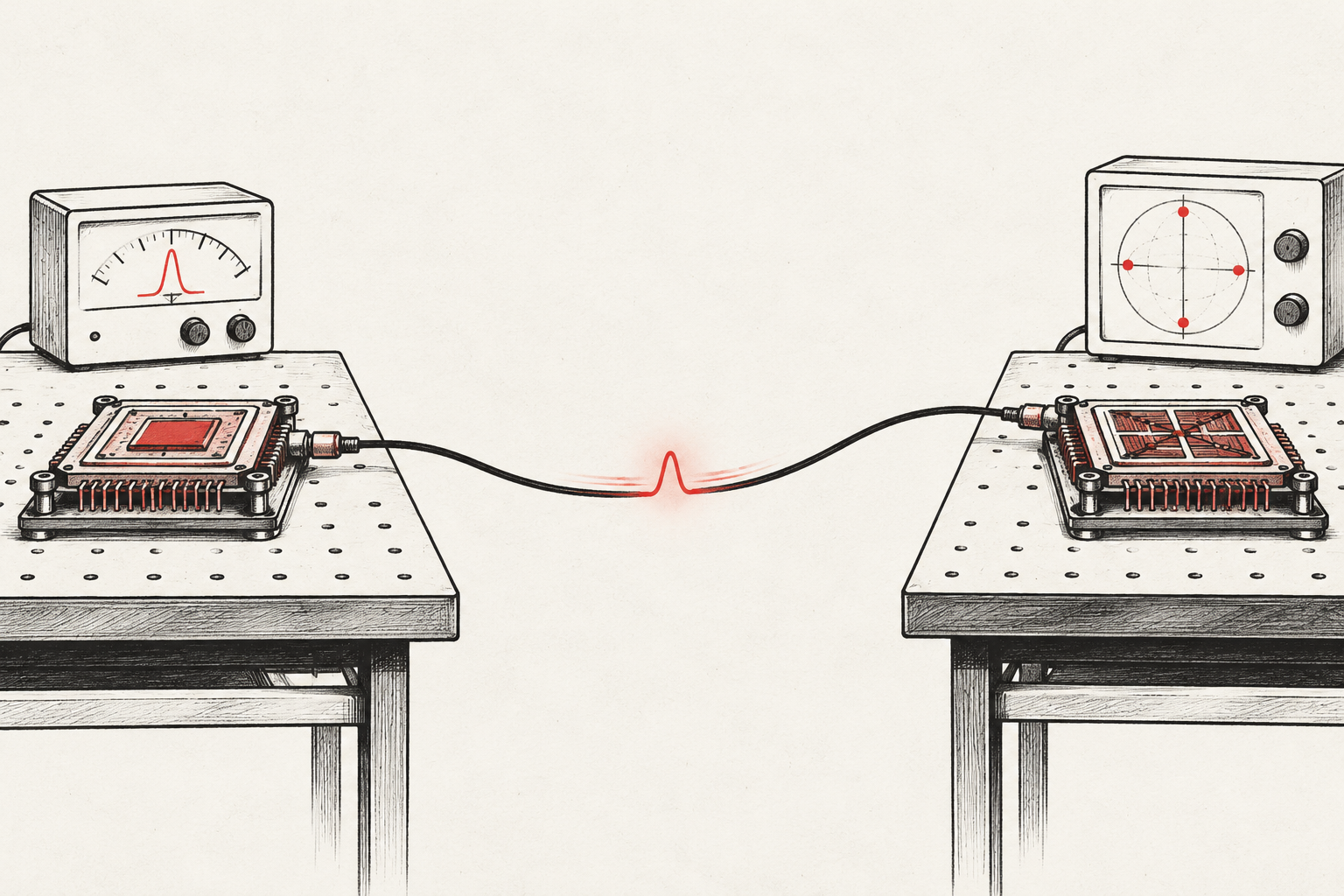
IBM’s October 27, 2026 post describes four 80-centimetre links between two Nighthawk R1 processors; the preprint dates to October 21. The practical question is how often a computation must cross the chip boundary. IBM announcement
That question shapes both the experiment and any future system comparison. A single processor lends itself to a leaderboard. A connected system adds a division of labour: which operations stay local, and which wait for another module? This article examines the evidence needed around that division, rather than judging commercial fault tolerance.
Measure the operation being claimed
The original preprint reports mean state-transfer fidelity of 99.00% and mean remote-CZ fidelity of 94.75%. They measure different operations. The first number cannot stand for the quality of the complete remote gate.
Moving a state and completing a joint operation sound similar, but an evaluator needs to locate the beginning and end of each test. If a measurement covers the middle of a workflow while the application also requires preparation and subsequent operations, the application's boundary is wider. Nor should the difference between the two percentages be assigned entirely to the cable: that attribution requires an error decomposition under a comparable protocol.
An earlier remote-CNOT benchmarking study likewise separates transfer from a complete remote gate and addresses preparation and measurement errors. It offers methodological context, not older numbers that can be attached to the present system.
A sensible evaluation therefore starts with a description of the operation the customer or researcher needs. Evidence should cover that operation, not the most attractive component statistic. This preserves the value of the experiment without allowing the claim to grow beyond it.
Ask how the program uses the boundary
Consider two hypothetical tasks. Task A mostly works inside each module and exchanges information occasionally. Task B needs cross-module cooperation after almost every small block of work. Identical connecting hardware would not justify identical test plans. This example assumes neither an achieved algorithmic speed-up nor a measured result on IBM's equipment.
For A, a useful observation is whether a later remote operation still behaves as expected after prolonged local work. For B, the evaluator needs to see how consecutive remote steps are scheduled and what subsequent steps do when one takes longer. A component experiment asks whether an operation can work. A workload experiment must also explain how operations form a program over time.
This suggests a concrete research or procurement request: show two workloads with deliberately different boundary-use patterns and explain their selection. Different outcomes can be diagnostically valuable. One carefully selected success, however impressive, leaves its range of applicability uncertain.
A replaceable connection needs a renewed evidence trail
IBM's August 19 account of modular cryogenics discusses cooling expansion alongside processor connectivity. It places the connection inside a larger engineering system rather than treating distance as a free-standing specification.
Our proposed evaluation should therefore include an after-change plan. When a component is replaced, an assembly rebuilt or a connection adjusted, which results remain applicable and which tests must run again? This is not an allegation of a maintenance failure in the reported experiment. It is a way to make a modular system's validation auditable. Replacing a module is operationally useful only if validating the changed configuration is manageable too.
Separate research on interchangeable superconducting devices studies detachable connections alongside intermodule operations. It makes replaceability a legitimate experimental question; different devices and protocols cannot be used to grade IBM's links directly.
A useful deliverable would record the old configuration, the change, repeated tests and unresolved anomalies. Its purpose is continuity, not paperwork. Without that continuity, a team can accidentally combine successes from different configurations into the appearance of one stable system that was never tested as a whole.
What would make the next report more useful?
We suggest three questions. Which complete operation does each metric describe, and can the protocol support comparisons between experimental batches? How does the demonstrated program use module boundaries, including waiting and cooperation? How is the evidence renewed after configuration changes? These are our evaluation criteria, not a delivery checklist IBM has promised.
The optimistic interpretation is that multiple links let researchers investigate distributed programs without placing every engineering problem on a single chip. The cautious interpretation is that connectivity also expands the combinations of operations and configurations that must be explained. Both can be true.
The evidence supports further testing closer to complete programs. It does not establish commercial value, whole-machine fault tolerance or readiness for a particular industry application. The next report's most informative advance may be a clearer statement of which programs, configurations and conditions its results cover, rather than a modest improvement in a headline percentage.
Information only. No investment, legal, tax, or financial advice.