Qualcomm’s diversification test is now measured in profit, not sales
Auto and IoT replaced 56% of lost handset sales. The harder test is rebuilding profit and cash generation.
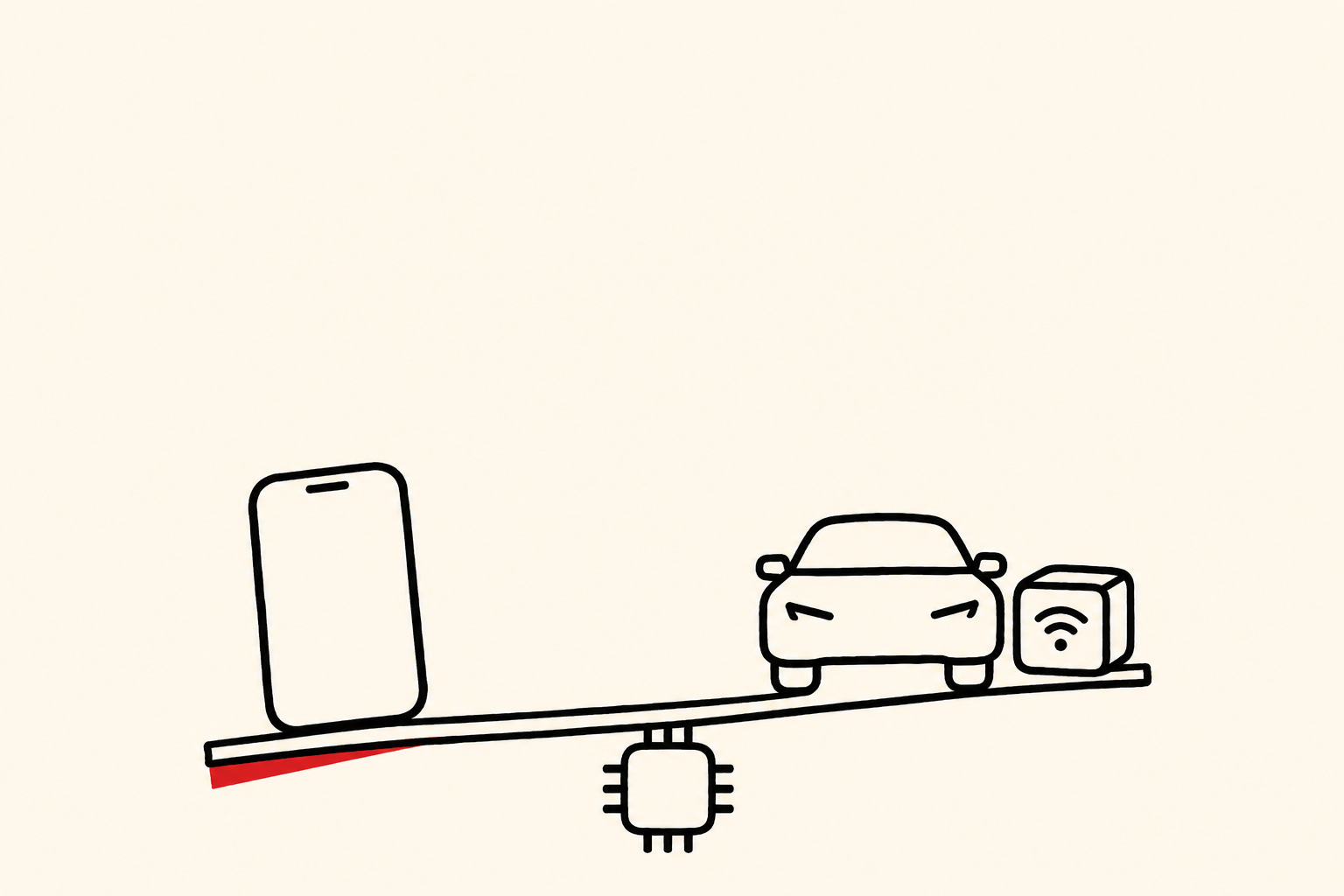
Qualcomm’s November 4 results put a price on the transition away from smartphones. The new businesses are growing, but replacing a dollar of handset sales does not automatically replace its contribution to earnings. The useful question for fiscal 2027 is how much cash and operating profit the broader portfolio can produce while the company finances its next generation of products.
The replacement ratio is only the first test
In the September quarter, handset revenue fell from $6.961 billion to $5.137 billion. Automotive and IoT together rose from $2.860 billion to $3.878 billion. Our calculation from the company’s financial tables: $1.018 billion of incremental non-handset sales replaced roughly 56% of the $1.824 billion handset decline. About 92% of that incremental revenue came from automotive, so the combined growth rate hides a highly uneven contribution.
The portfolio did become less dependent on handsets. Auto and IoT reached approximately 43% of QCT chip revenue, versus 29% a year earlier. But a share can rise because another business shrinks. Diversification should therefore be assessed using both absolute growth and the earnings generated, rather than a revenue mix milestone alone.
QCT’s quarterly earnings before tax fell 26%, against an 8% revenue decline. Its disclosed EBT margin moved from 29% to 24%. Qualcomm does not publish separate handset, auto and IoT profit margins in these tables. The results establish pressure on the chip division’s profit pool; they do not establish that auto chips are less profitable than phone chips.
Revenue timing and margin timing diverge
Management describes automotive’s shift toward integrated compute modules and newer platforms, rather than merely more chips of the same type. A richer product package can increase revenue per vehicle. It can also bring purchased components and integration work into the revenue and cost base. The economic test is contribution after those costs and the engineering needed to support the platform, not the invoice size alone. This is an analytical distinction, not a disclosed auto-margin forecast. Earnings call
The next quarter introduces another comparability problem: data center enters QCT. Management guided QCT EBT margin to 20%–22%, including a three-percentage-point impact from adding that business and its investment ahead of the accelerator and CPU revenue ramp. Treating the whole decline from 24% as deterioration in the existing phone-and-auto portfolio would misread the segment change.
Gross margin is also an incomplete verdict. Management says custom silicon engagements should dilute gross margin while adding to QCT operating margins. Those statements can coexist when a business carries more production cost but requires proportionally less incremental operating expense. Execution, rather than the label “AI,” must demonstrate that outcome. Earnings call
The cash account is less flattering than headline profit
Fiscal 2026 GAAP net income rose 146%, but included a $5.7 billion tax benefit from releasing a valuation allowance. That accounting event is not evidence of improved chip economics. Adjusted earnings help isolate it, but also exclude costs such as stock compensation; neither measure should replace cash-flow scrutiny. Results and reconciliations
Using operating cash flow less capital expenditure, we calculate $8.651 billion of free cash flow for fiscal 2026, down from $12.820 billion in fiscal 2025, approximately 33%. This is our simple definition, before acquisitions and other investments. Dividends and repurchases totaled $11.671 billion, exceeding that cash measure by $3.020 billion.
That gap does not establish a liquidity crisis or predict a dividend cut. It shows why the transition cannot be judged only by sales targets. Investment, working capital and shareholder distributions compete for funding. Repurchases can support per-share figures without repairing the underlying operating profit engine.
Licensing buys time, not an exemption
Apple’s modem transition should not be confused with the end of its patent relationship. Qualcomm announced renewed long-term licensing agreements with Apple, Huawei and Transsion. QTL’s quarterly EBT margin was 70%, making licensing an important source of earnings during the chip transition. Company release
Reuters’ reporting places the handset weakness alongside softer demand and Apple’s shift toward internal modems. These are different challenges: a demand recovery could help Android sales, while a customer’s internal chip substitution requires replacement business. Neither is solved merely by announcing a design win.
The next evidence should be concrete: absolute non-handset growth, QCT profitability adjusted for the segment change, and cash left after investment. Qualcomm also expects the full benefit of input-cost price increases in the second half of fiscal 2027, so improved sales and improved margins may arrive at different times. That remains a management expectation.
Qualcomm has demonstrated a revenue bridge away from phones. The stronger proof will be a repeatable earnings and cash bridge that can finance the new portfolio without relying on tax effects or a shrinking share count.
Sources
Information only. No investment, legal, tax, or financial advice.