A tokenized bond can trade after hours. When does the cash settle?
The Eurosystem’s Pontes pilot shows how cash availability and legal finality can still depend on the settlement calendar.
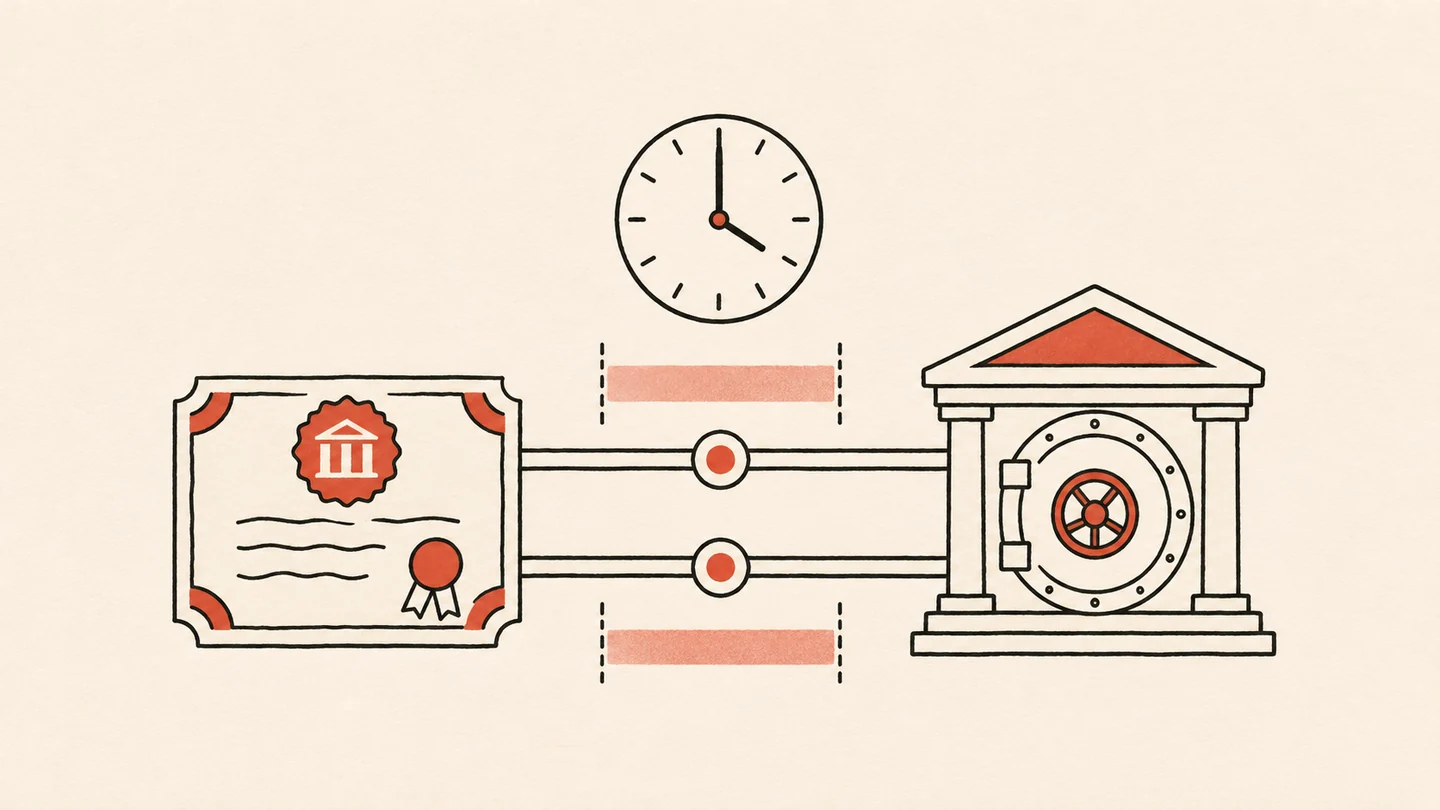
At 16:10 local time on a T2 business day, imagine two institutions agreeing a trade in an eligible euro-denominated tokenized bond. Their market platform, if it is still open, can record that trade. But if they rely on the initial Pontes schedule, they have missed the window for full settlement processing that day. The trade record alone says nothing about whether cash has moved. The distinction is operational, not just a choice of terminology: it decides what a firm can tell the client and which downstream actions it can safely take.
The two legs run on different systems
The Eurosystem launched Pontes on September 21, 2026. It links eligible distributed-ledger market platforms to central bank money through TARGET Services. The initial design offers two cash settlement routes: cash tokens on the Eurosystem ledger or direct settlement in T2, the real-time gross settlement system. Delivery versus payment coordinates the asset and cash legs so that the design does not depend on one party handing over its asset and hoping the other party pays later. An interface can show that a request has been recorded or that assets have been reserved without demonstrating that the conditions for final settlement are met.
The operating guide distinguishes a preparatory phase beginning at 08:00 from a full transaction window of 09:00–16:00 on eligible euro T2 business days. Some funding or direct T2 operations can start earlier. The subsequent redemption phase for cash tokens is a separate operation, not an extension of general settlement hours. The ECB design ties legal finality for the cash leg to completion of the corresponding transaction in T2. If a platform receives an instruction after the cutoff, the issuer or participant must check the relevant rules before assuming it will automatically queue for the next window.
What the extra hours would change
A round-the-clock asset market can ease scheduling across time zones. It can also increase the amount of cash a participant must have ready if its funding sources do not work to the same calendar. A buyer may have the economic means to pay but hold liquidity in the wrong system, currency, or legal entity. Even a synchronized instruction cannot fill that gap. Bank of Japan Executive Director Kazushige Kamiyama raised this point on November 27, alongside the distinction between technical confirmation and legal finality. The ECB describes 24/7/365 access in 2028 as a goal, not a current feature.
An operator can model three states independently: instruction received, eligible cash available, and cash legally settled. The first belongs in a service log, the second in treasury monitoring, and the third should be tied to settlement evidence. When an application shows only one “completed” status, disagreements about what happened become harder to reconcile. A useful pilot result therefore measures more than how fast successful trades run: it also measures funding needs around cutoff, failed matches, retry handling, and the time it takes an operator to explain an exception.
Sources
AI Q&A
Does cash tokenization extend Pontes’ settlement hours?
No. The pilot has an operating calendar and a full transaction window even when using its token route.
Is recording a bond trade proof that it settled?
No. A record can precede cash availability, synchronized delivery and legal finality.
Is 24/7 settlement already available through Pontes?
No. The ECB describes round-the-clock availability as a 2028 objective.
Information only. No investment, legal, tax, or financial advice.