After Pax Silica’s new declaration, what makes an AI supply chain replaceable?
A shared commitment is not spare capacity. Supplier qualification, common dependencies and switching costs determine resilience.
A State Department media note distributed by Public says the United States and nine Pax Silica participants signed the San Francisco Declaration on November 15, 2026, proposing five working groups. The event date is November 15, not the following day’s coverage. Signing is not evidence of a purchase contract, completed capacity or newly implemented restrictions.
Open Market Notes sees the industrial question as moving beyond which countries cooperate to which dependencies can actually be replaced. Common commitments may improve coordination. Between a partnership roster and dependable delivery, however, lie technical, commercial and operational tests. The analysis below concerns those mechanisms, not predictions about particular governments or companies.
Draw the whole dependency map
The agenda did not suddenly expand beyond chips. The original December 12, 2025 declaration published by Australia already encompassed software, compute, manufacturing, logistics, mineral processing and energy. That earlier document must not be presented as new provisions agreed this week.
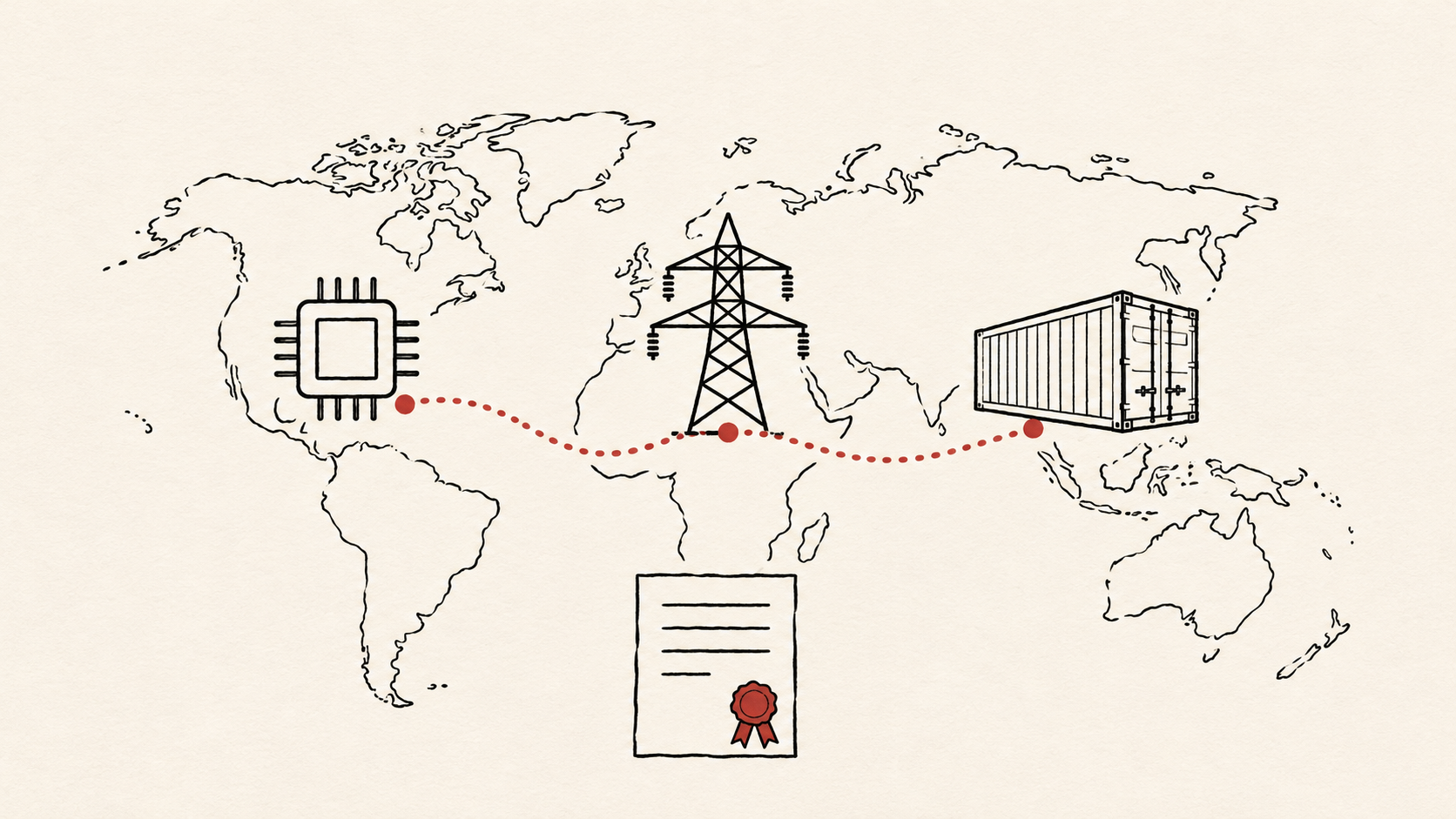
An AI service needs more than a processor. It also needs somewhere to operate equipment, continuing power, connectivity and the ability to maintain or replace failed components. This is a general dependency example, not a list of technical obligations imposed by the new declaration. A fuller map reveals that the customer buys a combination of conditions, not an isolated product.
Suppose servers arrive but supporting power is not ready. Delivery has not made the service usable. Conversely, a ready facility may still wait while a specialized component is requalified. The useful unit of supply security is consequently a complete path capable of meeting a business commitment, rather than a count of announced projects.
Two suppliers can carry the same risk
Adding names does not necessarily create independent choices. Different assemblers might rely on the same upstream component; different locations might use the same difficult-to-replace software tool. These are hypothetical situations, not allegations about participants. They show why the length of a purchasing list cannot substitute for examining dependencies.
Meaningful diversification asks whether one disruption could disable several options together. Multiple suppliers can still offer price or service advantages when that answer is yes, but they should not be described as eliminating the shared failure. Separating commercial competition from operational independence helps avoid paying for cosmetic variety.
Independence also has a cost. Different toolchains or materials may require additional testing, training and spare parts. A dispersed architecture can reduce one interruption risk while increasing ordinary complexity. Both sides belong in the assessment; concentration is not automatically disastrous, nor dispersion automatically superior.
Available to buy is not ready to switch
A willing seller is only the beginning. The customer must establish compatibility, quality, maintenance arrangements and a workable delivery cadence. For a continuously operating service, maintaining work through a transition matters more than merely starting equipment in a laboratory.
Consider a team that has tested backup hardware but never migrated a real workload. It has demonstrated technical feasibility, not that staff can execute a switch, move data completely or recover within business requirements. A stronger exercise records remaining manual steps, conditions that prevent rollback and responsibility for returning to the original path.
Backup capability should therefore have an explicit status: discussed, tested, purchasable, adequately provisioned or already used in operation. Keeping these stages separate is more honest than labeling every candidate an alternative supplier. This does not require duplicating every asset. It connects the cost of preserving choice with the capability actually preserved.
Cooperation can remove costs or add coordination
The earlier documents held by Japan’s foreign ministry emphasize complementary industrial strengths. That has an understandable appeal: each participant need not reproduce an entire technology system. But complementary dependence is different from substitutable dependence. A concentrated capability may benefit the network while remaining a critical node requiring contingency preparation.
Shared classification, communication and verification methods could reduce repeated work. If institutions continue demanding different evidence and procedures for the same component, however, businesses may acquire another coordination layer instead. These are competing possibilities, not outcomes established by signing. Progress should appear in less duplicate assessment, earlier discovery of problems or clearer switching paths, not merely more meetings.
Investment must also wait for detail. Expected demand can justify investigation without proving that new capacity will remain utilized. Purchase commitments, financing, construction and customer acceptance deserve separate tracking. Progress in one does not complete the others.
From a statement to an inspectable capability
The next evidence to watch is how working arrangements become specific standards, participation terms and verifiable projects. Businesses can map their dependencies, distinguish shared upstream exposure from genuinely independent options and document the most important transitions. This is a risk-analysis framework, not a recommendation to replace a supplier on the strength of a headline.
The reverse test matters too. Does the more complex network actually shorten recovery, or just move cost elsewhere? If a reliable alternative remains unused for long periods, who pays to preserve it, and on what terms? There is no universal answer, but these questions determine whether policy coordination becomes a lasting service.
The San Francisco Declaration supplies a new coordination point. A stricter industrial test is whether a validated alternative can take over the work when needed. A national signature, a qualified supplier and an operational capability must each be established before they can jointly constitute resilience.
Information only. No investment, legal, tax, or financial advice.