Parallel coding needs a precise release decision
Pando raises a practical question: which exact combination of changes did a team test and approve?
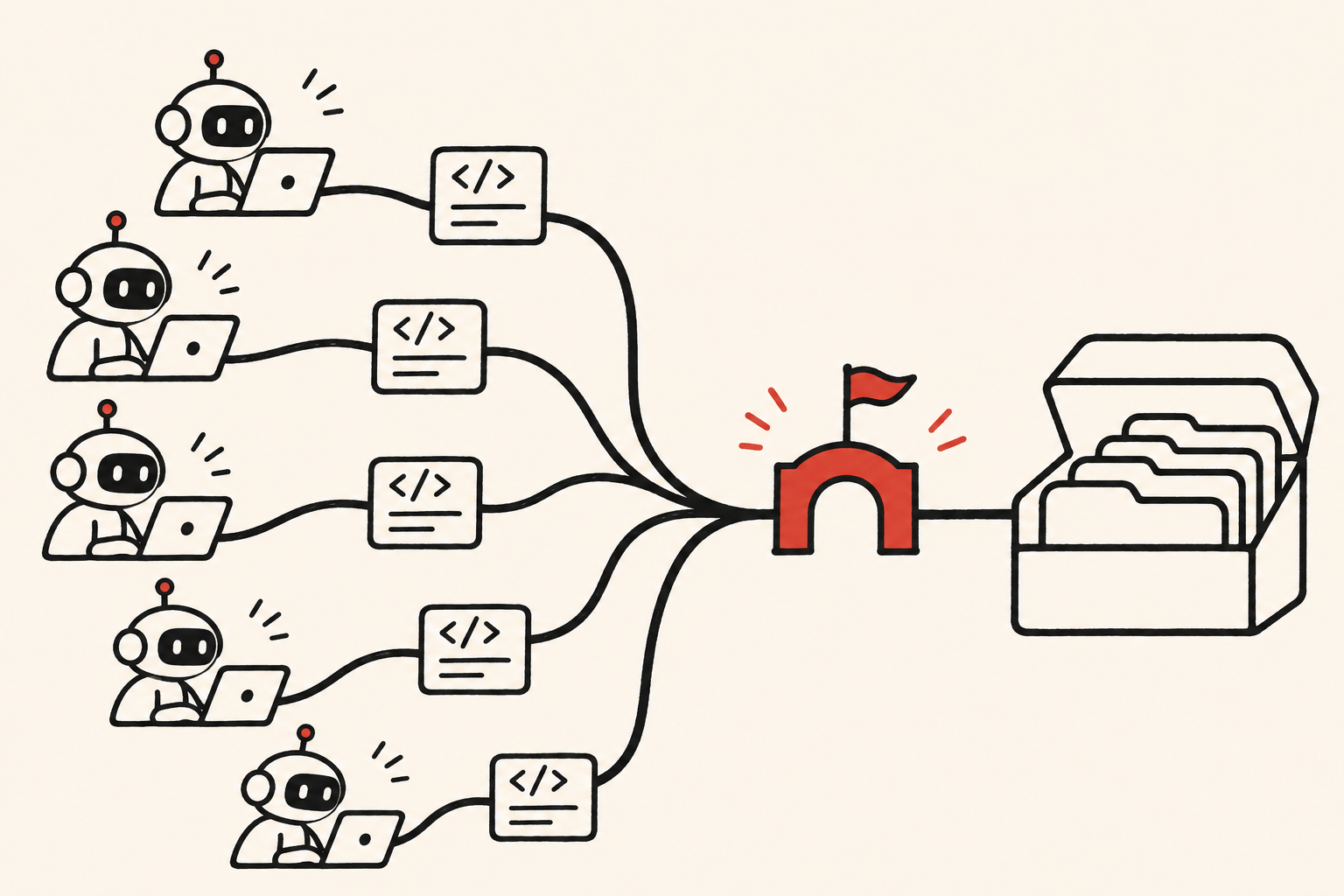
On November 2, 2026, OpenAI described Pando: independent branch updates, without a repository-wide snapshot across branches. That boundary matters when parallel coding reaches release approval. Primary announcement
The analysis below concerns release design, rather than an independent performance evaluation of Pando. A team can have ample capacity to accept changes while remaining uncertain about the combination it intends to ship. These are different engineering responsibilities, and faster development makes their handoff more important.
A successful upload leaves a decision open
Consider a hypothetical team with two agents. One changes the shape of an API response; the other updates a client that consumes it. Both complete their assigned tasks and both report passing tests. A release manager still needs to ask whether those tests ran against the intended pair of changes. The client might have been tested with a stub that preserves an old field. The server might have been tested without the new client. Neither test result is necessarily false, yet the pair can fail together.
This example is not a report about OpenAI's internal workflow. It illustrates why counting accepted changes can mislead. A source-control service answers where a change is stored and which revision is being referenced. A release decision asks whether a selected combination is fit for a particular use. Increasing the first system's throughput does not answer the second question.
Git's update-ref documentation provides a useful small example: an update can be conditional on the reference still having an expected previous value. Git documentation
For the hypothetical team, the corresponding organizational discipline is to identify what an approval actually covers. If the approved candidate changes, a green badge attached to yesterday's candidate should not silently approve today's one. A branch name is convenient for people; an approval record needs enough precision to distinguish those cases.
Test the combination that will be released
GitHub documents merge queues that run required checks against the target branch plus preceding queued changes. Merge-queue documentation
That mechanism offers a concrete point of comparison, not a claim that every team needs GitHub or a merge queue. An organization might use a release branch, a candidate manifest or another controlled assembly process. The essential question is whether the checks and the proposed release refer to the same inputs.
Suppose a third agent fixes an unrelated defect while the first two changes are awaiting review. Automatically rebuilding everything may be expensive; ignoring the third change may delay a useful fix. A practical policy can separate changes that invalidate the candidate's evidence from changes that can wait for the next candidate. The criteria should be explicit enough that automation does not improvise the decision each time.
This creates a tradeoff. Large batches reduce the number of release decisions, but make a failed integration harder to diagnose. Very small batches narrow the search for a regression, but can multiply setup, review and deployment work. The right unit depends on dependencies and operational risk, not simply on how many agents are available. A team should measure the cost of a verified release rather than choose a batch size from the volume of generated code.
Carry the decision through to the artifact
SLSA describes provenance as verifiable information tracing an artifact's origin; its build and source tracks address distinct parts of that history. SLSA provenance
For our example, a useful release record would connect the chosen revisions, checks, approval and delivered artifact. This is an editorial recommendation, not a statement that a provenance format alone establishes safety. A signed record can faithfully describe an inadequate test. A complete test can still omit a failure mode that matters in production.
The record nevertheless makes investigation more tractable. If a customer sees an incompatible response, the team can ask which candidate produced the deployed artifact and whether the relevant client-server combination was tested. Without that link, people may spend the first part of the incident reconstructing what actually shipped. Agent-generated summaries are helpful navigation, but should not replace the underlying identifiers and evidence.
The same distinction matters for rollback. Reverting a code change does not necessarily reverse a database migration, a message already sent or an external action. Release approval should therefore include the consequences that are difficult to undo. A narrow rollback test for a binary cannot establish that the entire business operation is reversible.
Measure the handoff, not only the activity
A useful evaluation would track time from candidate creation to verified deployment, how often approvals are invalidated by new changes, and how much work is repeated after integration failures. These are proposed measurements, not published Pando results. They would help distinguish a storage bottleneck from a testing or ownership bottleneck.
There are limits to the argument. A small team changing an isolated component may gain little from elaborate release machinery. Excessive gates can consume the time that automation was meant to save. Conversely, a system with coupled components or costly external effects may need a stronger decision record even at modest commit volume.
The sensible response to more parallel coding is to make the release boundary explicit before adding ceremony. Decide which combination is being approved, what evidence supports it and what would require that decision to be revisited. Then make the tooling carry that decision intact to the artifact users receive. Faster code movement is useful when the organization can still explain the result it chose to ship.
Information only. No investment, legal, tax, or financial advice.