Google TPUs on OCI: Purchased capacity is not yet qualified work
Oracle’s TPU plan broadens future hardware choice, but useful capacity still depends on the work and its acceptance conditions.
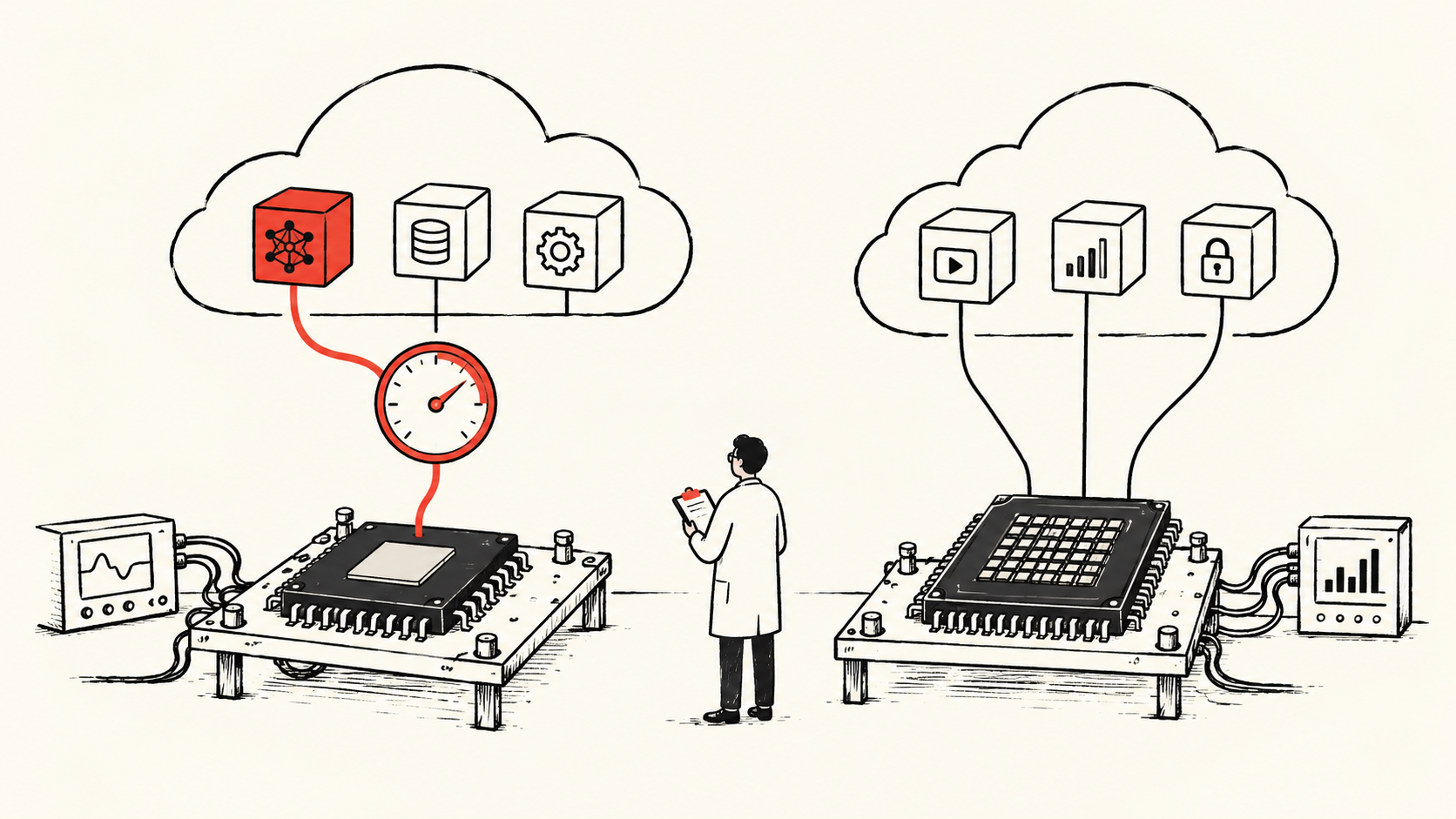
On October 27, 2026, Oracle and Google announced Google TPUs on Oracle Cloud Infrastructure (OCI) for 2027, not immediate availability. Oracle announcement · Google announcement
The change invites a more demanding question than which chip is faster: how much of an organisation's actual work would an additional architecture be qualified to handle? Purchasing capacity and validating useful capacity are different activities. A larger hardware catalogue does not, by itself, make workloads interchangeable.
The analysis below is Open Market Notes' own framework for assessing that question. The examples are hypothetical, not reported customer results, and no price or performance advantage is assumed for the future offering.
Start with the work, not the accelerator
A company might describe its requirement as language-model inference. That label hides several different demands. An employee asking a short question expects an immediate response. A batch of documents can perhaps wait until morning. A long analytical request may consume resources for much longer than a routine answer. Counting those requests together produces an easy number, but a poor description of the service the organisation needs.
A meaningful qualification exercise would therefore begin with a demand sample. It should retain input lengths, expected output lengths, arrival patterns and the quality conditions that make a response usable. Those dimensions do not need to be identical across all applications. They do need to be explicit before hardware results are compared.
Otherwise a configuration can appear more capable simply because its test contains easier work. If a benchmark excludes the longest documents, a result described as requests per second says little about a service that must accept them. The omission might be reasonable for a narrow product; it should then be a declared product boundary, not an invisible optimisation.
Throughput can conceal a waiting-time decision
MLPerf's inference rules distinguish scenarios and require specified quality and latency conditions. They do not certify the announced OCI service. MLPerf rules That methodological distinction is useful here: a pile of work available in advance and an unpredictable stream of live requests are not the same operational problem.
Imagine a hypothetical team comparing overnight document classification with a customer-facing assistant. The first service might group work aggressively to finish a scheduled backlog. The second has to preserve the experience of someone waiting for a reply. A setting that improves total output could be inappropriate if it achieves that result by making requests wait longer before processing begins.
This does not establish that one architecture is inherently better for either task. It shows why the acceptance condition must travel with the result. A throughput number without its response-time boundary is incomplete. An average response time is also insufficient when a small but important group of requests experiences much longer waits.
For planning, the useful object is not a single winning score. It is a range: which combinations of arrival rate and workload mix remain acceptable under the chosen service obligation? Procurement can then ask for capacity that meets an identified need, rather than interpreting a best-case result as a universal conversion rate.
Keep hardware utilisation separate from accepted work
Google's TPU performance guide identifies input supply, tensor dimensions and padding as possible constraints. It is general technical guidance, not a specification for the future OCI deployment. Performance guide
The operational inference is that an accelerator can be present without being productive for the task at hand. A test should distinguish time spent waiting for inputs, time performing useful computation and output that ultimately fails the application's acceptance criteria. This is a proposed measurement boundary, not a claim about the partners' observed results.
Consider a hypothetical system that becomes busier after a configuration change. If the extra activity accompanies more rejected answers or repeated attempts, increased utilisation would not necessarily represent more usable work. Conversely, a configuration with spare headroom may be deliberately preserving responsiveness for bursts. Neither busyness nor idleness is self-explanatory.
The appropriate denominator depends on the task. For a document classifier it might be documents accepted under a defined accuracy check. For an assistant it might be completed interactions meeting quality and response requirements. The denominator should not be changed halfway through a comparison merely because a different one flatters the new configuration.
A heterogeneous fleet needs boundaries between jobs
An additional architecture can be valuable even if it is not the best fit for every request. A reasonable adoption path might assign a well-understood, separable workload first, while leaving other work where it is. The important qualification is what happens at the boundary between those pools.
If routing a request requires information that arrives only after expensive preprocessing, the apparent allocation flexibility may be smaller than it looks. If one workload expands at a busy time, capacity reserved for another may not be immediately usable. These are questions for a proposed design, not disclosed limitations of the announced service.
A planning model should therefore distinguish capacity that is installed, capacity qualified for a particular job and capacity actually available when that job arrives. Adding the first category across architectures can overstate the third. A portfolio can still be worthwhile, but its value lies in matching differentiated work to appropriate resources rather than pretending all resources are one uniform pool.
There is a competing interpretation worth taking seriously: a more homogeneous fleet may be operationally preferable for a small team or a rapidly changing application. Maintaining multiple qualification paths takes effort. On the other hand, organisations with stable, distinct workloads may gain useful flexibility from a broader mix. Neither outcome can be inferred from a partnership logo.
What the next disclosure should establish
The announcement creates a future option to qualify, not a measured answer to that exercise. Commercial availability, configurations and customer tests still matter. No cited announcement proves that a particular organisation can process its workload more cheaply or with fewer resources.
The most informative follow-up would describe a representative task mix, explicit acceptance conditions, configuration choices and the range over which the result holds. A later model or changed input population should trigger a fresh question about whether that evidence still applies.
That is the substantive significance of putting another accelerator into a cloud catalogue. It may broaden the tools available for capacity planning. To become useful operational capacity, however, the hardware has to be connected to work that has actually been defined and qualified.
Information only. No investment, legal, tax, or financial advice.