NVIDIA Attribution: what a diagnosis should earn the right to change
A diagnosis should justify the next decision. Our proposed test: preserve evidence, expose uncertainty, and measure the cost of acting wrongly.
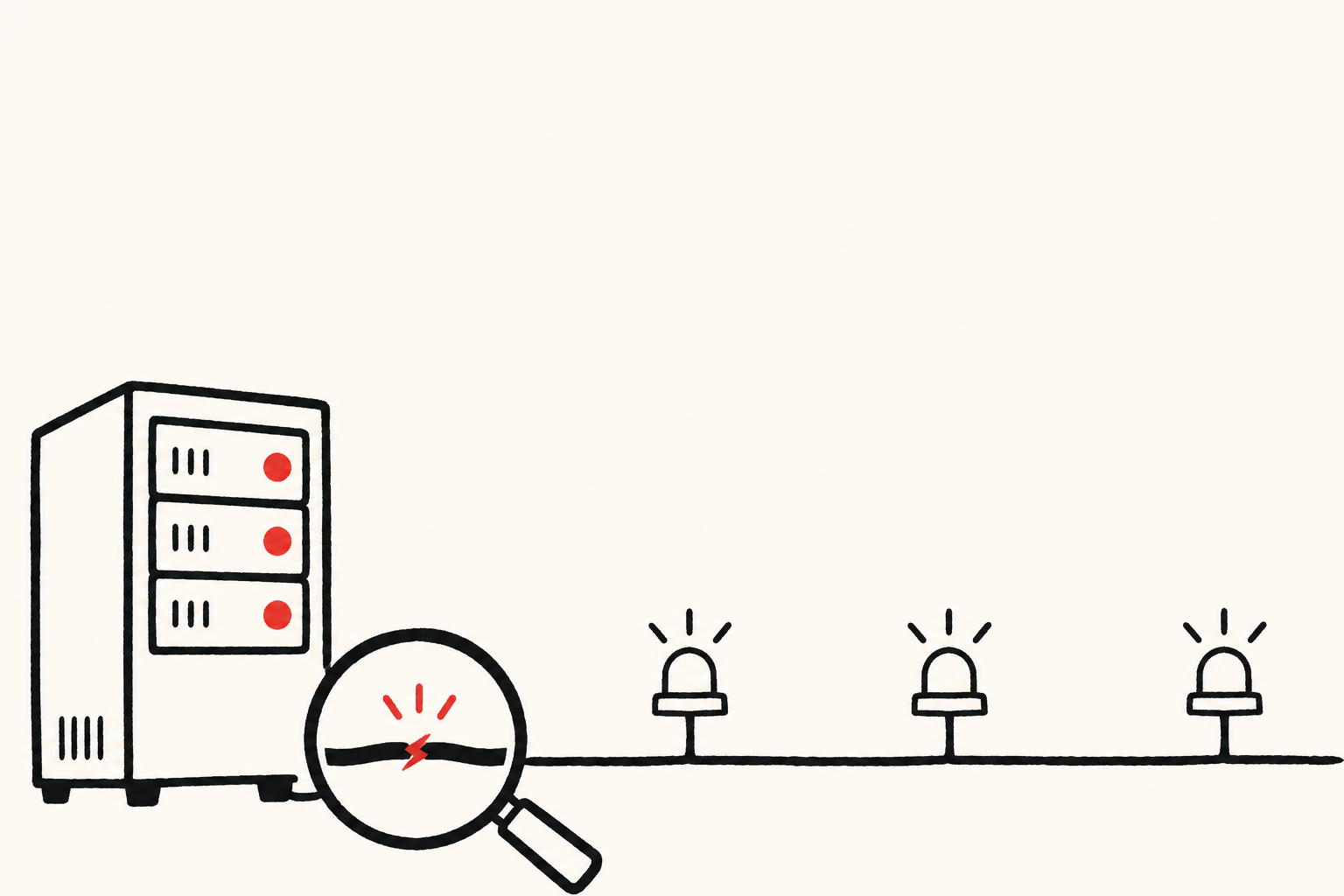
NVIDIA’s November 2, 2026 post introduces its open-source Attribution tool for diagnosing distributed AI workload failures.
This article proposes an operator’s evaluation framework, rather than a product benchmark or deployment report.
Start with the decision
An incident room needs two answers: what can we safely do now, and what would establish why this happened? Treating them as one question encourages an expensive shortcut. A plausible explanation becomes permission to change infrastructure before anyone has tested the explanation.
Consider a hypothetical training job that stops twice. Moving its next attempt to a spare node might be a sensible, reversible containment step. Replacing the original node’s hardware is a different commitment. Both actions could follow the same initial report, but they need different evidence thresholds. The report should therefore state which decision it supports, who owns that decision, and what observation would overturn it.
This is our central test for attribution software: does it improve the quality of those choices? A dashboard that always produces a neat answer may be less useful than one that leaves a difficult case unresolved while identifying the cheapest discriminating test.
A label is not an intervention plan
The project repository describes log correlation, not hardware probing; replacement decisions remain with operators. That boundary should shape procurement and rollout.
We propose evaluating three outputs separately: a candidate explanation, the evidence needed to challenge it, and the permitted response. For a suspected component, for example, ask whether the available observations distinguish an internal defect from an external interruption. If they do not, keep both possibilities visible. A high-confidence classification can still be too broad to justify a particular repair.
Use a decision ledger rather than a leaderboard of diagnoses. Record what was proposed, what was actually done, the evidence available at that moment, and the later result. This makes it possible to distinguish a mistaken explanation from a reasonable precaution that happened not to be necessary. It also avoids praising a diagnosis solely because a later restart succeeded.
Retention deserves its own acceptance test
Kubernetes documentation notes that pod eviction removes the associated containers and their logs. That is a practical reason to test evidence availability independently of recovery speed.
Our suggested drill starts with a deliberately unimportant workload. Before any destructive cleanup, verify that an authorized responder can retrieve its bounded incident record elsewhere. Include a record of missing inputs. Apply a documented time limit to collection so that investigation does not indefinitely block service restoration. Keep secrets and unnecessary payloads out of the archive, and give retained evidence an expiry date.
Then have a second responder reconstruct the incident without relying on the first responder’s memory. If reconstruction requires an undocumented query, a private notebook, or a vanished terminal session, the workflow has failed this drill even if the job is running again. The aim is a portable basis for review, not unlimited logging.
Test the uncertainty, too
OpenTelemetry’s log model distinguishes event time from observation time. We suggest delaying one input stream to test whether conclusions become more cautious.
Other useful tests are editorial recommendations, not claimed product features. Remove one evidence source, introduce two competing explanations, and replay the same incident under a revised rule set. Ask reviewers to explain every changed conclusion. A system should not receive credit for certainty that depends on facts it was never given.
PyTorch’s torchrun documentation describes selecting each node’s earliest error by timestamp as a root-cause heuristic. An early reporter therefore deserves investigation, not an automatic assignment of blame.
Price mistakes before automating responses
A pilot should count false interventions as carefully as missed incidents. Unnecessarily removing a healthy node consumes capacity; repeatedly retrying a failing attempt consumes time and compute. Which cost dominates depends on spare capacity, workload urgency, and the reversibility of the proposed action. There is no universal threshold worth copying from a demonstration.
Our recommended pilot has an explicit end point: a reviewer can trace a proposed action to retained evidence, describe the remaining uncertainty, and reverse or escalate the action under a written policy. Until then, run recommendations alongside existing operations rather than wiring every diagnosis directly to remediation.
The commercial question is whether the process reduces avoidable decisions and repeat investigations after integration and maintenance costs. NVIDIA Attribution is a timely occasion to ask it. A convincing answer needs a local trial with real operational constraints, not an assumption that a new diagnostic label has already solved the failure.
Information only. No investment, legal, tax, or financial advice.