NeoWorld released 1,324 robot-simulation objects. Looking right is only the first test
The first NeoWorld-10K release exposes editable joints and geometry, making it easier to test what an object can actually do in simulation.
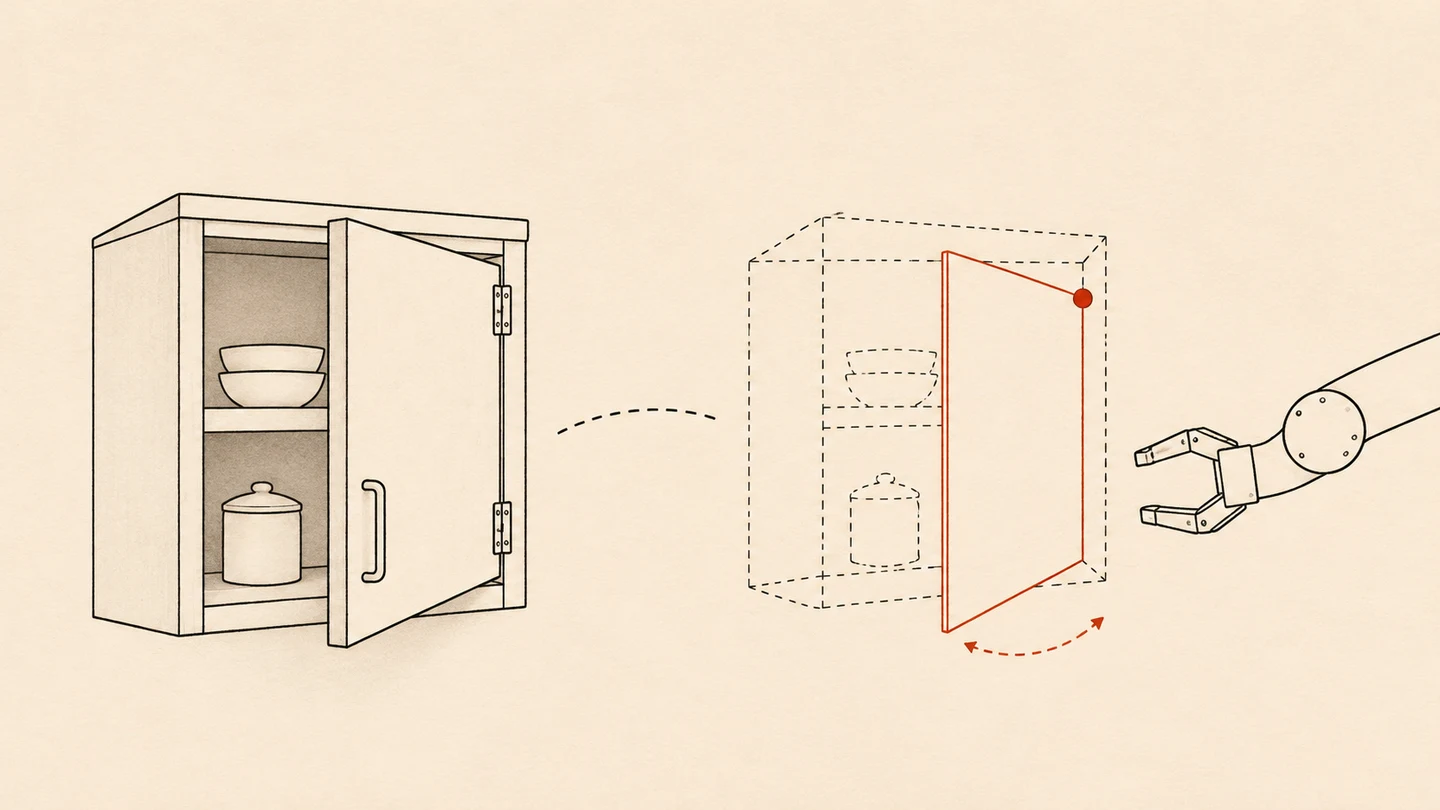
A photograph of a cupboard can reveal its color and contours without showing where the hinge pivots, when the door collides with the counter or how much force it needs to move. NeoWorld-10K starts with that gap. Its first public dataset has 1,324 object instances. The 10,000 in its name refers to the full collection described by its authors, not the number available in version 0.1. The examples include household objects with parts that can rotate or slide, not merely models to place in the background.
A scene that can be revised
The accompanying NeoWorld-3 work breaks a room into editable objects and each object into parts. A model can propose the cabinet and its hinge; numerical fitting then compares candidate widths and placements against the views. The exporter checks geometry, joint movement and placement. These steps make different failures visible. A drawer that looks correct when closed can still cross a side panel when opened. An asset with editable joints and geometry can be corrected without throwing out the whole scene. The dataset includes source programs and URDF descriptions, a format used to represent parts and joints.
Geometry is evidence, not a physical measurement
Across nine held-out RoboCasa365 scenes, the team reported a mean object-center error of 15.6 cm, versus 42.5 cm for VIGA. A separate repair comparison improved the share of surface area belonging to closed meshes from 77.9% to 100%, while the visual score remained unchanged. These are author-reported comparisons on defined samples, not general guarantees. They show why a visual score alone can miss a repair useful to a simulator. Neither a fully closed mesh nor an apparently correct hinge measures surface friction or internal weight distribution.
In a separate hardware exercise, programs developed with simulation succeeded on 21 of 40 trials over four tabletop tasks. The authors used separate real-robot layouts for program refinement and occasional operator hints before evaluation. This was not untouched transfer from a synthetic catalog to arbitrary hardware. For labs, a reasonable next test is to compare the same task and layout with a visual-only asset and an articulated one under several physical assumptions, then verify breakpoints on a real object. A library can make that experiment easier; it cannot replace it.
Sources
AI Q&A
Are all 10,000 objects publicly available?
No. Version 0.1 lists 1,324 public instances; 10,000 describes the full project collection.
Does a closed mesh prove physical accuracy?
No. Closure is a geometry check, not a measurement of mass, friction or stiffness.
Does 21 of 40 represent a general robot success rate?
No. The denominator is four tabletop tasks with ten held-out layouts each under the authors’ procedure.
Information only. No investment, legal, tax, or financial advice.