Ming-Image and the work that starts after an AI design is approved
Ming-Image’s new design weights make the difference between a convincing draft and a reusable production asset easier to test.
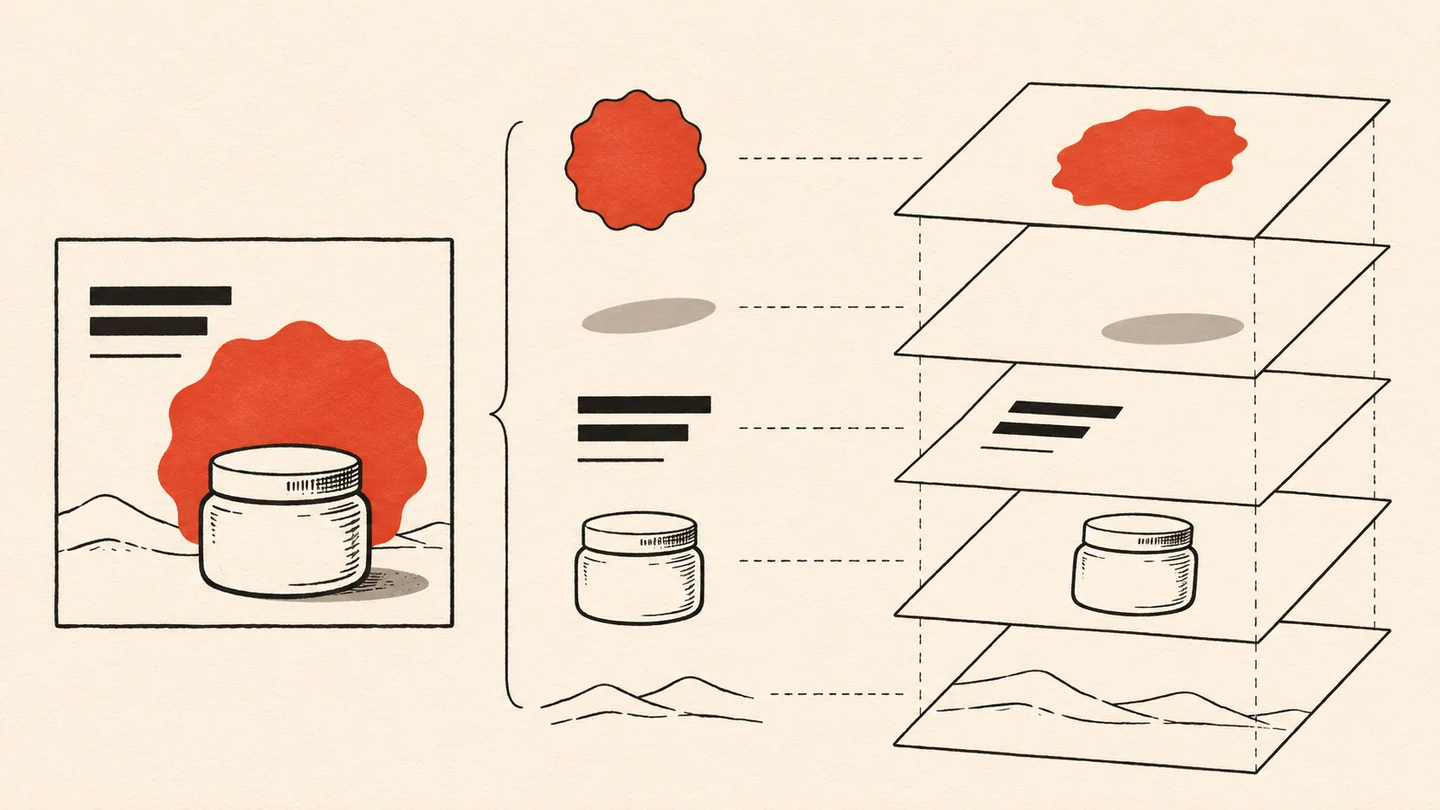
An AI-generated poster can get through a creative review and still cause problems the next morning. The campaign price changes, legal adds a line, and the merchant needs the same composition in three aspect ratios. The value of the first image then depends on which parts can be changed without rebuilding the rest. This is why the Ming-Image release is interesting to design teams: it gives them a way to evaluate the work that follows the first render.
Two jobs, two documented artifacts
InclusionAI made the Ming-Image-0.2-Design weights public in late November 2026. Its model card lists a 6-billion-parameter diffusion transformer and an MIT license. The card recommends a default 2048-by-2048 canvas and describes a validated CUDA configuration with 80 GiB of VRAM. That is a documented test configuration, not a universal minimum. The published examples also describe other aspect ratios and faster 1024-pixel square generation. These choices make resolution part of the workflow cost, rather than a proxy for editability.
The separately published Ming-Image-0.1-Design-Layer takes a flat image and a written layer plan and returns RGBA layers. Each layer is a raster image with an alpha channel that represents transparency. It is a reconstruction from the visible pixels. The original type objects, vector paths, masks and component metadata are not contained in a flattened composite. A font that looks right in an image may still have to be re-created as text if the team needs an editable file. The updated release materials describe finer decomposition elsewhere in the workflow; they do not establish that the 0.2 text-to-image checkpoint directly exports a native design document.
Test a revision while holding the original constant
Consider a multilingual coffee launch. A useful decomposition might separate the product, its shadow, the background, a round badge and two text boxes. If the badge crosses the product edge, removing it asks the system to reconstruct a region it never saw. Most pixels could look right while the product boundary acquires a halo or a different silhouette. A logo deserves the same treatment: an approved vector file is evidence of the intended mark, while a generated raster layer is an interpretation. Retain an approved source asset and use the reconstruction only where its limitations are acceptable.
A practical evaluation starts with one already approved example and two realistic changes. Replace the price without shifting the product position, then set a longer translation without affecting the spacing or hiding the legal line. Compare the untouched regions against the approved original. Composite the extracted edge over both dark and light backgrounds. Finally ask a colleague to open the deliverable and make the next revision without the generator. Record time spent on retouching and handoff as well as generation latency. A raster layer can be perfectly usable for moving a silhouette; a price that updates every week benefits from ordinary editable type.
There is also an editorial difference between an image benchmark and a handoff test. A preference score compares finished pictures under a defined protocol. It does not say whether a team can preserve a valid SKU, conform to brand rules, or finish a six-language update in an afternoon. A small set of representative edit tasks, repeated at the same output size and with the same review standard, can test that production question directly. Teams should also separate the model license from the permissions attached to logos, product photos and fonts in their input. The release is an opportunity to move parts of an image into a conventional workflow; its value is clearest when the next round of edits can be independently checked.
Sources
AI Q&A
Does the new image generator itself export a layered design file?
The 0.2 checkpoint is documented for image generation. The separately released layer model reconstructs transparent raster layers; those are not native text or vector objects.
What makes text in a poster genuinely reusable?
Keep critical copy as native type or supply a verified text layer separately. A legible word in a rendered picture is still made of pixels.
What is the highest-signal benchmark for a small team?
Change a price and a longer translation on an approved design, then measure time and inspect the unchanged product and brand regions.
Information only. No investment, legal, tax, or financial advice.