MicroVision and on-sensor computing: where integration work moves
On-sensor computing changes the work of integrating and maintaining a machine, beyond reducing its hardware count.
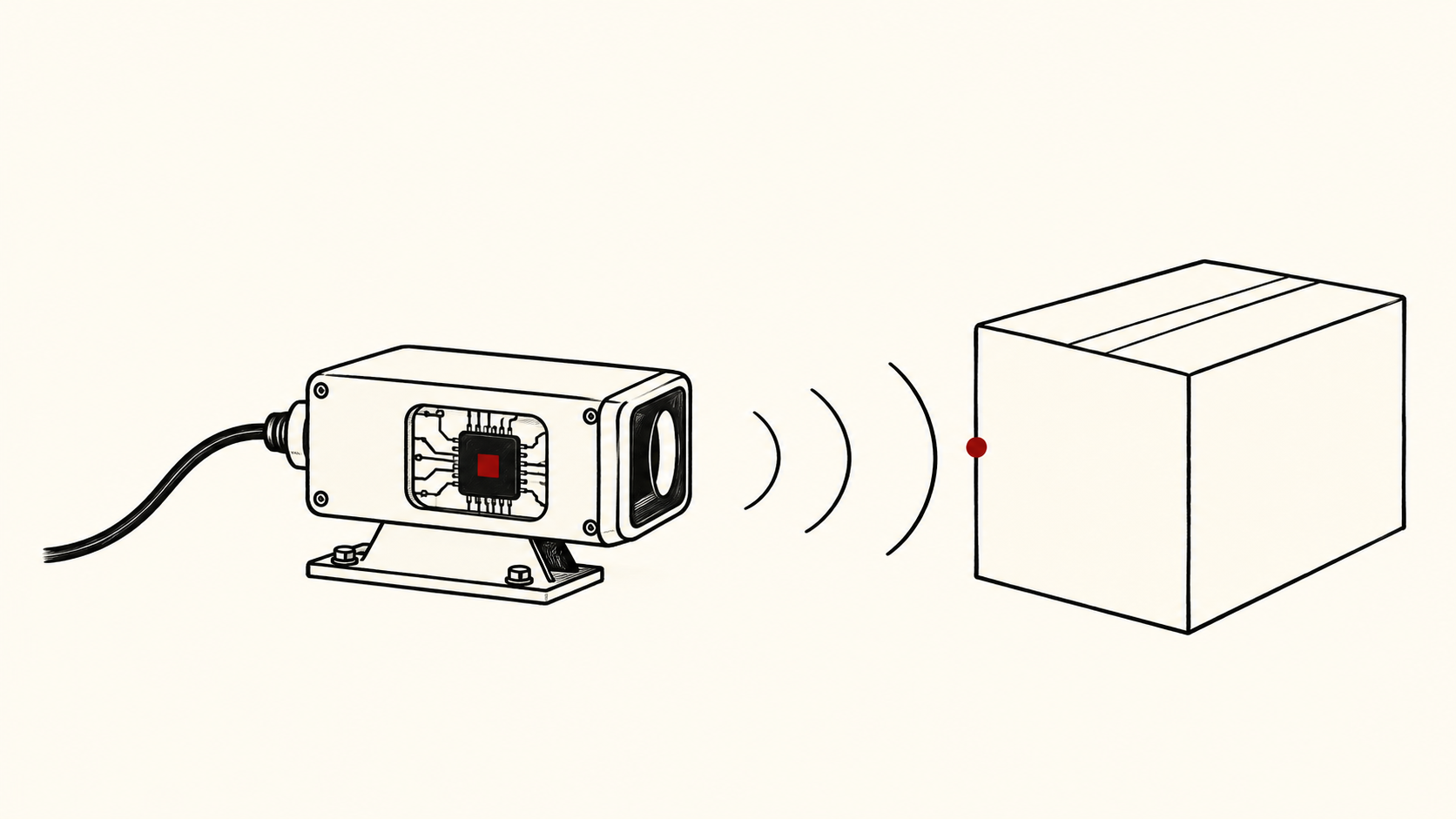
MicroVision announced commercial production of MOVIA Pro on October 22, 2026. The sensor supports onboard perception and a Linux-based framework for customer applications. Company announcement
For an equipment manufacturer, putting computation inside a sensor changes more than the parts list. It changes what the manufacturer buys, which assumptions the rest of the machine must accept, and where engineers look when performance deteriorates. The following is Open Market Notes' analysis of that architectural choice, not an assessment of a customer deployment. The useful question is how much integration work disappears and how much moves into the device's software lifecycle.
Choosing the level of information
Consider a hypothetical warehouse vehicle. Its designer could send spatial measurements to a central computer, where software interprets the scene. Alternatively, some interpretation could happen near the measurement source, leaving the central controller to consume a smaller set of outputs. The second arrangement may reduce data movement and host processing. It also gives the receiving system less freedom if information needed for a later task has already been discarded.
Suppose the first application only counts pallets entering a marked area. A later application needs to distinguish a briefly obscured pallet from one that has left. A count alone cannot explain which interpretation produced a change. The designer may need object histories or selected raw observations. This example illustrates an interface decision, not an asserted feature or limitation of MOVIA Pro. Processing locally is most valuable when the resulting abstraction preserves what the downstream task needs.
That makes the output contract important. A receiving controller needs to understand what a reported object represents, when it was observed and whether the result remains valid. A number without those meanings may be easy to transport but hard to use. More detailed output can preserve options, although it also increases processing, storage or communication work. There is no universally optimal amount of information to remove.
Nor should an object detection be confused with an instruction to move or stop. The machine still needs a design that relates observations to its operating conditions and control decisions. A production announcement for a component does not establish the safety of a complete installation. Keeping that distinction visible helps a buyer evaluate the integration rather than treating a convenient device boundary as the boundary of system responsibility.
Capacity has to survive the whole shift
The product page lists a 10 Hz frame rate and power consumption below 9 W. These are vendor specifications, not a measurement of a customer's complete workload. In particular, sensor sampling frequency does not by itself specify how quickly a downstream controller receives a usable interpretation after application processing and communication.
A sensible comparison therefore follows a result from observation to use under the intended workload. It should include sustained operation, not only a short demonstration. If additional applications share finite resources, a new function can compete with an existing one even when each works in isolation. The relevant questions concern workload combinations, response-time variability and the behavior when a processing deadline is missed. None of this establishes that this product has such a problem.
Temperature belongs in that comparison. The Linux kernel documentation describes temperature thresholds and mechanisms for throttling devices. That is general background, not evidence that MOVIA Pro uses any particular thermal policy. For an integrator, it motivates testing the same application under relevant enclosure and ambient conditions. A workload that fits during a brief bench test may leave insufficient operating margin elsewhere. Conversely, a deliberately modest application may fit comfortably, making local processing an entirely reasonable choice.
This is why spare capacity has economic value. It gives a later software change somewhere to run without forcing a hardware redesign. Yet unused capacity also costs money and power. The buyer has to decide which future changes are plausible enough to justify that margin, rather than assuming every application can be added indefinitely.
An installed fleet becomes a software population
Once behavior can change through software, physically identical devices need not behave identically. Imagine replacing one failed sensor with a spare that has an older application. The connector may fit and messages may arrive, while the interpretation differs. Identifying the installed hardware is then only part of maintenance; the operating software and its configuration also matter.
A fleet rollout should consequently be planned around a compatible set of components. Updating a sensor application, the receiving controller and their shared data definitions in unrelated steps can create a period in which both ends run successfully but disagree about the message. This is a general integration risk, not a reported incident or a claim about the vendor's update tooling. A rollback plan likewise needs to consider whether the earlier version can still read the configuration or data left by the newer one.
There is a countervailing benefit. When a useful change fits the installed platform, software can avoid replacing physical equipment. Whether that benefit materializes depends on testing effort, maintenance windows and the support life of the relevant software. Describing a framework as open does not settle those questions, or by itself establish open-source licensing for every component.
The comparison extends beyond a smaller box
A central computer can pool processing across several inputs and provide one place to update shared logic. Distributed processing can avoid some of that central load and put a tailored function close to its input. Which arrangement is cheaper depends on the installation. Counting removed boxes without counting added application testing, field support and downtime would bias the comparison; assuming centralization is always simpler would make the opposite mistake.
MOVIA Pro's announcement is therefore a useful occasion to ask for a concrete integration demonstration: the intended application running for a representative period, a compatible software update, and recovery to a known working configuration. These are proposed evaluation questions, not results already demonstrated here. The commercial value of on-sensor computation will be clearer when buyers can compare the cost of keeping a complete machine working over time, rather than just the cost of acquiring one component.
Information only. No investment, legal, tax, or financial advice.