Message threads make recovery boundaries more important
Faster conversation transport still leaves applications responsible for explaining interrupted work.
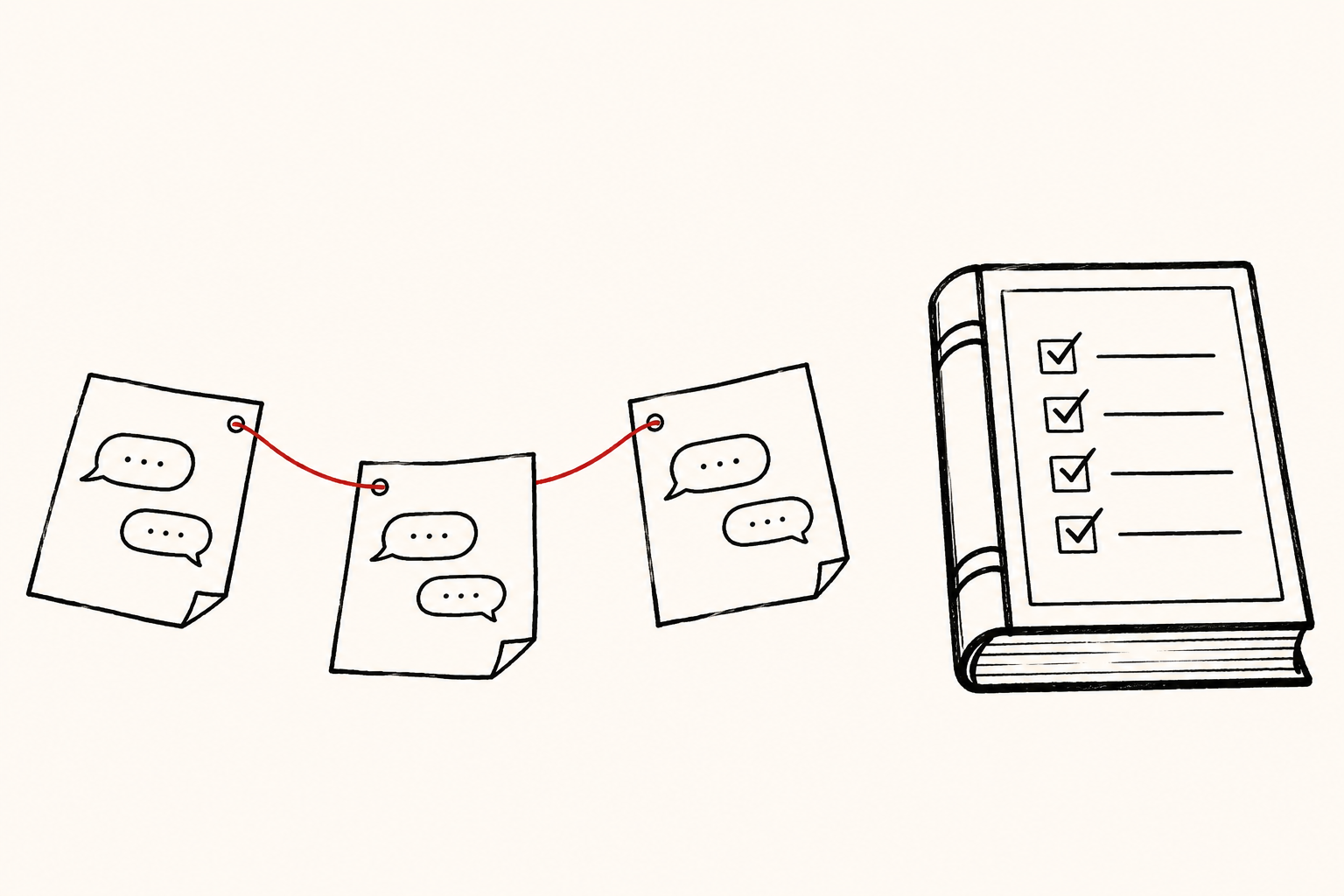
On November 2, 2026, Anthropic announced message threads in public beta: later requests upload only new messages, while full-context token usage remains unchanged. Announcement
A practical question helps locate the significance. During an agent’s work, which information merely helps the next turn start sooner, and which information must still explain progress after an interruption? Both can describe the same work while requiring different storage decisions. Our argument is that easier transport optimization makes an application’s recovery boundary more important. The scenario below is hypothetical analysis, not a customer case or a product benchmark.
One conversation contains several kinds of waiting
Imagine an agent helping an editor organize research. It reads documents, compares data, waits for approval of a passage, and sends the approved version to a publishing system. The early calls may follow one another closely. Later work may pause for lunch, permissions or another assignment. To the editor it is one task; to the application these are different operating rhythms.
Designing everything around rapid consecutive calls can make a demonstration smooth while leaving more to reconstruct when a person returns. Conversely, building a heavyweight archival procedure into every turn can burden simple research. A sensible design chooses costs by task phase rather than giving all state the same lifetime.
Claude’s documentation says threads expire five minutes after their last request; applications must retain conversations for replay. The feature is not eligible for zero data retention. Documentation
For the hypothetical editor, time away should not determine whether the draft still has an intelligible status. An application can use conversational continuity while retaining confirmed findings, unresolved questions and the current task stage in its own recoverable record. The form depends on the workflow. Every word in a chat window need not become business state.
Resuming reading and resuming action need different evidence
Suppose the agent submitted the draft, but the publishing service’s response did not reach the client. Reading the source material again restores material for reasoning. Submitting again might create another public page. Both steps could appear as “continue” in a chat interface, despite very different consequences.
AWS’s idempotent-API guidance uses caller-supplied request identifiers to express a single operation’s intent. AWS Stripe supplies a concrete implementation: its API v1 returns a saved response for the same idempotency key and checks parameter consistency. Stripe
Applied to our editorial example, a separate publication record could hold the approved version, destination column, submission identifier and the service’s actual result. Recovery would first seek the status of that submission, rather than infer it from conversational statements about preparing or completing publication. This is a design proposal, not a claim that every platform supports the same confirmation or retry mechanism.
New facts may also arrive before work resumes. The editor may change the title, column rules may change, or the authorized publication window may pass. An old conversation helps explain a prior decision; it does not automatically establish that the decision is still applicable. An application should separately check what was known then and what is permitted now, particularly before affecting an external system.
That adds engineering work, but reduces an unhelpful ambiguity. When something goes wrong, the first discussion need not be about whether the model remembers. The team can inspect a particular version, request and outcome. Conversation records provide context; action records help establish changes already made. They are related through the task rather than treated as substitutes.
Measure the waiting that people experience
Lighter message transport may improve consecutive interactions. Whether it improves a complete business task still requires application-level measurement. The editor cares about receiving a usable draft, knowing when intervention is necessary and avoiding repeated explanations after a pause. An earlier first token is related to those outcomes, not equivalent to them.
For this transport change, a useful measurement splits a turn into request upload, waiting for the first token and completing the response. Keep the model, task and output requirements unchanged, then vary history size and the pause between turns. If only the first segment improves, that is still useful, but it supports a narrower claim than improved reasoning or a faster completed task. Record replay cases separately instead of letting a favorable continuous-session average hide their cost.
A useful experiment would run the same materials continuously, with a long human approval pause, and with a process restart. Keep the objective and acceptance criteria fixed. Compare completion time, repeated human explanations and whether external outcomes can be reconciled. No implementation is assumed to win. The experiment exposes how costs move between different kinds of waiting.
Testing only continuous execution can overstate how widely an optimization helps. Testing only the worst recovery path can hide valuable everyday improvements. Report ordinary and recovery paths separately, then interpret them using the frequency of real tasks. A supplier’s latency improvement should not simply be relabeled as team productivity growth.
Design retention around the task
Owning recovery does not mean retaining every input forever. Research material, internal comments and unpublished drafts may have different sensitivity. Start with what is necessary to resume the task, then specify who can read it, when it is deleted and how access is revoked. Make those rules enforceable in the application’s records. Task needs, rather than storage convenience, should explain retention.
Deployment teams must also check compatibility with their contracts and data-handling requirements. The zero-data-retention restriction above is a concrete product boundary. This article draws no legal compliance conclusion and does not equate temporary in-memory processing with every privacy assurance an enterprise may require.
Message threads offer a timely view of AI applications optimizing the connections between successive interactions. Buyers and builders should also ask which commitments remain supported by evidence when that connection breaks. A faster request is immediately perceptible. An explainable recovery process has to prove itself when work is disrupted. Both belong in product acceptance, assessed with different evidence.
Information only. No investment, legal, tax, or financial advice.