After compressing a local model, track which work starts failing
An unchanged test score can hide new errors; a compressed model needs a bounded account of which work it can take over.
NVIDIA’s October 28, 2026 local-AI update said quantized versions of Nemotron 3.5 Transcribe were forthcoming. That was an availability promise, not evidence of their deployed accuracy. NVIDIA announcement
For a team already using a model, a smaller downloadable checkpoint creates a specific decision: which previously accepted work can move to it? Open Market Notes’ analysis focuses on that transfer. A capacity improvement can make an application possible on a laptop, but an existing acceptance decision belongs to the configuration that was actually tested. The new package needs evidence connecting it to the old operating scope.
Count changed outcomes, not just the final score
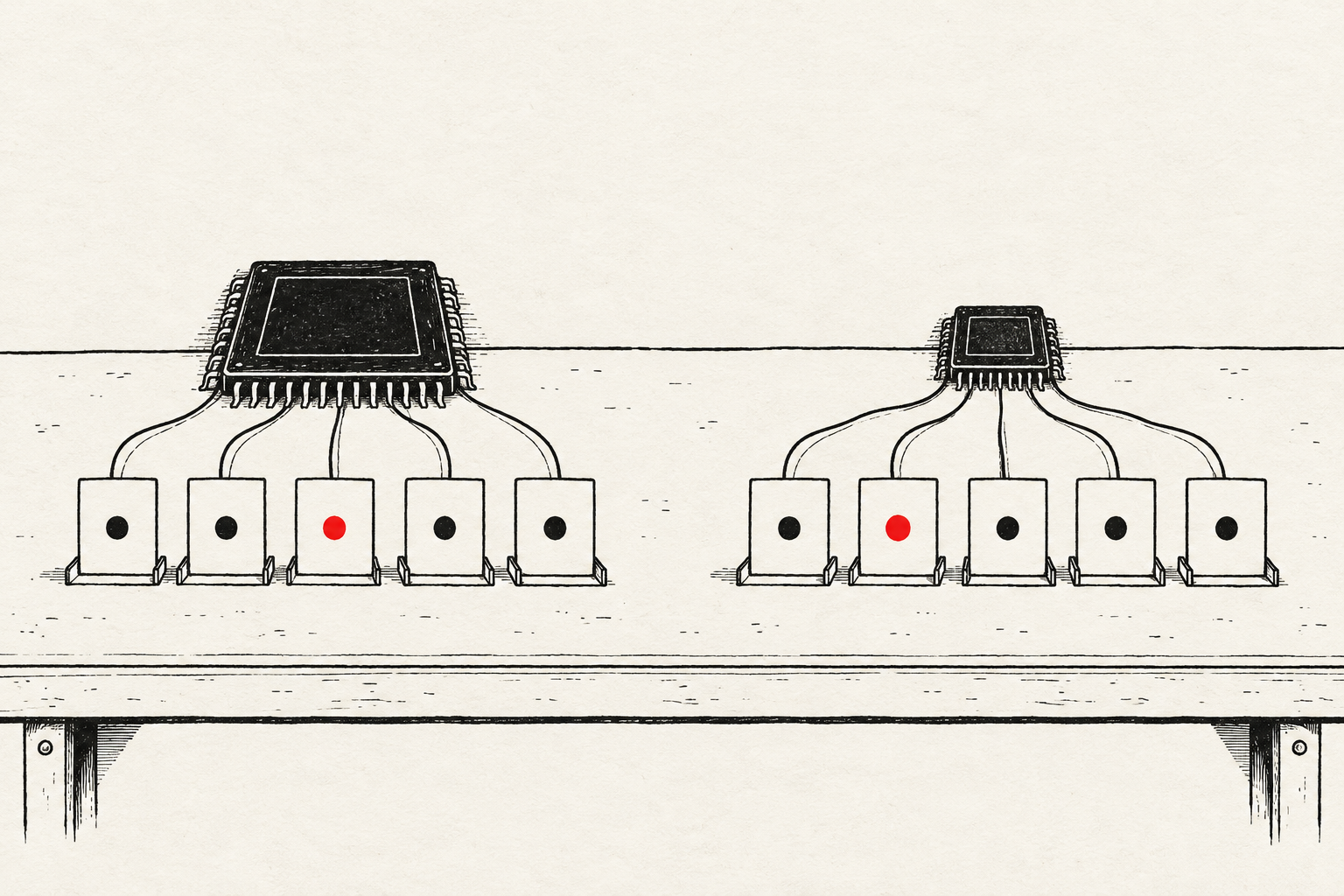
Imagine a hypothetical internal assistant that drafts maintenance tickets from staff requests. Both the existing and compressed configurations pass ninety of one hundred test cases. That result looks reassuring until the team compares individual cases. Some formerly incorrect tickets may now be correct, while an equal number of previously correct tickets acquire errors. The unchanged total conceals a different set of people and workflows bearing the mistakes.
The useful comparison therefore retains four groups: cases both versions handle correctly, cases both mishandle, corrections introduced by the new version, and new regressions. The groups answer different questions. Persistent failures concern the application’s existing limits; new regressions concern the migration. Improvements are valuable, but they do not automatically compensate for a newly wrong destination, quantity or instruction to act.
This is not an argument for demanding identical prose. Rewording can preserve the work’s meaning. A ticket that changes punctuation is different from one that changes “inspect before restarting” into “restart.” Acceptance should attach to the consequential fields and actions rather than resemblance to a preferred answer. Otherwise a test may penalize harmless variation while accepting fluent operational mistakes.
The comparator also needs a boundary
NVIDIA’s NVFP4 QAD report studies recovering quantized-model accuracy using a higher-precision teacher. Its results concern the tested models and settings, rather than every downstream deployment. Technical report
A deployment comparison should record the exact two configurations, including checkpoint, runtime, prompt and decoding settings. If several components change together, a useful combined system test is still possible, but attributing every difference to compression becomes unwarranted. Teams can separate the practical question, “May this package replace the current one?”, from the research question, “Which component caused the change?” The first requires adequate acceptance evidence even when the second remains unresolved.
The original system is also not a truth oracle. If both versions produce the same wrong ticket, agreement provides no reassurance. A subset of outputs needs an independently checked expected result. Where the source request is ambiguous, the expected outcome might be a clarification request rather than a completed ticket. That distinction prevents a faster, more assertive answer from receiving credit simply because it looks complete.
Use disagreements to narrow the release
A separate study of long-context quantization found effects varied with model, method and task. Its findings cannot supply an error estimate for the new Transcribe package. Research paper
For our hypothetical assistant, the team could first permit the compressed version to draft short, single-request tickets while keeping multi-step instructions on the current route. This would be a scope decision based on observed cases, not a claim that short requests are always safe. An unusual short request can contain the most consequential instruction in the entire queue.
The restriction must be enforceable by the application. If staff cannot reliably identify which requests fall within the approved slice, a narrow approval on paper will not produce a narrow deployment. A practical pilot can retain a reviewer before any ticket is sent, log disagreements, and test whether the routing rule itself works. It should include both ordinary traffic and deliberately chosen cases that cross the proposed boundary.
Reviewers should distinguish a model error from a failed parser, missing input or an incorrect reference answer. A new runtime might truncate an input that the old system received in full. Calling that a reasoning regression could lead the team to change the wrong component. Equally, blaming the wrapper without evidence could hide a genuine model weakness. The paired record should preserve enough input and output context to investigate the difference, subject to the organisation’s data-handling rules.
The record need not grow without limit. Its purpose is to explain a particular error, not to retain every employee’s information indefinitely. Fields retained, access rights and deletion should follow existing policy. Creating a larger personal-data copy merely to validate a new version introduces a separate problem.
Benefits and failures arrive on different clocks
Research across instruction-tuned models also reports differences among task categories. It is useful context, not a certification of a particular local installation. Independent study
A faster pilot produces more observations per working day, which can improve testing. But the most visible benefit may arrive immediately while a rare regression appears only after the application encounters a less common request. A release decision should state what was tested and what remains lightly sampled. “No failure observed” and “failure ruled out” are different claims, especially for actions that are difficult to reverse.
Rollback also needs a work-level meaning. Reinstalling the previous checkpoint does not repair tickets already issued. The pilot should make it possible to identify affected outputs and route them for correction without replaying completed actions. This is particularly important if the assistant retries after an interruption: faster recovery should not create duplicate work orders.
There is a legitimate competing case for moving quickly. A compressed system may let a team serve users who previously had no viable local option. Waiting for exhaustive evidence could preserve a poor status quo. The reasonable response is to compare the new option with that real alternative, limit initial authority, and disclose the uncertainty. It is not necessary to claim complete equivalence to extract useful value.
NVIDIA’s announcement makes this an immediate deployment question, while leaving the forthcoming quantized package’s eventual behavior to be tested. The useful release record is a bounded account of which work transferred successfully, which errors moved, and how affected work will be corrected. That gives a smaller model a defensible role without treating its file size as an acceptance result.
Information only. No investment, legal, tax, or financial advice.