LFM3’s longer context raises a question about relationships, not just recall
A useful long-context test asks whether an assistant can connect separated evidence, not simply find a familiar sentence.
On October 27, 2026, Liquid AI introduced LFM3. Its text architecture combines convolutions, local attention and global attention, with a stated 256K-token context window. Liquid AI announcement.
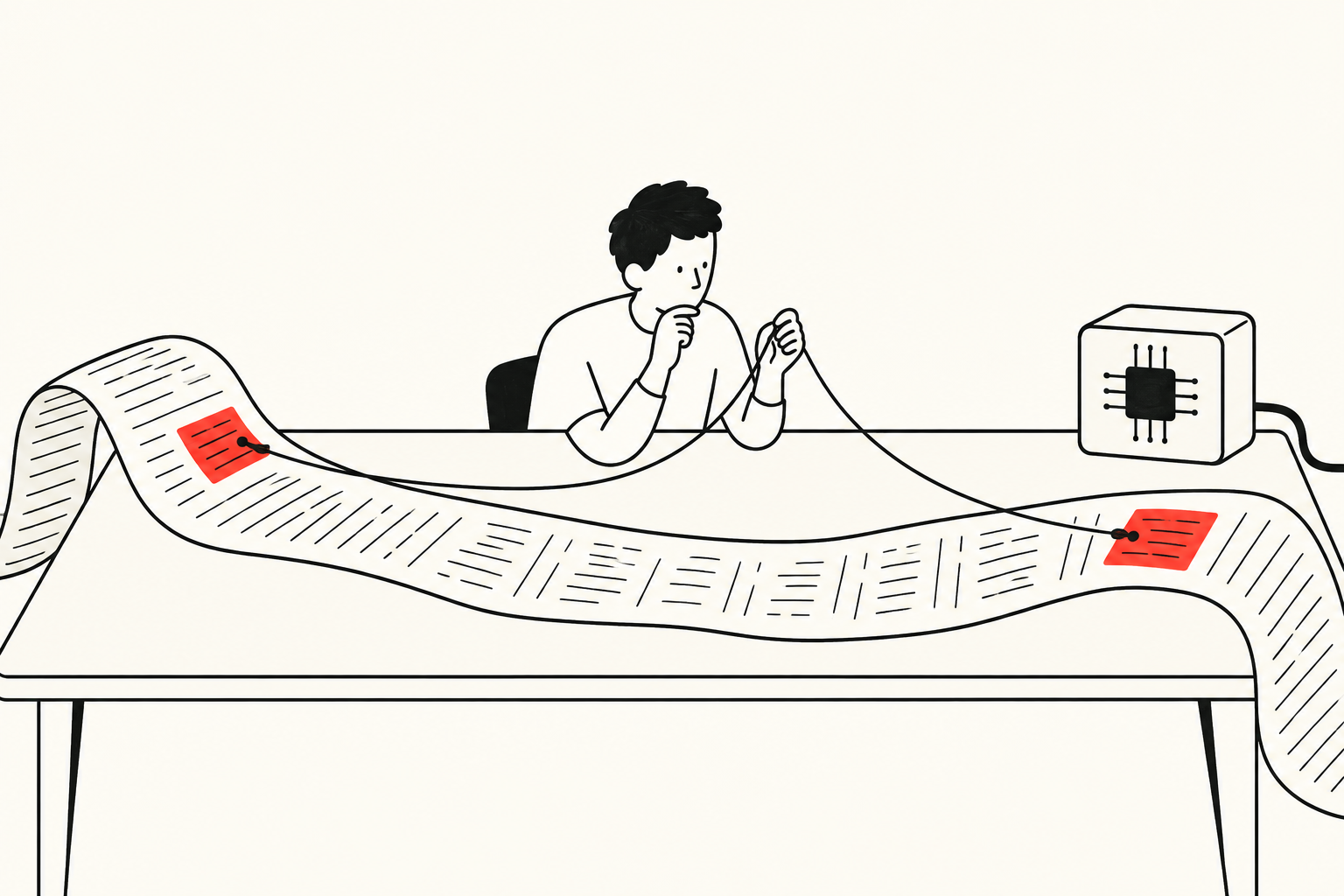
The interesting question for an application team is what it would do with that space. Keeping more material in a request can reduce the need to decide in advance which pages deserve to survive retrieval. But it also changes the work expected of the assistant: instead of answering from a short selection, it may have to reconcile a long record whose parts disagree. Our analysis is that acceptance should focus on those relationships, rather than treating the longest successful prompt as the product’s useful capacity.
Finding a fact is the beginning of the task
Consider a hypothetical service desk reviewing a shipment dispute. The original order specifies a delivery address. A later message changes it, and another message says that the change applies only to the second shipment. Each sentence is easy to quote in isolation. The useful answer must connect the amendment to the right shipment and leave the first address intact. An assistant can retrieve all three passages and still give the wrong operational instruction.
This example suggests a more revealing test than hiding one identifier inside a large document. Keep the underlying case fixed, move the amendment farther from the original instruction, and insert plausible but irrelevant correspondence between them. The correct decision should remain the same. If it changes, the team has found a dependence on presentation that deserves investigation, even if every quoted passage is authentic.
The 2024 RULER paper broadened long-context evaluation beyond simple retrieval to tasks including tracing and aggregation. It predates LFM3 and is not evidence of this model’s performance. Original paper, first submitted April 9, 2024.
For the hypothetical service desk, tracing means retaining which revision modifies which instruction. Aggregation might mean checking whether several partial shipments satisfy one order. These are different failure opportunities. Combining them into a single pass rate would make it harder to determine whether the assistant needs better retrieval, clearer document structure or a narrower role in the workflow.
Preserve meaning while changing the presentation
A well-designed test can distinguish irrelevant changes from meaningful ones. Moving a paragraph without changing its date or scope should not alter the answer. Changing the scope from the second shipment to both shipments should. An evaluation set needs both kinds of variation; otherwise a system that stubbornly repeats its first answer could appear reassuringly consistent.
The 2023 Lost in the Middle study found that evidence position affected performance in its evaluated models and tasks. That historical finding does not diagnose LFM3. Original paper, first submitted July 6, 2023.
Our proposed application test goes beyond asking whether material near the middle can be found. It asks whether a decision remains tied to the same facts after their arrangement changes. Place the controlling amendment at the beginning, middle and end; then place it near a similar but unrelated amendment. Record not only the answer but the passages used to connect the parties, objects and effective dates. A correct answer with the wrong chain of evidence is fragile: it may be lucky rather than repeatable.
There is an important limit to this approach. Real document order sometimes carries meaning. A sequence of observations may establish what was known before a decision, while a transcript’s turns determine who answered whom. Randomly shuffling such material can destroy the task instead of testing it. The evaluator must specify which transformations preserve meaning and which require a new expected answer. That specification is substantive domain work, not an automatic property of a larger context window.
The application owns the boundary
Architecture is relevant to how a model handles information, but a product team should not infer a particular business error from the name of an architectural component. Nor should it assume that a mixture of local and global operations guarantees correct reconciliation. The practical evidence comes from the model, runtime and document workflow used together. A test of one deployment configuration is not automatically a result for every quantization, prompt format or later model revision.
Suppose the service desk introduces a summary of earlier correspondence to shorten the record. The summary becomes another component to evaluate. If it omits the limitation to the second shipment, a downstream model may faithfully follow an incomplete account. Testing only the final assistant would misattribute the failure. Keeping the original material and the intermediate summary allows the team to identify where the controlling relationship disappeared.
The same reasoning applies when a long-context assistant is paired with search. Search can reduce distraction and make evidence easier to inspect, but it also chooses what the assistant will not see. A useful comparison would give the long-context route and the retrieval route the same underlying cases, then count resolved cases, missed amendments and cases appropriately held for review. The choice need not be universal: a short, well-indexed case may favor retrieval, while a disputed record may justify broader inspection.
A reasonable objection is that this testing is expensive and that many applications need only rough classification. That objection should change the scope, not erase it. For reversible sorting, modest evidence may be enough. For an instruction that changes a shipment, the cost of a missed exception is different. The acceptance boundary should follow what the assistant is allowed to do, rather than the maximum number of tokens it can accept.
LFM3’s launch makes this a timely product question, not a settled verdict on the model. We have not independently benchmarked it. The useful next result would be a clearly bounded claim: in a specified workflow, with particular documents and meaningful variations, the assistant preserves the relationships needed for an answer—or knows when those relationships remain unresolved. That is a more actionable definition of useful context than capacity alone.
Information only. No investment, legal, tax, or financial advice.