After Lazarus, the model release is the security boundary
The bigger question is who can change an agent’s model, who approves its release, and what the agent can do afterward.
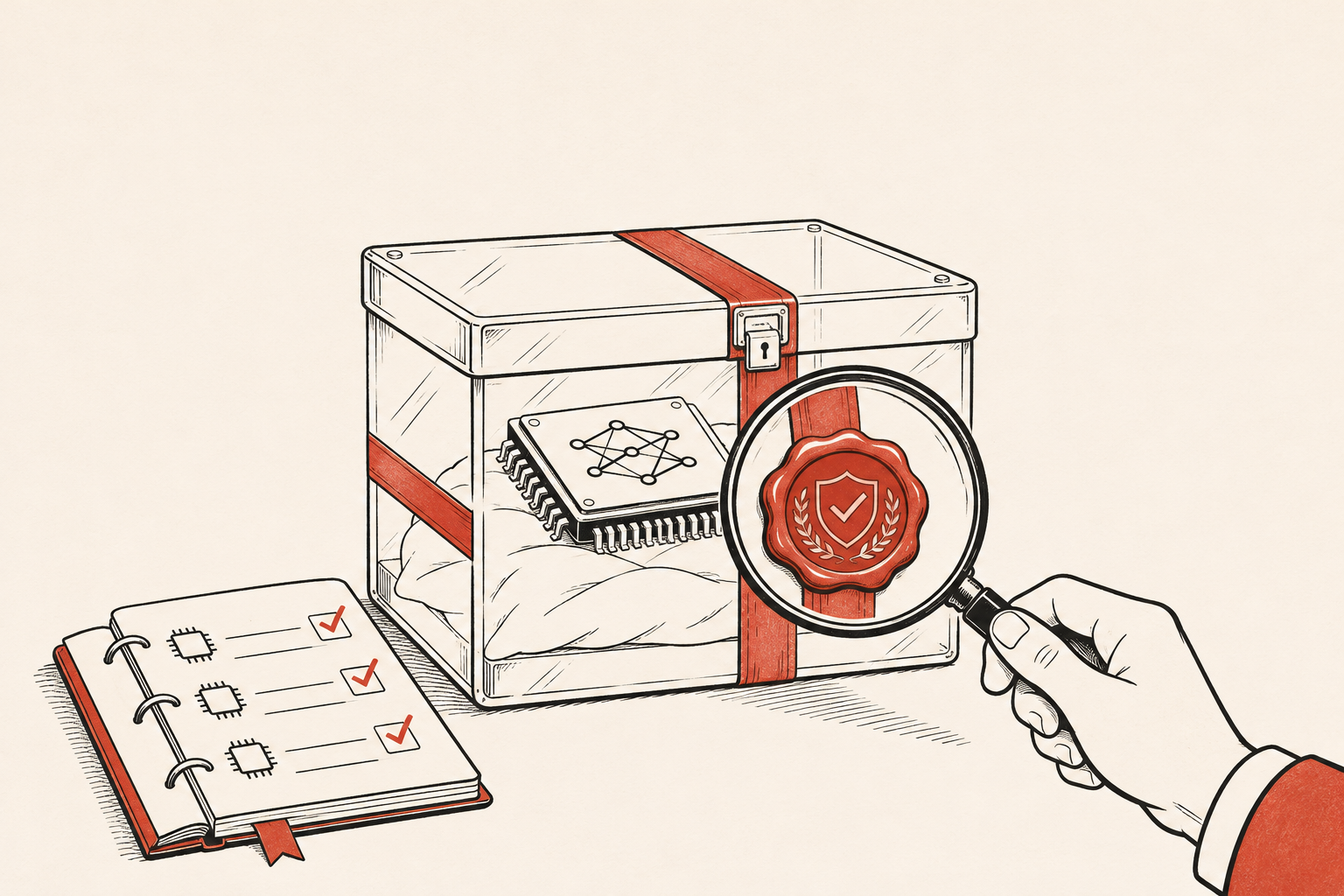
Microsoft’s November 10, 2026 Lazarus research demonstrates a trigger-activated backdoor through a small number of weight edits. Its security notice reports no observed weaponization. This is research, not evidence of a live campaign.
The important business question is not whether every enterprise model contains a hidden threat. It is whether an organization can establish which model actually performed a consequential action. An assistant’s name, benchmark ranking and procurement contract do not answer that question. A deployed agent is a particular release, running with particular permissions, inside a changing operating environment.
Our argument is that model integrity belongs in release governance. Treating it as a specialist research concern leaves a gap between the people who select a model and the people accountable for what it does.
Three questions, three different kinds of evidence
A model evaluation asks what a system did on a specified set of tasks. Artifact verification asks whether the deployed object matches an approved object. Authorization asks whether a particular action is permitted. None of these answers can substitute for the others.
Consider a hypothetical purchasing assistant that passes every invoice-processing test. Those results justify confidence about the tested workflow. They do not identify the file loaded tomorrow, establish who approved a replacement, or authorize an unusual payment. A company that uses one green evaluation badge to settle all three questions has compressed distinct decisions into a misleading signal.
This distinction also prevents a common overreaction. Evaluation remains useful; it simply needs an explicit scope. A strong report identifies the tested release and configuration, rather than letting a product name imply perpetual approval. When the deployed object changes, someone must decide which evidence remains valid.
Provenance should end in a decision
SLSA’s provenance specification describes verifiable information tracing an artifact’s origin. Sigstore supplies signing and verification tools. These are useful reference points, not claims that either standard alone certifies model behavior.
For a model operator, our proposed minimum release record would link an exact artifact identifier to its supplier, approved transformations, evaluation results, release owner and rollback target. An adapter or conversion should not disappear from that record merely because the marketing name stays unchanged. The organization needs to reconstruct the deployed combination, not just identify its most famous component.
There is also a difference between possessing evidence and enforcing it. If the registry stores approval records but production can load arbitrary replacements, the records are an archive, not a control. A release gate should make the approved identity operationally binding. Emergency exceptions need a named owner, a time limit and a subsequent review, rather than an undocumented bypass that quietly becomes normal practice.
A signature can establish an identity relationship; it cannot settle whether that identity made a good decision. A perfectly attributable release can still be unsuitable for a particular job. Procurement should therefore ask separately about artifact identity, the supplier’s change process and the customer’s own acceptance criteria.
Permissions determine the price of a mistake
NIST’s zero-trust architecture rejects implicit trust based only on location or ownership. Applied here as an analytical analogy, an internally hosted model should not automatically inherit broad authority simply because it runs inside the company.
Imagine two deployments of the same assistant. One drafts a proposed database update for review. The other can alter production records and export customer data using long-lived credentials. Even if their model-level uncertainty were identical, their possible losses would be very different. The relevant risk unit is the model-and-permission combination.
This suggests a practical order of investment: first map consequential capabilities, then decide what evidence each capability requires. Read-only retrieval, reversible edits and irreversible external commitments should not receive the same release requirements. High-impact operations need boundaries enforced outside the model, with authorization that the model cannot grant itself.
This is not an argument for placing a human click in front of every action. Excessive approval queues can encourage rubber-stamping and unofficial workarounds. The more useful design separates routine, bounded operations from exceptions, and makes the exception small enough for a reviewer to understand.
The overlooked cost is handling exceptions
Security purchases often center on detection accuracy. An operating budget also has to cover investigation, quarantined releases, delayed deployments and recovery. A scanner that produces an alert without enough context may simply move work from the research team into an already busy release queue.
Buyers should ask who investigates an alert, what evidence they receive, how a legitimate change is cleared, and how quickly production can return to a known release. Those questions expose whether a control can survive ordinary business pressure. They also favor tools that connect model records to deployment history and action logs, rather than adding an isolated dashboard.
The market implication is a hypothesis, not a revenue forecast: as agents gain authority, demonstrable release control could become a purchasing criterion alongside capability and price. Suppliers able to explain every shipped variant may have an advantage over suppliers offering only a broad assurance that their models are safe.
A useful management test
Before expanding an agent’s authority, ask the team to select one consequential action from last week and identify the exact model release, permissions, approval evidence and recovery path associated with it. If the answer depends on a shared model nickname or someone’s memory, the gap is concrete enough to fix.
Lazarus should not be turned into a claim that all models are compromised, or that a single scan can settle trust. The more durable lesson is organizational: separate evidence about capability, evidence about identity and permission to act. Then give each one an owner. An enterprise does not need certainty about every possible hidden behavior to stop treating an untraceable model update as an ordinary configuration change.
Information only. No investment, legal, tax, or financial advice.