A petabyte of SSDs can sit closer to a GPU. Will search get cheaper?
The Kioxia–NVIDIA prototype expands the data GPUs can address, but a database search must still justify each flash read.
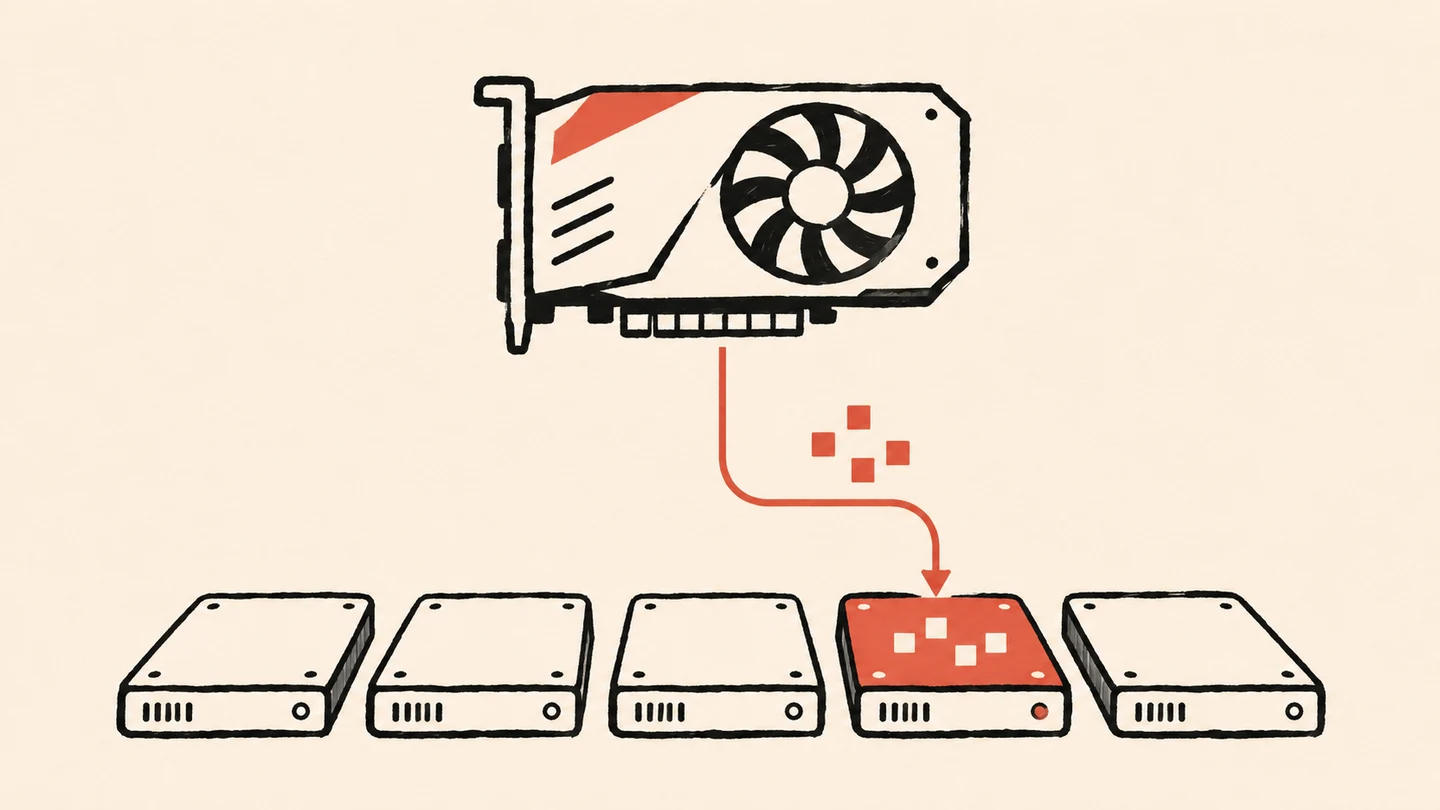
In the proof of concept Kioxia described on November 26, 2026, 144 existing XD8 SSDs of 7.68 TB each were connected to a GB200 NVL72 system with 18 server nodes. That yields about 1.106 PB of nominal flash capacity. Kioxia sees room to process two trillion vectors of 512 bytes each. Storing those raw vectors alone would take about 1.024 PB, before any allowance for index structures, identifiers, redundancy or operational space. The figures describe potential scale, not a measured production database or new physical HBM.
The important change is who can ask for a read
NVIDIA’s SCADA lets a GPU initiate fine-grained requests against compatible storage. In a conventional arrangement the CPU may plan and dispatch the reads; the accelerator waits for batches. Moving some of that control closer to the GPU can be useful when the next record depends on a calculation already running there. It does not change flash into memory with HBM latency or bandwidth. Request scheduling, transfers and caching still matter.
Consider a search that narrows a large collection to a few hundred candidates. A small hot index could remain in fast memory, while the SSD supplies selected vectors for a second pass. If the initial filtering is weak, the GPU may issue thousands of random reads and spend much of the query waiting. A larger cold corpus helps only where indexed access keeps the work per query under control. Neither company reported a query latency, recall or cost result for the prototype.
How to compare two deployments
Use the same corpus, update cadence and query distribution. Measure how many of the relevant targets each system returns, then match that recall before comparing the 95th-percentile latency and completed queries per second. Report hot and cold starts separately. Include the accelerator, SSDs, hosts and networking in cost per completed query, and test what happens when a drive is unavailable. This exposes whether improved capacity has reduced spend or merely moved the bottleneck.
Kioxia separately reported more than 18 million random reads per second at a 512-byte block size in a GP2 device test. It targets evaluation samples for select customers by the end of 2027. GP2 was not the drive used in the rack demonstration. Neither a device rate nor a sampling target establishes an application improvement or a purchase commitment. The next consequential evidence would be a named workload tested against a baseline with the same recall and service target.
An engineering team can also look at read amplification. At equal recall, record the number of SSD operations and bytes transferred for each completed query. A 512-byte logical request does not automatically translate into 512 bytes of work across the whole stack. If average transfer volume falls but the slowest queries still depend on several serial reads, gains in aggregate throughput may not improve the latency customers experience.
Sources
AI Q&A
Does the prototype add 1.1 PB of HBM?
No. The number is the combined nominal XD8 SSD capacity.
What should a database operator compare?
Tail latency, throughput and system cost at the same recall, with both warm and cold queries.
Were the 18 million reads measured in the joint rack?
No. They come from Kioxia’s separate GP2 device test; the rack used XD8.
Information only. No investment, legal, tax, or financial advice.