Innoviz: the financing calendar behind a sensor roadmap
Liquidity, engineering income and diversification need to be read together before judging a sensor supplier’s resilience.
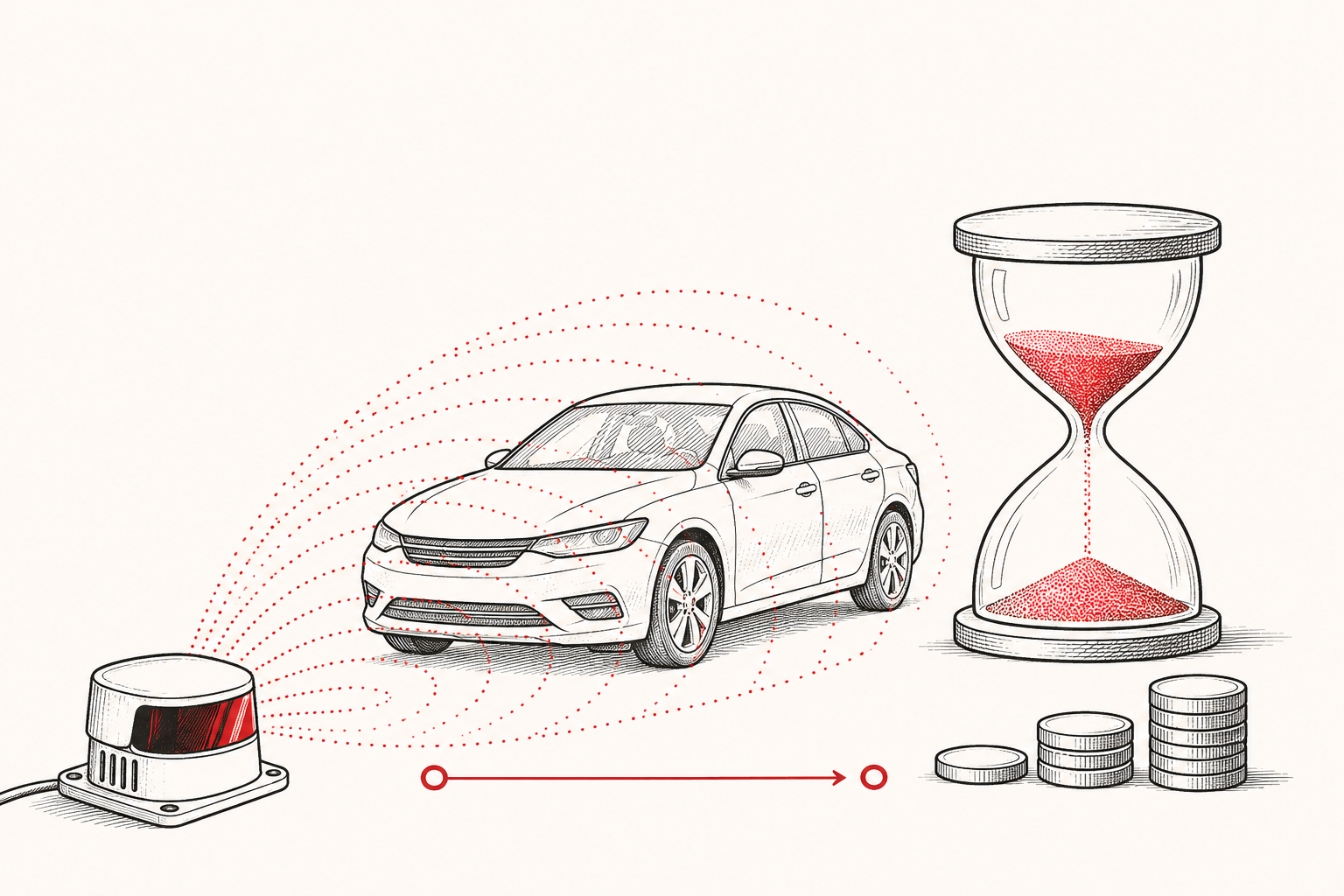
Innoviz's November 11, 2026 release reported $54.4 million of September-end liquidity and targeted $17.5 million in annualized savings. The latter is a plan, not cash already saved. Quarterly release.
The important analytical question is how a sensor supplier finances the interval between engineering work and repeat shipments. A promising product can coexist with a difficult payment calendar. Reducing that interval, or financing it more reliably, may matter as much as winning another program. The following is OMN's business analysis, not a forecast of the company's financing needs or a recommendation on its shares.
A balance is not a runway
The August 5 release put June-end liquidity at $48.5 million, excluding approximately $30 million of gross proceeds from an offering closed in July. Earlier release. Comparing two quarter-end balances without that financing bridge would therefore obscure rather than explain operating performance.
Nor should the difference between liquidity plus financing and the next balance automatically be labeled operating cash burn. Gross proceeds are not net proceeds; restricted funds, investment movements, working capital and other transactions can affect the comparison. A defensible runway estimate needs the cash-flow statement, payment commitments and accessible funds, followed by explicit assumptions about future collections. Dividing a balance by one quarter's accounting loss is not a substitute.
For a supplier awaiting customer milestones, timing risk can be more consequential than the annual revenue total. A payment received after payroll is due is not economically equivalent to the same payment arriving beforehand. A useful stress test moves receipts later without assuming that expenses conveniently move with them. That is a scenario, not an assertion that Innoviz customers will delay payment.
The mix matters before the margin
Innoviz's 2025 annual report attributed improved gross margin partly to engineering-services sales and a machinery sale. Annual report. That history is a reason to inspect the composition of profitability, not evidence that the current product business has any particular margin.
Engineering revenue can help finance development while doing little to establish the economics of repeat hardware shipments. Conversely, an early shipment may carry unusually high unit costs before a process stabilizes. Both can distort a simple quarterly comparison. An analyst should ask whether a better margin came from pricing, production yield, product mix or the timing of a service milestone. These explanations imply different prospects for repetition.
Consider a hypothetical supplier that completes a profitable customization project while shipping very few sensors. Its aggregate margin improves, but its capacity to support a larger production run remains untested. Another supplier might report a weak launch quarter because it bears setup costs before deliveries accelerate. Treating these cases as the same turnaround would discard the very information needed to understand them.
The company's first-quarter operating review separately identified engineering services and sensor sales as drivers of revenue changes. Operating review. Keeping that distinction visible is more useful than collapsing everything into a single growth narrative.
Diversification creates an allocation decision
For automotive suppliers exploring other markets, reusing an established platform has an attractive logic: more customers can help spread development expense. But diversification only improves resilience if the new business does not require disproportionate customization, inventory or support. A higher selling price alone cannot answer that question.
The practical test is incremental contribution after the costs necessary to serve the additional customer. Does the same product really suffice? Who performs integration? When is acceptance completed, and when does payment become collectible? These are questions to investigate, not claims about Innoviz's undisclosed contracts. The favorable interpretation is that common technology supports several demand cycles. The competing interpretation is that a leaner team inherits more kinds of work before any one market reaches sustainable scale.
Cost reduction sharpens this trade-off. Savings can extend decision time, but cutting the wrong engineering or service capability can delay acceptance and collections. Annualized savings also describe a future run rate, not the amount available immediately. The quality of a restructuring is better judged by the relationship between lower recurring expenditure and maintained delivery capacity than by its announced headline alone.
What would make the next update more informative
A useful follow-up would connect unrestricted liquidity, financing, customer receipts and operating payments; distinguish service milestones from repeat product deliveries; and explain whether new markets share an economical delivery model. A company need not disclose every contract to provide those bridges.
The optimistic case requires several things to work together: spending becomes more predictable, collections arrive as planned, and additional customers reuse rather than multiply the cost base. The cautious case is not that the technology has failed, but that commercial schedules may take longer than financial resources comfortably allow. The present disclosures cannot settle that tension. They do show why a financing calendar and a product roadmap should be read together, without mistaking either for a guaranteed outcome.
Information only. No investment, legal, tax, or financial advice.