IBM’s Nighthawk roadmap: the distance between a bigger machine and a useful answer
A larger quantum processor is a milestone. Economic advantage still needs a credible baseline, verifiable results and full-system accounting.
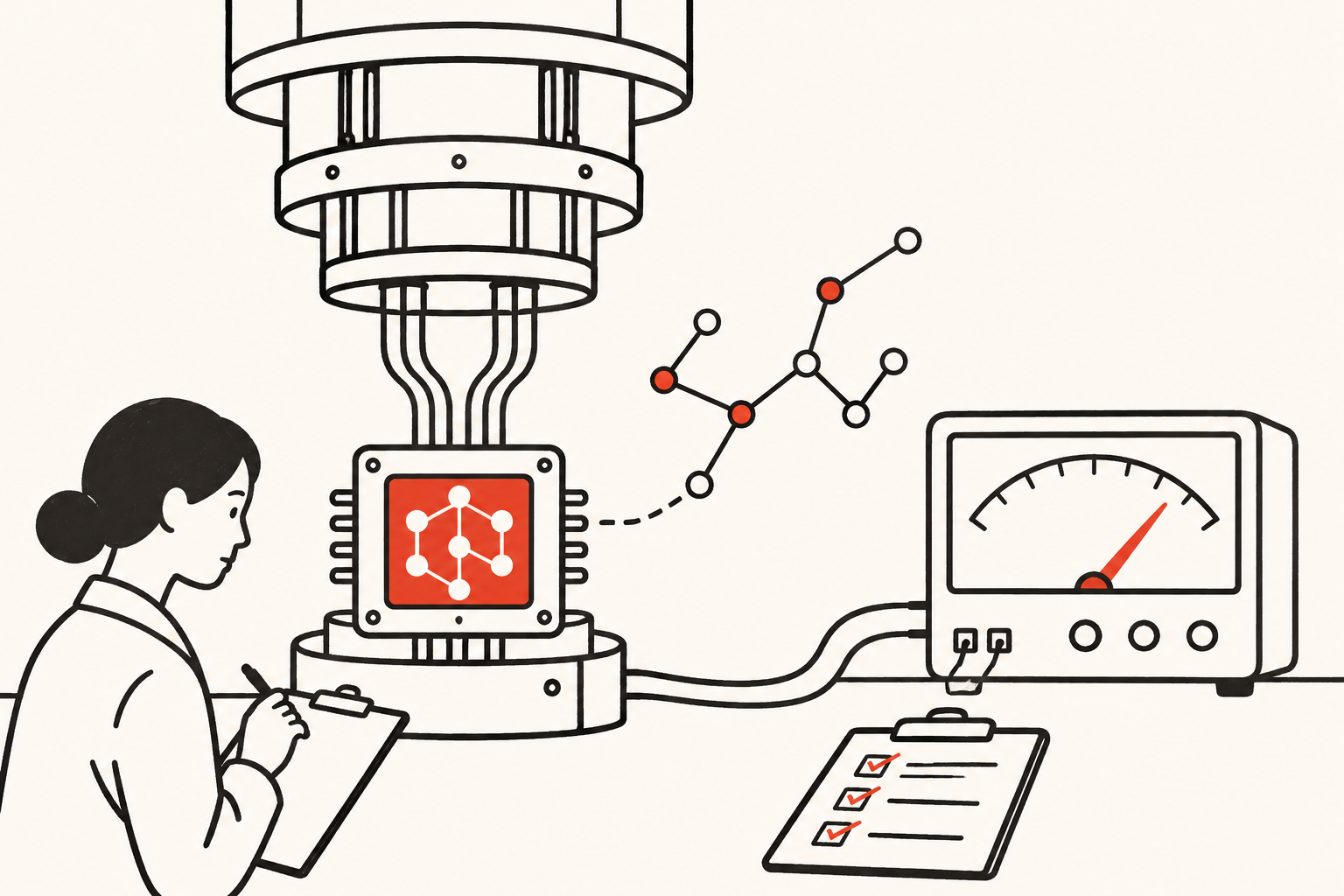
IBM’s November 11, 2026 announcement puts Nighthawk r3 at a planned 520 programmable qubits and 10,000 operations, with a two-processor, 1,040-qubit system planned for 2027. Those are targets, not delivered capacity. IBM announcement
The useful investor question is therefore not whether a larger number looks impressive. It is which uncertainty the announcement removes, and which uncertainties a customer must still finance. Our assessment separates engineering progress, scientific evidence and commercial usefulness. These are connected milestones, but they cannot be substituted for one another.
A roadmap is a sequence of tests
A hardware plan makes a project more measurable when it specifies what can be checked next. It does not establish that a practical workload will run reliably, or that a customer will prefer its answer to a cheaper alternative. A sensible evaluation attaches an acceptance test to each stage: usable access, repeatable quality, workload completion and ultimately a business decision improved by the result.
This also changes how to interpret a delay. Missing a chip specification and failing to deliver a worthwhile application are different problems. Conversely, meeting the specification cannot automatically close the application question. Investors should resist treating a product calendar as a revenue forecast without an explicit bridge between them.
Ask what the comparison actually compares
A faster quantum machine can be valuable even before it beats the best classical alternative. It lets researchers iterate sooner and test more ideas within a budget. But an improvement against an earlier quantum device answers a narrower question than superiority over classical computing.
For a procurement decision, we would require a named problem, an accuracy threshold and the strongest practical classical method available to the buyer. Both sides should receive a comparable optimization effort. An impressive ratio becomes much less informative if it silently changes the problem, excludes preparation work or compares against an outdated baseline. This is an evaluation standard, not an allegation that any particular benchmark has done so.
Scientific advantage must remain open to challenge
On July 30, 2026, IBM described three research collaborations claiming quantum advantage with validation frameworks. That is the researchers’ claim, not an independent certification by this publication. IBM research account
The Observable Estimations tracker distinguishes active, superseded and baseline entries, and asks for error bars. Tracker That structure suggests a useful reading habit: treat advantage as a claim with conditions and a date. A new classical method can change a comparison without making the original experimental work worthless. Publishing a challengeable result is more informative than announcing an unqualified victory.
For an end user, there is another step. A computation that is difficult to reproduce classically need not answer a valuable operational question. Ask what decision changes, how the answer is checked and how much improvement matters. Technical difficulty and customer willingness to pay are separate axes.
Quality has a resource bill
IBM’s learning material distinguishes discarding error-flagged runs from actively correcting errors. Error-correction lesson Its documentation also describes mitigation through multiple noisy executions and extrapolation. Noise-management documentation
Our implication is straightforward: count the resources needed for the accepted answer, not merely the resources used by the most attractive individual run. A buying team should ask for failed or rejected runs, calibration, statistical confidence and the sensitivity of the result to processing choices. This does not make mitigation a flaw. It makes overhead part of the product, just as data cleaning belongs in the cost of a conventional analytics project.
The system matters more than the chip photograph
AMD’s November 5, 2026 account describes a joint IBM–Oak Ridge platform colocating quantum hardware and the Umbra classical system. AMD announcement
For financial analysis, this encourages a whole-workflow view. Include orchestration, classical computation, staff time and the ability to reproduce a result on another day. Faster access to one component may not shorten the overall project if another component remains the bottleneck. Equally, better integration can create value even without a headline hardware leap.
The commercial questions are consequently specific: who pays, what recurring work is purchased, what service level is promised and what alternative would otherwise be used? Research participation and a production purchase should not be counted as interchangeable evidence of demand.
What would change our assessment
We would give more weight to independently repeatable, application-relevant comparisons with transparent costs than to another isolated scale record. Particularly useful evidence would include a stable accuracy target, current classical baselines, disclosed end-to-end runtime and repeated customer use after the trial budget ends.
Nighthawk’s roadmap is worth following as a set of testable commitments. It is not, by itself, proof that useful quantum computing has arrived across industries. The disciplined position is neither to dismiss the engineering nor to capitalize every promised capability as existing earnings. Follow the chain from specification to trusted answer to paid outcome, and keep each link visible.
Analysis as of November 12, 2026. This article does not independently reproduce the cited experiments or estimate quantum revenue.
Information only. No investment, legal, tax, or financial advice.