After a server repair, which security evidence still applies?
A replacement component changes the question behind a security check. We examine how to reconnect evidence with a return-to-service decision.
On October 29, 2026, NVIDIA described its infrastructure-security work with Eclypsium, including firmware assessment and monitoring. That vendor account provides the occasion for this analysis, not independent certification of any installation. NVIDIA announcement
A practical question follows for an operator: after a repair, what does the evidence collected before that repair still establish? A server can retain its asset number while a component, its settings, or the party responsible for maintaining it changes. An old approval remains a useful historical record. Whether it should authorize the next workload is a separate operational decision.
This article proposes a way to reason about that decision. It does not describe a disclosed NVIDIA or Eclypsium customer procedure, report a vulnerability, or claim that a particular product implements the workflow below.
The claim behind a green status
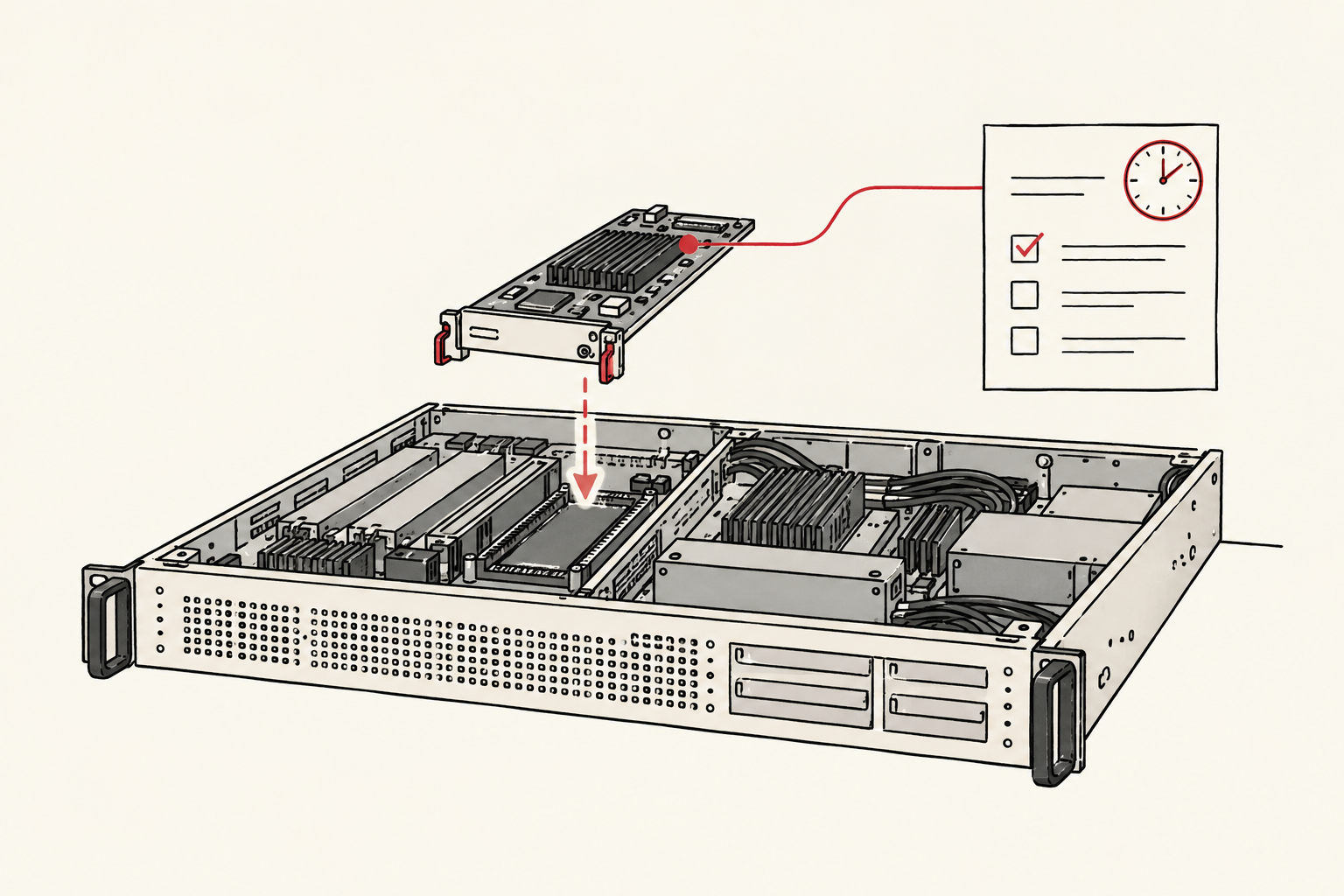
Consider a hypothetical server whose network adapter is replaced after a routine failure. The maintenance ticket closes, the inventory records the new serial number, and a connectivity test succeeds. Those observations answer worthwhile questions about the repair. An operator still needs to identify which security claims the previous approval covered, and whether the replacement changed their supporting conditions.
Suppose a sensitive workload was admitted partly because a specified configuration limited which management systems could reach the server. The useful comparison is between that approved boundary and the boundary after repair. Merely retaining the machine's name in an inventory does not settle the comparison. Conversely, a changed component does not by itself establish a security failure. It establishes a reason to revisit the claims that depend on it.
A useful maintenance record would therefore connect three things: the changed component, the claims affected by that change, and the evidence needed to reconsider those claims. This connection is more actionable than a single undifferentiated label saying that the whole server is trusted.
Two clocks, and a decision owner
The IETF's January 2023 informational RFC 9334 treats evidence freshness as involving both device state and the currency of appraisal policy. It supplies architecture, not a universal validity period. RFC 9334, section 10
Our operational proposal is to put two questions on the repair handover. When was the relevant state checked? Which acceptance rule was used? A recent check against an approval rule that the organization has since withdrawn should not quietly become a new permission to run sensitive work. Equally, a new rule should not make an earlier maintenance record disappear; the record explains what was accepted at the time.
For the hypothetical adapter replacement, the handover could name the replacement, the relevant configuration comparison, the acceptance-rule version and the person or service authorized to release the machine. Recording a successful measurement and recording a release decision serve different purposes. The former supports an assessment; the latter identifies who accepted the remaining uncertainty for a particular use.
Inventory, attestation and deployment approval should consequently remain distinguishable in the operator's records. Knowing what is installed, evaluating selected evidence about it, and deciding what the complete service may do are related activities with different scopes. None of these labels alone tells a reader which workload boundary was actually reviewed.
Recheck the dependency, not the entire estate
There is a serious objection to adding another handover gate: repairs already consume scarce staff time, and idle capacity has an operating cost. Repeating every check across a large fleet after every small change could overwhelm reviewers without producing proportionate understanding.
That objection favors a narrower, explicit scope. For our example, start with the decisions that depended on the replaced adapter. Ask whether the replacement affects the approved management path, configuration baseline or responsibility for updates. Other evidence may remain usable where its assumptions are demonstrably unchanged. This is a proposed change-impact exercise, not a claim that every adapter requires an identical test set.
The hard case is incomplete dependency knowledge. A team may know that a part changed without knowing which approvals relied on it. That uncertainty belongs in the release decision. Pretending that nothing relevant changed hides it; automatically treating every unrelated machine as suspect can be equally unhelpful. The appropriate response depends on the proposed workload and the consequences of being wrong.
Missing evidence is an operating choice
Imagine that a repair is mechanically complete, but the evidence required for its intended sensitive workload cannot yet be evaluated. The operator could keep the server out of that workload, assign a genuinely lower-exposure use, or consider a narrowly bounded exception. These are alternatives for organizational judgment, not interchangeable security guarantees.
An exception should identify its permitted use, unresolved question, owner and ending condition. “Temporary” without an ending condition tends to transfer the decision to the next shift. If restricted use cannot actually be enforced, naming it in a ticket does not create the restriction. The release authority needs to understand that distinction before trading an evidence gap for additional capacity.
There is also a planning implication. Spare capacity and repair contracts are usually discussed as ways to recover service. In the framework proposed here, recovery planning should include the time and responsibility needed to establish an acceptable basis for reuse. A short physical repair offers limited operational benefit if the team has no agreed route for deciding where the repaired machine can return.
Preserve what the check did not cover
The closing record should be intelligible to someone who was absent during the repair. It could retain the before-and-after identifiers, the reason for the change, the scope and time of the checks, the acceptance rule and any unresolved conditions. This is a suggested audit trail, not a compliance checklist or a claim of incident-free operation.
Crucially, a decision supported by selected platform evidence should not silently expand into approval of application behavior, data handling or every future operating condition. Those questions require their own evidence. A passed check has value precisely when its scope is legible.
For infrastructure buyers, a useful question for a supplier is therefore how a maintenance event changes the evidence available to the customer, and how that evidence can be connected to the customer's release process. No single expiry interval answers that question for every workload. The practical objective is a recoverable chain of reasoning: what changed, which permission depended on it, what was reconsidered, and what remains uncertain when service resumes.
Information only. No investment, legal, tax, or financial advice.