Google’s Wyoming site purchase is not delivered computing capacity
The acquisition changes project control; power contracts and construction still need to become usable computing infrastructure.
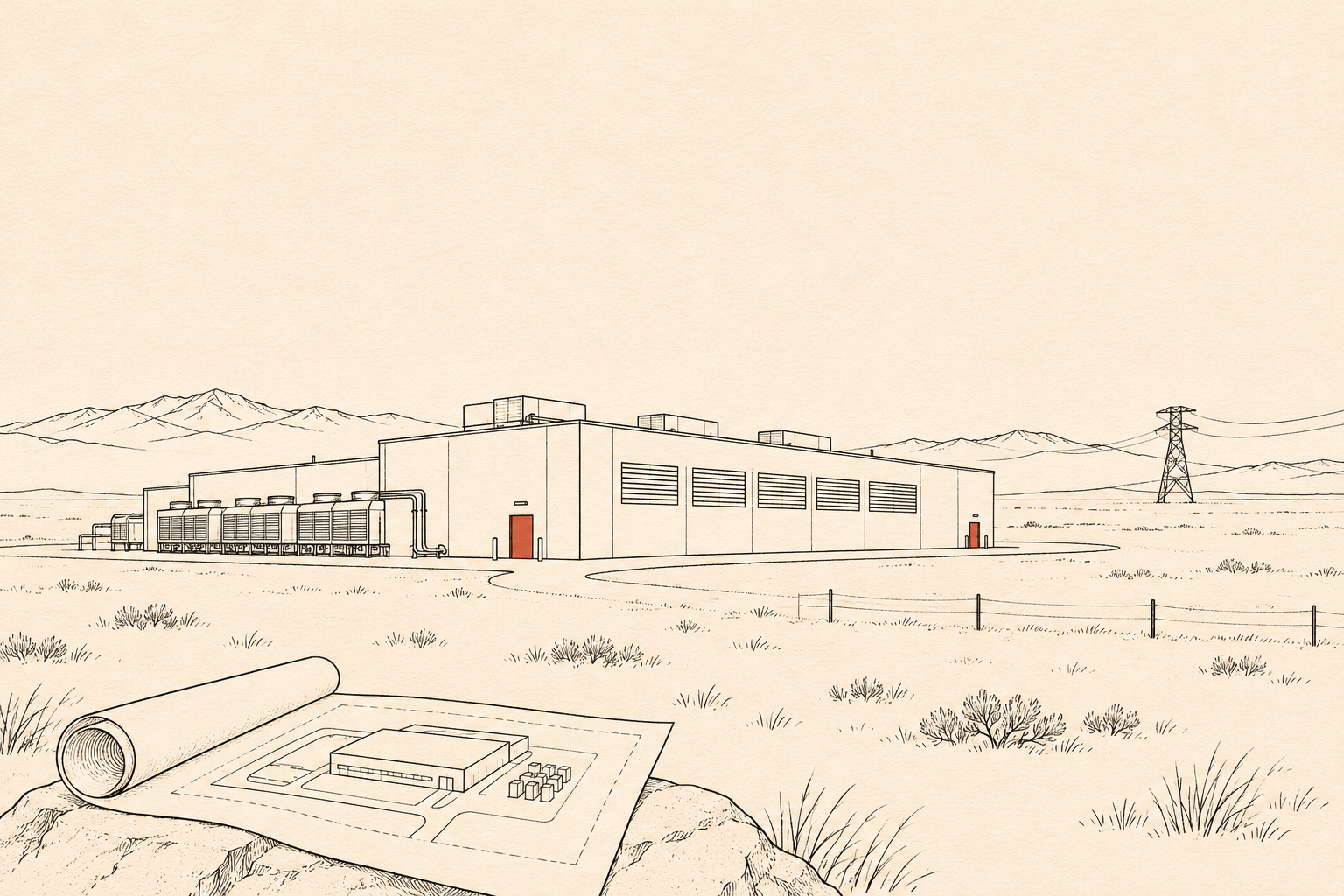
On November 6, 2026, Crusoe confirmed that Google acquired its southeast Wyoming data-center site, ending Crusoe’s pre-development involvement. This changes ownership boundaries; it is not an announcement of an operating campus. Crusoe announcement
The important question is not another addition to an AI investment total. Site ownership, organized electricity supply and usable computing capacity are different achievements. A property transfer can close while energy infrastructure remains under construction. Electricity can become available before servers and cooling systems are ready to serve customers. What follows is Open Market Notes analysis of the public evidence, not an account of undisclosed contract terms.
An investment plan is not a purchase price
Google announced a long-term $17 billion Wyoming investment on November 5. That commitment should not be read as the price paid to Crusoe for the site. Google announcement
This distinction matters economically. Treating a campus investment plan as a property valuation would misstate both the developer’s proceeds and the buyer’s immediate cash outlay. Future expenditure may cover phased construction, equipment and service arrangements. Announcements by different partners should not be added together mechanically without aligned accounting boundaries.
For a large cloud company, buying a site with development work behind it may save time otherwise spent on location selection and coordination. Acquisition changes who makes decisions; it does not remove physical constraints. Direct ownership can bring server deployment, construction and electricity schedules into one capital-allocation framework. It can also leave the buyer carrying more coordination work and delay consequences directly. Neither model is universally superior. The relevant question is whether decision-making power matches responsibility for risk.
Power capacity is not computing output
AEP’s October 14 announcement described a 702-megawatt fuel-cell project and a 20-year power-purchase agreement with Google. These are supply and contractual arrangements, not proof of delivered computing capacity. AEP announcement
Electricity is necessary for computing, but it is not the computing product. Identical power supplies can support different amounts of useful service depending on chips, cooling, redundancy and workloads. Converting megawatts into training output requires equipment configurations, deployment schedules, availability and utilization assumptions. An energy announcement alone cannot supply those answers.
Nameplate capacity must also be distinguished from continuously usable power. Reserves can improve reliability without creating additional everyday production capacity. Black Hills said on November 5 that the resource mix includes reserves and that the contracted peak load is confidential. Black Hills discussion
Consequently, adding partners’ capacity figures and labeling the sum immediately available IT load would be misleading. Milestones are more informative: what has passed acceptance testing, what can reliably deliver power, which buildings can operate, and whether those steps connect on the same schedule. A disclosure of scale without development stage remains evidence of a plan, not completed output.
Long contracts finance projects but require coordination
A power-purchase agreement can provide a longer revenue horizon for energy construction, reducing dependence on short-term electricity prices. It does not abolish risk; it allocates risk contractually. The supplier must deliver equipment on time. The customer needs computing demand to arrive on a compatible timetable. Both need arrangements for payments, remedies and replacement supply if the project slips.
The useful question is not which party appears to have more bargaining power. Nor should a long contract be treated as unconditional electricity availability throughout the year. Minimum payments, availability standards, remedies and expansion rights can produce very different economics from the same headline capacity. Without complete contracts, this analysis cannot determine the precise allocation of obligations or estimate project returns.
Consider a hypothetical mismatch: the power facility finishes before the computing halls. If payments begin while computing services produce no revenue, capital remains tied up. In the reverse case, servers arrive before electricity and may sit idle. Neither scenario is asserted to have happened here. They explain why timing, rather than total planned expenditure alone, is central to evaluating construction.
Progress needs delivery evidence
There are at least two reasonable interpretations of a site transfer. It may reflect specialization, with early development passed to a party better suited to long-term ownership. It may also reflect the complexity of execution and the value of more direct coordination. The confirmed transaction alone does not establish which explanation dominates, much less prove that one party failed or another has already succeeded.
The next useful evidence concerns the practical connection between construction, equipment, electricity and operation, using consistent definitions. Confirmation that a stage is complete should improve confidence in delivery. Repetition of distant capacity targets should not have the same effect.
Google’s acquisition is a concrete step, but the immediate change is organizational. Creating AI infrastructure supply still requires legal control, technical availability and commercial use to converge. Keeping those categories separate is more useful than reading an entire industry’s boom or bust from a single investment figure.
Information only. No investment, legal, tax, or financial advice.