Glimpse and the cost of looking again
A visual AI launch raises a practical question: when does another inspection improve the answer enough to justify its cost?
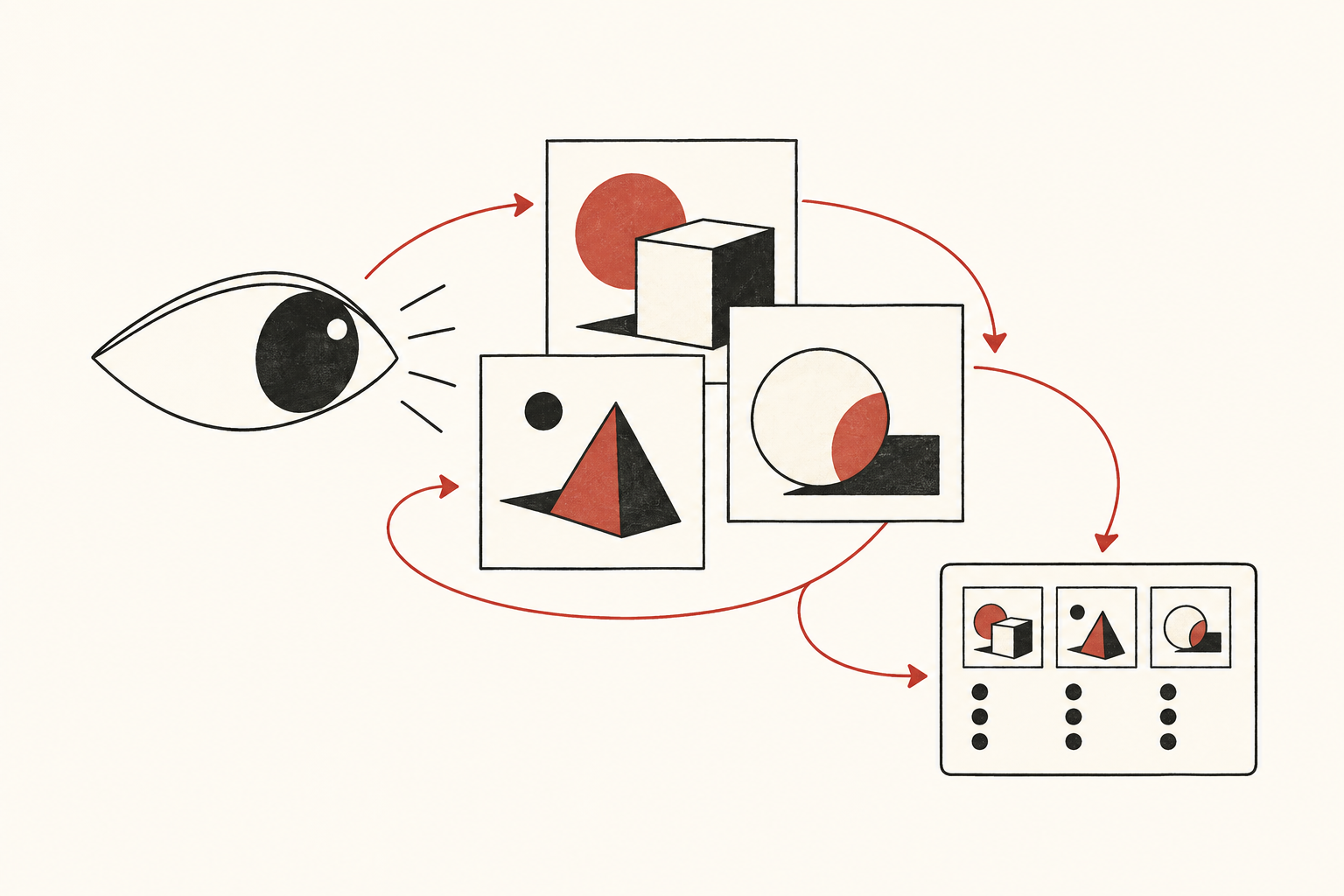
On October 16, 2026, Elorian introduced Glimpse, a research preview that revisits visual evidence while reasoning. Elorian’s announcement
That makes a useful question newly timely: what should a buyer demand from a second look? A longer inspection can consume resources without resolving the uncertainty that matters. The commercially interesting unit is therefore an accepted task, not an impressive sequence of intermediate pictures.
Analysis: build an inspection ledger
Open Market Notes proposes a simple evaluation instrument: an inspection ledger. This is our proposed test design, not a reported Glimpse feature. For every additional view, record the original answer, the unresolved question, the exact source region or interval requested, the revised answer, and whether an independent reference supports the change. Preserve the original media alongside the record.
Consider a hypothetical conveyor video with two similar parcels. One disappears behind a divider; another enters the frame. A reviewer asks whether the departing parcel is the one that previously entered. A plausible description of each visible box does not establish identity across the hidden interval. The ledger should distinguish evidence of continuity from a guess based on appearance. “Cannot determine from these frames” must remain an acceptable outcome.
The underlying evaluation problems are established. HallusionBench examines language hallucination and visual illusion; POPE tests object hallucination. Neither paper is evidence about this new model’s performance. HallusionBench, POPE
Measure repairs and regressions separately
For the proposed parcel test, randomly assign matched clips to a fixed inspection allowance and an adaptive allowance. Keep the task wording and scoring rules unchanged. Record correct-to-incorrect revisions as carefully as incorrect-to-correct revisions. A single net accuracy number could conceal a system that repairs many easy mistakes while introducing a smaller number of expensive identity errors.
Add an explicit missing-evidence condition: remove the only interval that establishes continuity. If a system supplies a confident identity anyway, extra inspection has not recovered information that the input lacks. Another condition can repeat identical frames. That tests whether additional processing is being confused with additional evidence. These are proposed experiments, not results from tests we have performed.
A visible record should help reviewers find the relevant source material; it should not be treated as a complete explanation of internal computation. A neat sequence can still accompany a wrong conclusion. Audit the claim against the media, rather than rewarding how persuasive the sequence looks.
Price the completed workflow
Before procurement, count review time, retry time and unresolved cases alongside model charges. Define acceptance before testing: for example, a parcel-identity decision with a supporting interval, or an explicit escalation when that interval is unavailable. These are alternative valid workflow outcomes, not interchangeable model successes.
The inspection allowance should follow the consequence of error. Routine archive tagging can tolerate a different threshold from a decision that releases a shipment. In the latter case, an unresolved identity should route to a person instead of silently becoming an operational instruction. This is a deployment recommendation, not a claim about any customer’s implementation.
Glimpse gives buyers a timely reason to ask these questions, but this article does not independently validate its capabilities. The proposed ledger would be useful precisely because it can produce an unwelcome answer: another look may help, may change nothing, or may make a correct answer worse. A purchasing decision should distinguish all three before celebrating the ability to look again.
Information only. No investment, legal, tax, or financial advice.