Gemini file editing makes preservation part of the assignment
A useful file edit must preserve the content and behavior outside the requested change.
On October 29, 2026, Google announced in-chat file preview and editing in Gemini. PDF editing covers web and mobile; other listed formats are web-only. Google announcement
This changes the question a team should ask before accepting AI-assisted office work. When a request concerns one paragraph or one table, acceptance also depends on everything that should remain untouched. The following is Open Market Notes' analysis of that practical obligation, not a fidelity test of Gemini.
Define the unchanged part of the job
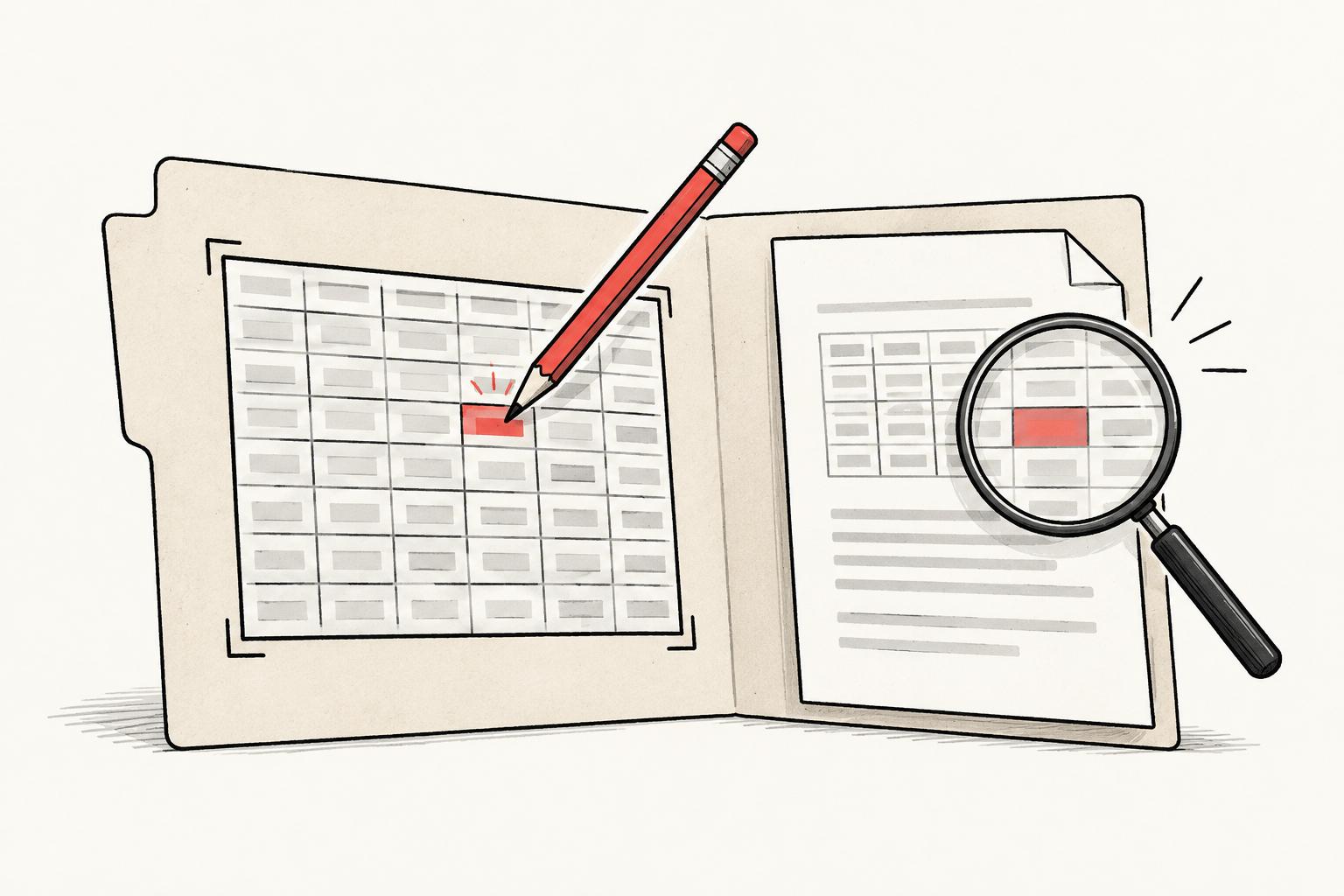
Consider a hypothetical supplier comparison. A colleague asks an assistant to shorten the introduction and improve the table's readability. The delivery dates, tax assumptions and qualification notes were already checked. If those elements change while the prose improves, the recipient has acquired a new review task that was never requested. A successful rewrite of the introduction cannot compensate for an altered assumption elsewhere.
A useful brief therefore identifies both the intended edit and the protected content. For this example, the introduction can change, while dates, units, footnotes and comparison criteria must remain equivalent. Equivalence matters more than identical bytes: a line break may move harmlessly, whereas a lost qualification can change the decision. Review should concentrate on meaning and function rather than demanding that every visual element stay frozen.
That distinction also makes requests easier to price internally. A team can allow an exploratory redesign to touch the whole file, but it should budget for a full review. A narrow edit deserves a narrower acceptance test only when the rest of the file has been checked for unintended changes. Calling both jobs “polishing” conceals a different amount of responsibility.
A spreadsheet has behavior as well as appearance
Microsoft documents that Excel can display formulas instead of their results. Microsoft guidance That simple distinction is relevant to AI deliverables: the number visible today is not the whole spreadsheet.
Imagine a planning sheet with quantities, unit prices and calculated totals. A copied value could look exactly right until next week's quantity changes. In a test copy, altering a designated input and checking the dependent output examines a different property from rereading the displayed total. The original approved file should remain untouched during such a test. This is a proposed review method, not a claim that Gemini replaces formulas with values.
The same reasoning extends to a presentation. A visually correct chart may still need editable labels for the person delivering it; a document may need a footnote that survives a page rearrangement. The right checks follow the recipient's intended use. A static handout and a working model can legitimately have different acceptance conditions even when they look similar on screen.
Review the file that will actually travel
The recipient may open a downloaded copy in a different application, print it, or reuse it next month. The last review should therefore examine that delivered form. A preview is useful for rapid correction, while opening the actual exported artifact answers whether the agreed handoff works. This does not imply every export is faulty; it identifies where evidence is needed before relying on one.
Google's documentation describes reviewing and restoring earlier document versions. Google help Version history can help establish a baseline. It does not decide whether a modification was authorized or whether a restored file meets the recipient's requirements. Keep an approved starting copy and a short description of the requested change, then compare the candidate against both.
There is a reasonable objection: this sounds slower than simply doing the edit by hand. For a tiny low-stakes note, it may be. The proposed discipline should scale with the consequence of a silent change. A repeated commercial template can justify a reusable test, whereas a disposable brainstorm rarely needs a formal acceptance record. Count the review time when judging the efficiency of the process; generation speed alone excludes part of the work.
A team adopting this workflow still needs its own acceptance evidence. This article has not tested formula retention, round-trip conversion or complex layout fidelity in Gemini. Teams can investigate those questions with representative files and explicit pass conditions. The useful operational change is to treat the file as something another person must continue to use, and to make preservation part of the assignment before the first revision begins.
Information only. No investment, legal, tax, or financial advice.