Gemini Decisions API: faster judgment still needs execution boundaries
Dedicated decision models can simplify routing, but evidence, permissions and error costs still determine whether automation works.
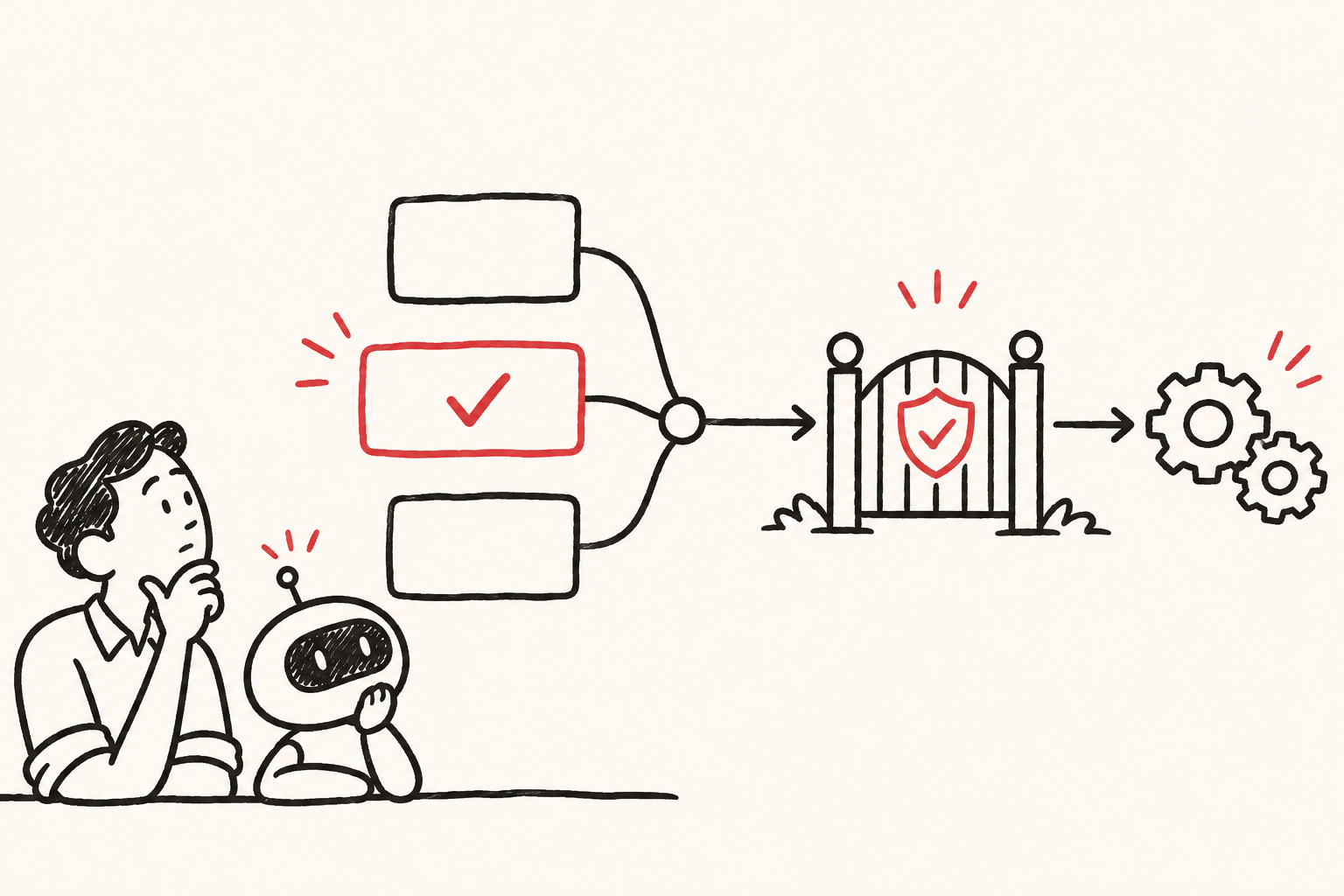
On November 11, 2026, Google launched Gemini Decisions API for bounded choices. That is a useful product development. But the important question is not simply whether a model can select an answer faster. It is whether an organization has decided which judgments may trigger action and which must stop for further checking.
The Google announcement supplies the news context. This article examines engineering and commercial implications; it is not an independent performance test.
Keep judgment separate from execution
Imagine a software company receives this support message: “You charged me again this month. Please cancel.” This is our hypothetical example, not a Google customer case. Several questions remain unresolved. Is the customer describing duplicate billing or an ordinary renewal? Do they want future renewals stopped or a past payment refunded? Does the order belong to this account? Has someone already refunded it?
A language model can help interpret intent. It should not establish facts in a payment ledger from a sentence alone. Even a confident classification cannot prove duplicate billing. Account records must be checked, permissions validated and refund rules established. Combining everything into one question, “Should we refund?”, may reduce the apparent number of calls while concealing missing evidence.
A dedicated decision component can encourage a cleaner division of work. One component interprets the request, another reads authoritative business records, and explicit rules constrain permitted operations. A model need not assume every responsibility, while conventional software need not pretend that fixed keywords can handle every expression. The boundary between them belongs in the product design.
Options determine what a system can recognize
Google’s API documentation warns that choice questions distribute probabilities even when no option fits, and recommends setting thresholds with labeled business examples. A well-formed response therefore does not establish that the question was well defined.
If a support workflow offers only “refund” and “renewal,” a request to download an invoice can be pushed into the wrong category. Adding “other” is only a beginning. Someone must decide where those requests go, who reviews them and which recurring issues deserve their own category. An unstaffed fallback queue merely makes automation failures less visible.
Categories also change with the business. An expired trial, a revised promotion or an enterprise contract exception can alter the proper treatment of the same sentence. Teams must maintain option descriptions, policy versions and acceptance examples, not just model versions. Otherwise the system can keep producing consistent structured responses after their business meaning has changed.
Confidence should not become a permanent permission slip. Evidence adequate for a low-risk label may be inadequate for moving money. A routing mistake that adds a minute of waiting and an irreversible transaction require different safeguards. Choosing a threshold is primarily a judgment about the cost of error, not a search for a professional-looking decimal.
The bill extends beyond inference
Vercel confirmed Gemini Decision 1 availability on November 11, including decision calls in logs and budgets. More access channels make experimentation easier, but they do not replace evaluation on actual work.
Buyers should compare total cost per correctly completed task. A cheap decision that frequently requires retries, a larger model or manual review may save less than expected. Conversely, an option with a higher unit price might improve overall economics if it reduces unnecessary escalation and repeated handling. There is no universal answer that can be calculated without business examples.
Vercel’s decision documentation describes an optional low-confidence rerun with another model and two-stage billing. A fallback is therefore both a reliability mechanism and a cost. Teams should record when it runs and whether it corrects an error. They should not erase the first judgment from evaluation simply because the eventual request succeeds.
Speed must also be measured across the entire service. If most waiting comes from retrieving an order or obtaining approval, faster classification improves only one segment. If many lightweight judgments genuinely sit on the interactive critical path, a dedicated endpoint may produce a meaningful experience improvement. A useful comparison holds the task, data and success criterion constant instead of lining up vendors’ advertised latency figures.
A developing category, not a universal answer
OpenAI announced general availability of its Decisions API on October 22, 2026. Google’s entry can therefore be understood as another supplier responding to a common need: applications frequently need bounded choices as well as generated prose.
Competition may simplify access and supplier replacement, but similar interfaces do not make results interchangeable. Product teams should maintain supplier-independent acceptance material: ordinary requests, edge cases, insufficient information and misleading wording. After changing models, verifying acceptable business behavior matters more than verifying identical response fields.
A sensible deployment sequence is to let the new component observe a live process first, recording suggestions without acting; then allow limited execution in low-risk situations; and expand only after reviewing outcomes. This is our engineering recommendation, not a guarantee about any vendor’s safety. Tests should include missing information, because good systems need to recognize when more evidence is required, not merely answer sooner.
The significance of Gemini Decisions API is that judgment becomes a component organizations can buy, measure and replace separately. It cannot define policy or supply absent evidence on their behalf. Practical gains depend on separating judgment, facts, authority and execution, and continuing to inspect those boundaries.
Information only. No investment, legal, tax, or financial advice.