Fabrinet’s profit bridge runs beyond the factory
Fabrinet’s earnings invite a closer look at operating execution, asset values and tax assumptions.
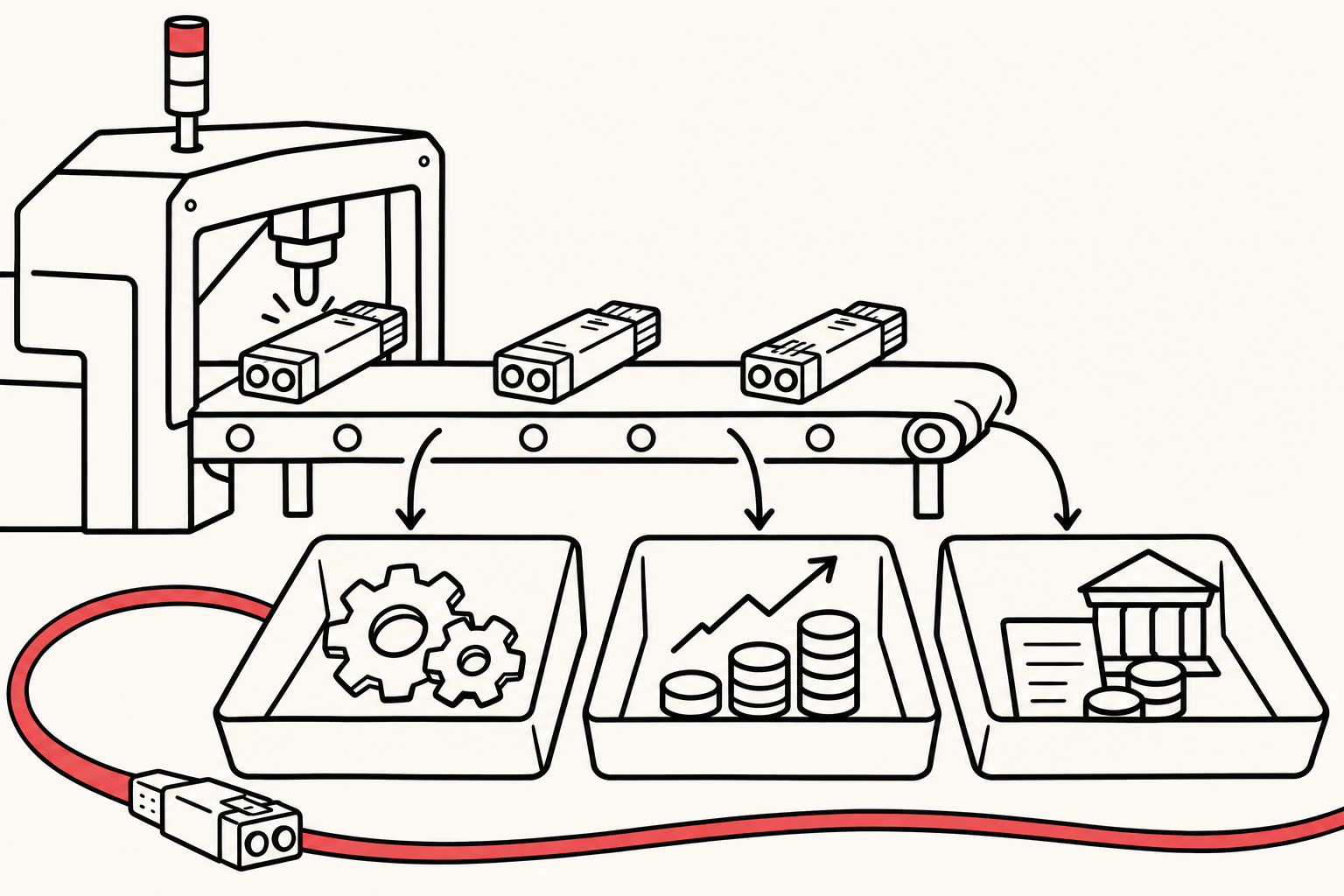
Fabrinet’s November 2, 2026 release reported revenue of $1.4745 billion, GAAP profit of $103.5 million and adjusted profit of $157.4 million; exclusions included investment revaluation and Pillar Two tax. Quarterly release
The analytical question is how to connect production performance to the profit shareholders ultimately receive. Choosing whichever earnings number looks more persuasive leaves that connection unexplained. A useful reading keeps the factory, the balance sheet and the tax calculation visible at the same time. The following is Open Market Notes’ analysis, not management guidance or an assessment of the shares’ fair value.
Separate the questions before comparing the answers
A production manager needs to know whether a new order can be delivered reliably, with acceptable labor, material and testing costs. A shareholder also needs to know whether capital outside that production process has retained its value, and how much profit remains after taxes. These questions overlap, but their accounting boundaries differ.
An adjusted number can help isolate a particular activity. Its usefulness depends on the reader preserving a second view of the costs removed. Imagine two otherwise identical manufacturers: one earns an operating return and holds its surplus capital in cash; the other invests the surplus in an asset that subsequently loses value. A comparison of their factories may reasonably set the investment outcome aside. A comparison of the owners’ accumulated wealth cannot. This hypothetical illustrates a measurement choice, not an explanation of Fabrinet’s specific investment.
The same discipline applies to cash. An expense that does not require immediate payment may still describe a reduction in economic value. Conversely, a cash payment today can finance productive capacity used over many years. Neither the presence nor absence of a current cash movement, by itself, settles whether a cost belongs in a long-term assessment.
Tax needs its own operating assumption
The OECD describes Pillar Two as jurisdiction-based minimum taxation for in-scope multinational groups, with a 15% floor. OECD framework
For analysis, the important distinction is between the timing of a tax entry and the tax economics of future activity. A transition-related accounting effect and an enduring change in the tax burden need different treatment. It would be premature to label every adjustment permanent; it would be equally premature to assume every excluded tax expense disappears.
Consider a new production line that meets its output and quality targets. If the applicable tax burden changes, the line may still be an operational success while generating a different after-tax return. Readers therefore need a bridge from operating assumptions to jurisdictional tax assumptions before extrapolating an earnings trend. This article does not determine Fabrinet’s future effective rate or the cash settlement schedule of the reported provision.
This distinction also matters across periods. If the tax environment changes, simply restoring an excluded expense may not produce a comparable result. Research should state which conditions are held constant and which have changed, rather than treating an adjusted margin as a stable forecasting assumption.
Manufacturing growth also consumes coordination
Fabrinet’s annual filing identifies customer concentration, inventory management, capacity expansion and manufacturing yields as business risks. FY2026 annual filing
Those categories suggest a practical way to read subsequent disclosures. If orders accelerate, management may have to arrange components, train staff and qualify equipment before collecting the associated revenue. A larger sales base can spread fixed costs, but it can also increase the amount of work and money committed before customer acceptance. Which effect dominates is an empirical question.
A hypothetical delayed component makes the distinction concrete. Most of a module may already be assembled, yet one missing part can prevent testing and shipment. The factory has performed useful work without completing the commercial cycle. That is why output, invoicing and collection should be traced separately rather than treated as three interchangeable versions of demand. This is an analytical example, not a report of a current Fabrinet disruption.
New equipment also needs to be judged within its ramp-up stage. Training, validation and process tuning consume resources without necessarily proving an investment unsuccessful. Potential future efficiency, however, does not erase current capital commitments. A useful comparison considers production activities at similar maturity and complexity, rather than merely dividing aggregate numbers from two quarters.
Use reconciliation as a research map
SEC staff guidance emphasizes clear labeling and consistency in non-GAAP presentation, and warns that exclusions can still mislead. It does not establish that this company’s disclosure is improper. SEC guidance
For the next reporting period, the useful questions are specific: which adjustments recur, which reverse, which require cash, and which reflect capital committed outside the factory? Then ask whether comparable operating activity is producing cash on a sustainable timetable. A single combined score would obscure these different tests.
The current release offers a starting point for that work, not permission to select one profit definition and discard the other. Operational progress and costs borne by owners can coexist. Keeping both in view produces a more useful account of a manufacturer than either a celebratory revenue headline or a suspicion built solely around the existence of adjustments.
Information only. No investment, legal, tax, or financial advice.