ERNIE 5.5 opens its weights, but commercial freedom remains conditional
Baidu lowers the cost of starting, while territory, revenue and derivative-model terms shape how far a business can go.
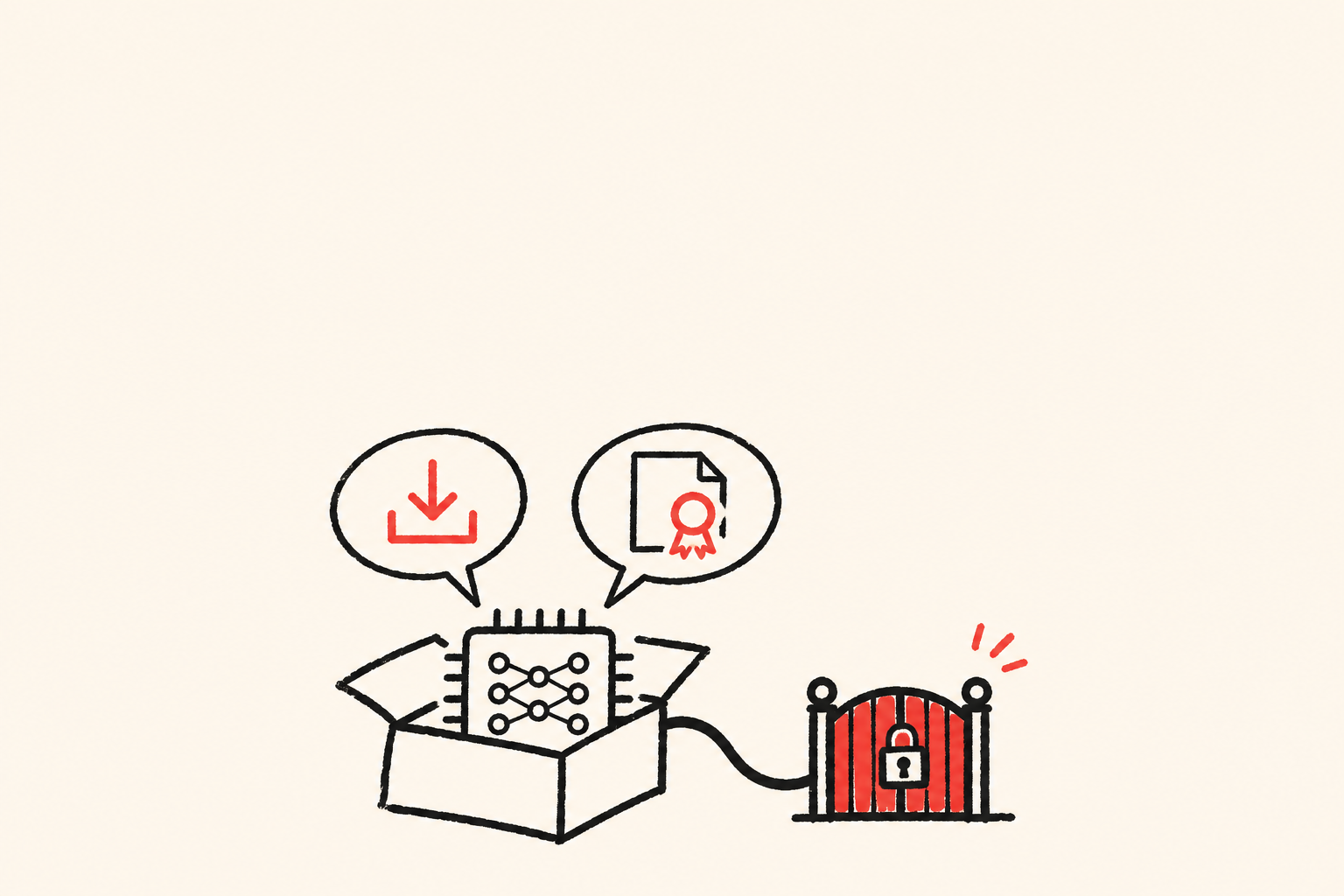
Baidu has released a foundation for further training, rather than a finished chatbot ready to take over customer service or business workflows. ERNIE 5.5 Flash Base gives more teams access to expensive pretraining work. Downloading that work, however, is not the same as acquiring unrestricted commercial infrastructure.
As of November 6, we checked Baidu’s release documentation and the v1.0 model licence, dated November 5. Our central assessment: this release lowers the technical starting point while preserving territory, business scale and model lineage as commercial boundaries. Choosing a model also means choosing which future changes may require renewed supplier agreement.
Separate the foundation from the finished product
Baidu describes 280 billion total parameters, with 14 billion activated per token, and supplies FP8 and BF16 weights. This checkpoint comes directly after pretraining, without mid-training or post-training. A post-trained version is promised later, without a release date in the documentation.
Teams can choose their own domain adaptation, instruction training or reinforcement learning. They cannot infer dependable behavior from base-model scores alone. Text completion does not automatically become an enterprise assistant that respects permissions, calls tools correctly and stops when something goes wrong. Downstream teams still need training data, evaluations, tool boundaries and human review.
Nor do 14 billion activated parameters imply hardware only needs to accommodate 14 billion parameters. Sparse experts reduce the parameters involved in each computation, but storing and loading the full weights and communicating across devices still affect deployment. Costs should be measured at the intended concurrency, context length and latency, rather than treating the activation ratio as a discount on the bill.
This is valuable optionality for teams with training and operational capabilities, not an automatic reason for every business to run its own model. The gap between buying a service and maintaining weights includes failure recovery, version management and ongoing safety evaluation, not just API prices.
The free commercial tier follows product revenue
The licence allows qualifying non-commercial use without a model fee. Commercial use with related-product or service annual revenue of no more than US$50 million can also avoid a model licence charge, subject to attribution and a one-time advance use notice. Qualifying users need not wait for Baidu’s reply. This is not approval for every model call.
The revenue definition matters more. Section 1.7 uses the preceding consecutive 12 months, assessed continuously. Where a related product uses several models, its entire revenue counts, not just the portion attributed to ERNIE. Entities under common control are aggregated. Funding, valuation and profit cannot substitute for revenue.
A small feature can therefore sit inside a large revenue pool. Suppose a software company has US$60 million in annual revenue from a related product, with ERNIE powering one supporting feature. Low revenue attributed to that feature alone would not establish eligibility for the free tier. This is an illustration based on the wording, not a case Baidu has adjudicated.
Above the threshold, separate written commercial authorization is required in advance, with fees negotiated separately. Growing businesses must address this before crossing the threshold; affected above-threshold commercial use without authorization must pause. The risk is renegotiation and continuity during growth, not a fixed royalty already announced by the agreement.
Geography reaches beyond the server
The licence excludes the European Union, United Kingdom and South Korea from its territory. Section 5.3 extends restrictions to the use, reproduction, distribution and display of derivatives and outputs. It cannot safely be reduced to a rule about keeping servers outside Europe.
Cross-border software, content platforms and shared-service teams must also consider where customers are, where employees access systems and where generated content appears. Applying the text to particular operations requires legal review; it does not settle every cross-border scenario on its own. But deployment location is clearly not the only boundary to map.
That changes the order of selection. Teams should establish whether their markets and actual usage chain fit the authorization before investing heavily in adaptation. Discovering that key customers cannot be served after a successful technical pilot leaves sunk costs behind.
Distillation does not automatically remove the licence
Section 1.5 includes fine-tuned models, quantized versions, adapters and models created through output-based distillation or synthetic-data training within its derivative definition. Section 5.5 restricts improving other models with the materials or outputs, while preserving the ability to create derivatives under the agreement.
Read together, these clauses do not ban all distillation. They also do not let a team transfer capabilities into another model and assume the restrictions disappear. For businesses combining several suppliers’ data to train proprietary models, provenance becomes part of commercial asset management.
A practical response is to connect generated datasets, training runs, model versions and applicable terms, reviewing rights before mixing data. At migration time, proving where capabilities and data came from may matter more than exporting weights. This is about contractual and switching risk, not a claim that Baidu owns every derivative work.
Measure exit costs, not download enthusiasm
Our analysis is that Baidu supplies a useful technical entry point while retaining negotiating power when commercial use expands. Developers can avoid starting pretraining from scratch, but still bear post-training, infrastructure, governance and licensing-management costs. No model licence charge does not mean no operating costs or no future commercial agreement.
A procurement assessment should answer three questions together: is the model reliable enough on actual tasks; do the entire product’s revenue and geographic arrangements fit the terms; and how long would replacement and data rebuilding take if continued use became impossible? Preserve the licence associated with the acquired version before experiments, and include revenue alerts and migration tests in the launch plan.
Base-model benchmarks cannot guarantee those answers. We have not independently tested performance and do not infer Baidu’s future revenue or market share from this release. The meaningful outcome is how many teams turn accessible weights into maintainable products within clear rights boundaries, rather than simply downloading a checkpoint.
Product and business analysis, not legal advice. The linked licence controls over this summary.
Information only. No investment, legal, tax, or financial advice.