The same stablecoin can pay an invoice or fund a loan. Who owes the money?
The EBA’s DeFi report highlights borrowing and collateral, while redemption and responsibility still depend on the actual service.
On November 25, 2026 the European Banking Authority released a report examining stablecoins in decentralised finance. Its public notice identifies roles for stablecoins in borrowing, lending, trading and collateral. It also reiterates that the European Commission should examine possible requirements for crypto-asset service providers that facilitate access to DeFi lending. This is a question for review, not a new rule. The distinction matters because a single token can pass through very different legal and operational arrangements without changing its name.
An invoice, a rewards balance and a loan
Imagine a company in the European Economic Area paying a supplier in USDC. Evidence includes the invoice, who approved the payment, the matching receiving address, and whether receipt was reconciled. The transfer itself is not a lending transaction. For the underlying token, Circle’s published policy distinguishes the redemption route of EEA holders through Circle France from the route applicable to non-EEA holders through Circle LLC. The route is tied to the holder and applicable terms, not simply the blockchain used.
Now suppose the company is offered a payment based on how long it holds the balance. Article 50 of MiCA prohibits EMT issuers and crypto-asset service providers providing related services from granting interest. Benefits equivalent to interest that depend on holding time can fall within that prohibition, including in some third-party arrangements described in the text. To assess a product, document who promises the payment, who funds it and how holding time enters the calculation. The marketing label does not answer those questions.
Protocol claims are a different asset to trace
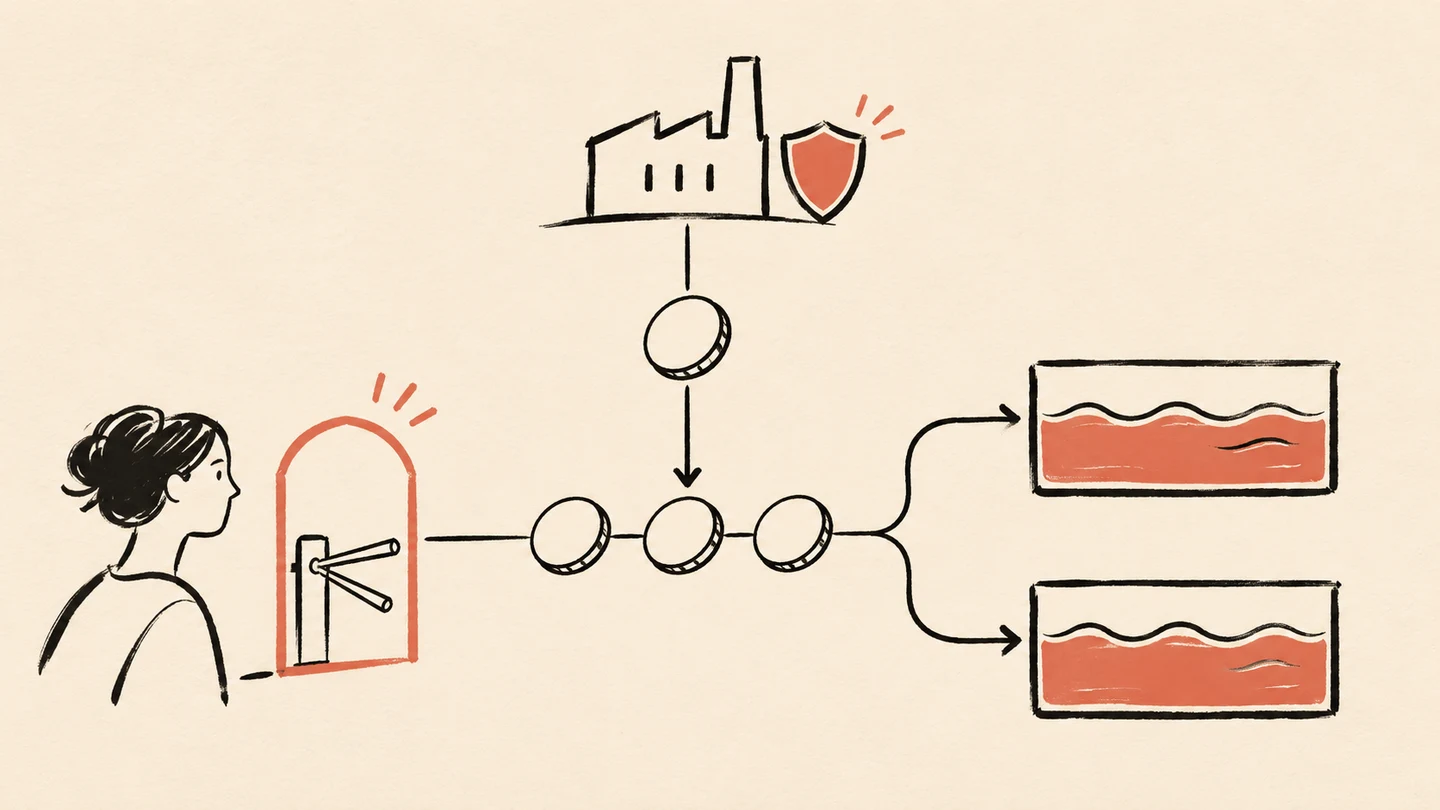
If a service provider’s interface helps the company commit USDC to a lending protocol, the company may instead hold a claim recorded by the protocol. Read the customer agreement and the execution record together. Who signs the transaction? Can the platform route or block it? On which pool and liquidity conditions does a withdrawal depend? The issuer’s published redemption route for the underlying USDC does not establish a direct claim against the issuer for the protocol position or guarantee withdrawal on demand.
For a product review, follow one euro-equivalent unit through the controls before transfer, the execution transaction, the resulting claim and the route out. A screen can look similar across services, so record who controls the asset and who is the counterparty at each step. Separate what existing law says from what the EBA wants the Commission to consider. The report is useful because it identifies where intermediaries may matter; it does not settle the classification of every interface.
Consider how a failure would be reported. A confirmed blockchain transaction can establish that a transfer occurred, but not necessarily which legal entity controlled the destination or why a withdrawal was unavailable. A good incident record links the on-chain transaction to the customer instruction, service terms in force at the time and the point at which the claim changed. This also makes the explanation useful to an auditor who was not present for the transaction.
Sources
AI Q&A
Did the EBA announcement create a new rule?
No. It examines market use and reiterates an issue for the Commission to consider.
Can a holding-time reward escape Article 50 by name alone?
No. The calculation and contractual roles matter; equivalent benefits can be covered.
Is a protocol claim the same as USDC held in a wallet?
No. The protocol position has its own withdrawal conditions. The issuer’s token redemption policy does not guarantee that position.
Information only. No investment, legal, tax, or financial advice.