When Earth AI Joins Data, Missing Must Stay Missing
A useful geospatial agent must preserve the difference between no recorded event and evidence that nothing happened.
Google’s October 14, 2026 update expands experimental Earth AI access, including an agent-to-agent API. The important question for a decision-maker is what survives when an agent combines datasets. A polished map can hide a consequential change in meaning: an empty cell may become a confident answer.
This is our proposed evaluation framework, not a finding that Google’s system makes that mistake. The principle is straightforward. A system should preserve the difference between a measured zero, an unobserved outcome and an observation that cannot be matched to the requested place or time.
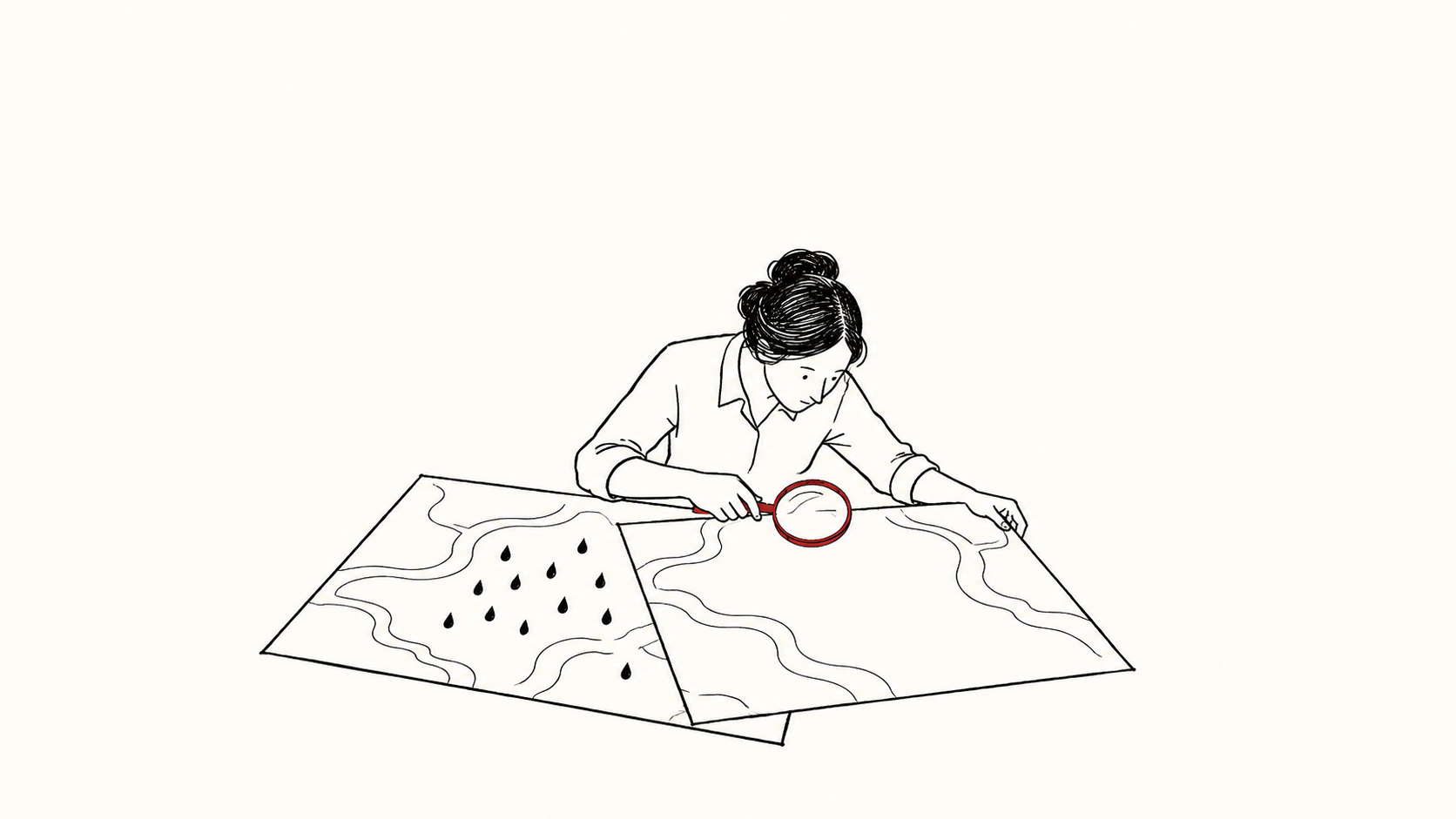
Two maps, two processes
Groundsource launched in March 2026 and extracts flood events from news. Its forecasting companion notes that missing reports complicate precision measurement.
Consider a hypothetical pair of equally flood-prone neighborhoods. Each experiences ten floods, but an archive captures nine in one and three in the other. Ranking their recorded counts would place the first neighborhood at three times the second. It would not establish a threefold difference in underlying flood risk. The archive contains both the physical process and the process that makes an event observable.
Adding more records can improve coverage without removing that distinction. Likewise, joining the archive to population or property data creates a useful ratio only if the numerator and denominator describe compatible places, periods and observation conditions. A larger spreadsheet does not resolve a mismatched denominator.
Preserve the meaning through the join
We would require a geospatial agent to return an evidence companion beside its answer. For every important input, it would identify the observation period, geographic unit, missing-data treatment and transformation applied. The goal is not a long bibliography. It is a compact account of how the input became the output.
Suppose a user asks which proposed warehouse location has lower flood exposure. The agent might combine event records, building footprints and a forecast. Our suggested response would separate what each source can establish before producing a ranking. Historical reports describe recorded events; a forecast is a prediction; a building location is an exposure input. Those roles should remain visible after the join.
If location or time cannot be reconciled, a qualified comparison may be the better output. That is a usable result: it tells the decision-maker which missing observation could change the choice, instead of converting uncertainty into a reassuring color.
Test the decision, not just the answer
A practical acceptance test could start with deliberately incomplete data. Remove reports from one district while leaving the hypothetical underlying events unchanged. Then ask whether the agent changes its confidence, flags the coverage difference or silently concludes that risk has fallen. Repeat with mismatched time windows and boundaries that only partly overlap.
A second test would measure whether uncertainty survives the final summary. An agent could correctly preserve a missing-value marker internally yet erase it when writing a one-sentence recommendation. The map, calculation and prose therefore need to be checked together.
For procurement, we would compare systems on the stability of their decisions under these controlled changes, the clarity of their qualifications and the ease of inspecting transformations. None of those measures alone establishes real-world forecasting performance. They answer a narrower operational question: does the interface let the user distinguish evidence from an assumption?
Geospatial AI becomes more useful when it can combine sources without flattening their differences. The valuable output is not always a definitive ranking. Sometimes it is a precise explanation of what remains unknown, and what evidence would make the ranking defensible.
Information only. No investment, legal, tax, or financial advice.