Daimler Truck’s 73% profit rebound still faces three tests
Better margins do not prove a broad recovery. Daimler Truck’s results need tests of order replenishment, cash quality and geographic breadth.
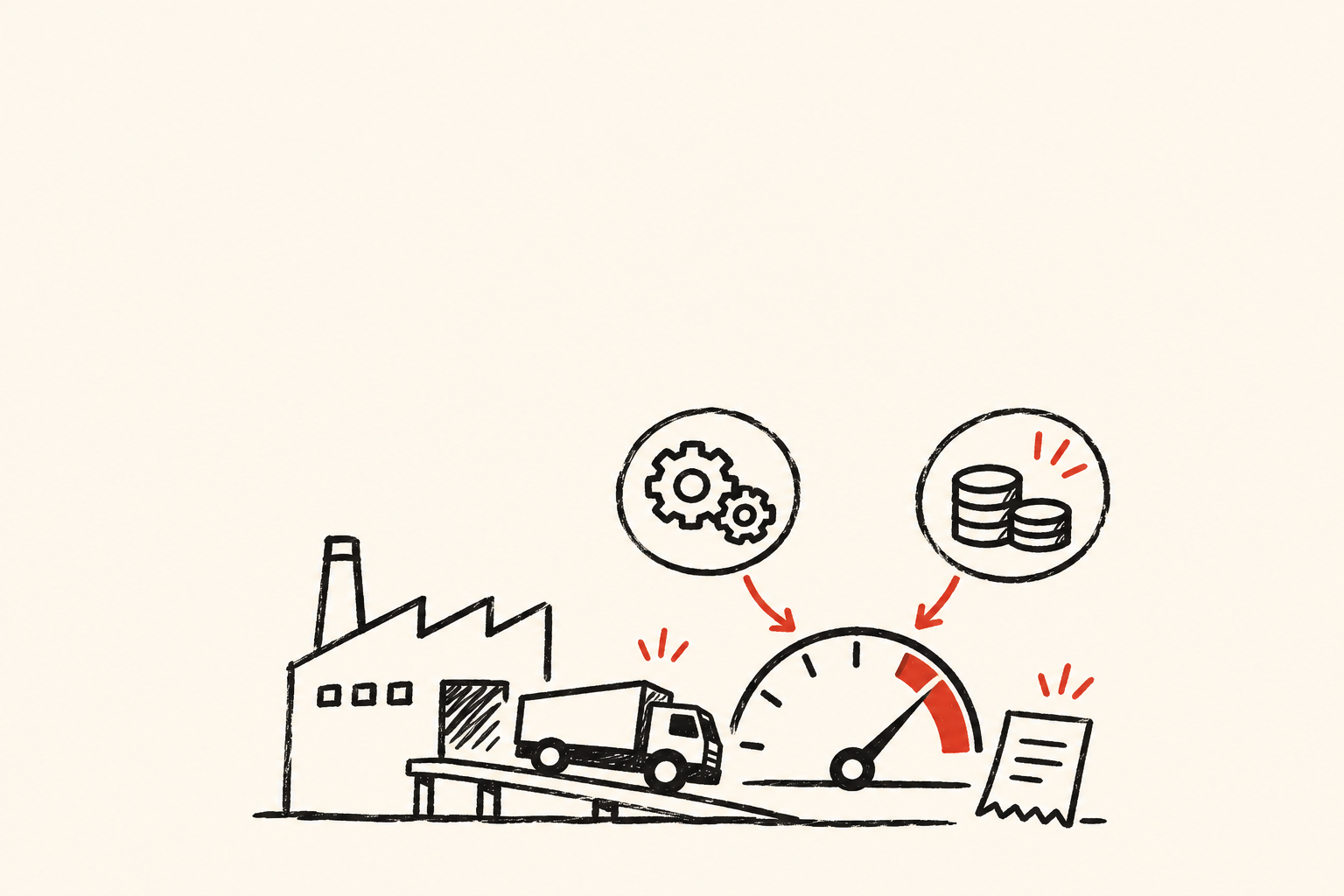
Daimler Truck’s November 6 third-quarter results offer an encouraging industrial-cycle signal: adjusted group EBIT rose 73% to €1.124 billion and the industrial business’s adjusted return on sales reached 9.1%. Reading that as a simultaneous boom in freight demand, manufacturing investment and technology procurement would skip several unproven steps. The company release establishes an earnings recovery, not an escape from cyclicality across the supply chain.
First test: what creates the earnings elasticity?
Industrial revenue rose 20%, far less than profit. That gap is consistent with operating leverage: factories, machinery and some research spending do not increase with every additional vehicle, so recovering production spreads existing costs over more units. This is an economic interpretation, not a precise profit bridge disclosed by the company. Pricing, vehicle mix, currency and expenses can also affect earnings; two growth rates cannot isolate their contributions.
The distinction matters for industrial technology investment. A manufacturer can possess competitive products while underused capacity depresses margins. Conversely, a production rebound can conceal an absence of improved pricing power. Assessing whether digital systems, powertrains or factory automation create a lasting advantage requires examining unit economics at normal production levels, rather than crediting every early-cycle profit gain to technological progress.
The time horizon offers another restraint: adjusted group EBIT for the first nine months was still down 10% year over year. A strong quarter and weaker cumulative earnings can coexist. The reported figures make the pace of repair a better subject than a declaration that earnings have permanently shifted higher. Substituting the strongest quarter for a full-year operating level risks mistaking a low comparison base or timing changes for structural improvement.
Second test: can orders replenish deliveries?
Deliveries reflect demand being fulfilled; orders point more directly toward future production schedules. Third-quarter group orders were 71,168 vehicles against deliveries of 91,260. Dividing the two gives roughly 0.78. This is our calculation using unit counts, not a company-reported revenue book-to-bill ratio, and it is not seasonally adjusted. The inputs appear in the orders and sales table.
The gap does not automatically mean demand is weakening. A manufacturer may intentionally accelerate delivery of accumulated orders, while customers may place orders in particular months. Order intake and delivery also occur at different times. Nevertheless, the next results must address whether fresh demand supports the current production pace or whether earlier orders are doing most of the work. Without complete information on backlog, cancellations and delivery times, both explanations remain possible.
Fleet replacement is also different from net capacity expansion. An operator may replace old trucks to reduce maintenance downtime or fuel costs even without substantial freight growth. Replacement can generate genuine supplier revenue, but it does not establish an economy-wide acceleration in freight, construction and capital spending. Component, logistics-software and charging-equipment suppliers must verify their own demand drivers rather than share a generic truck-recovery label.
Third test: can the cash recur?
Third-quarter industrial free cash flow was €974 million, but Daimler Truck explicitly said proceeds from selling part of its ARCHION stake supported that figure. The cash is real; its sources are not all repeatable operating achievements. See the cash-flow disclosure.
Selling equity can improve financial flexibility, but cannot be repeated indefinitely every quarter. For electrification, software platforms and factory upgrades requiring years of investment, the relevant question is how much cash the core business can provide after removing asset-disposal effects. Annualizing the entire quarterly figure could overstate the simultaneous capacity to fund research, capital expenditure and shareholder returns. The headline disclosure does not separate every contribution, and this article does not invent a normalized cash-flow number.
Nor is better free cash flow a mechanical consequence of better margins. Inventory, receivables and supplier-payment timing can shift cash between quarters. Operating profit, working capital, capital expenditure and asset transactions need separate examination to distinguish cash generation from obligations merely deferred.
Regional recovery is not universal recovery
German official statistics released the same day showed production up 0.7% month over month in September, yet down 0.4% in the third quarter compared with the second. Those adjusted output measures are not directly comparable with a global truck group’s year-over-year financial results. They provide a boundary condition rather than a rebuttal of company performance. See the Destatis release.
A company can outperform its home economy through geography, product mix and execution. Strong deliveries in one market may offset weakness elsewhere. Analysis should therefore move beyond a binary call on the cycle to examine which regions contribute growth, which customers order, and whether extra revenue requires additional incentives or financing support.
Daimler Truck retained its full-year industrial adjusted-margin guidance of 7%–9%, despite reaching 9.1% in the quarter. The guidance neither proves management pessimism nor guarantees future upside. It simply means a quarterly result cannot substitute for a full-year forecast.
The next evidence should be mutually reinforcing: orders replenishing deliveries, margins holding when volume growth slows, and cash continuing without disposals. Together, those would more strongly support a sustainable industrial recovery. Daimler Truck has delivered an encouraging earnings signal. Returns on technology investment still depend on demand, costs and cash finding durable support within the same cycle.
Information only. No investment, legal, tax, or financial advice.