Cloudflare’s AI traffic test: who pays for the network?
Revenue growth, lower gross margins and free AI tools expose the gap between carrying more traffic and capturing its value.
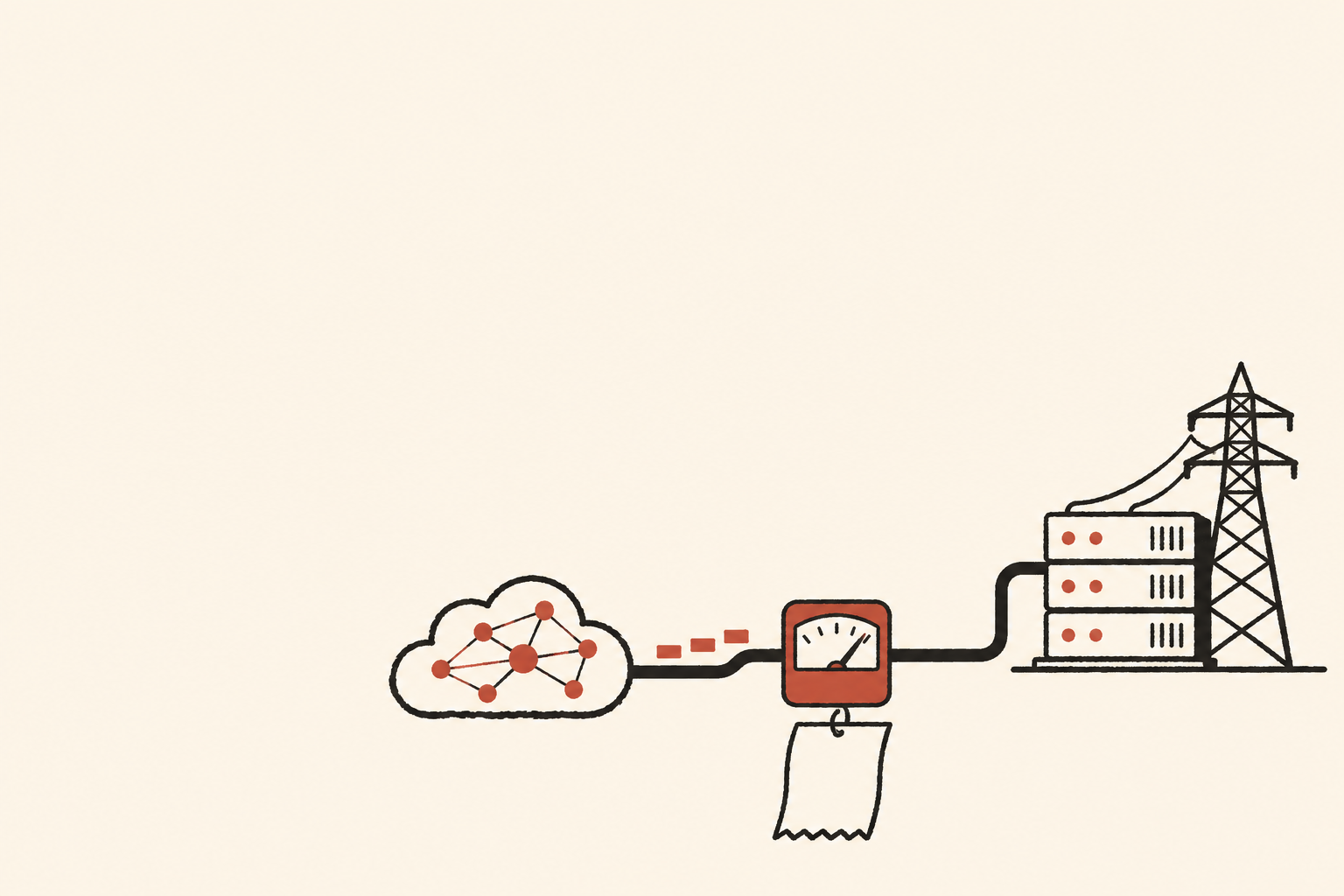
Cloudflare’s November 5 results pose a harder question than whether AI can generate demand: how much of that demand can become profitable, paid usage? Third-quarter revenue reached $782.5 million, up 39%, while GAAP gross margin fell from 74.0% to 71.2%. Growth and weaker revenue-level economics can coexist. These figures do not establish that AI caused the decline; the release does not isolate AI revenue or AI delivery costs. Quarterly results
Traffic is an input, not the business model
An AI request can create several different economic relationships. Cloudflare might transport or secure it, run the inference, or route it to another model provider. Those roles do not necessarily produce the same invoice or gross profit. Counting requests without identifying the paying customer risks confusing network activity with monetization.
The distinction is visible in product pricing. Workers AI meters inference through Neurons, a measure of GPU work; paid usage above the daily free allowance costs $0.011 per 1,000 Neurons. AI Gateway’s core analytics, caching and rate limiting are free. Its unified billing instead charges a 5% fee on purchased credits while passing through provider inference prices without a markup. These are different charging mechanisms, not evidence that every AI request earns Cloudflare a fee. Workers AI pricing, AI Gateway pricing
The strategic inference is that free traffic management can attract applications before revenue arrives through compute or adjacent services. That can be sensible distribution, but adoption alone cannot demonstrate the return. The relevant conversion is from an active application to durable paid usage, after the cost of supporting the free layer. A fee on credit purchases also cannot be treated as the margin on all inference spending or as proof of how that spending is recognized in Cloudflare’s accounts.
Two margins tell different stories
GAAP operating margin deteriorated from negative 6.7% to negative 8.7%, even as non-GAAP operating margin rose from 15.3% to 17.5%. The reconciliation includes $174.1 million of stock-based compensation and related employer payroll taxes in the quarter, plus other adjustments. The roughly $205 million gap between the two operating results is therefore a substantive difference in measurement, not a rounding issue. Financial statements and reconciliation
Adjusted profitability can help describe operations with specified items removed. It does not settle what shareholders bear through compensation and dilution, and related payroll taxes should not be casually described as non-cash. Conversely, a GAAP loss does not prove every new AI workload loses money. Company-wide accounts mix products, operating expenses and accounting adjustments. Without a product-level bridge, assigning the margin decline to GPUs, traffic growth or pricing concessions would be conjecture.
Cash has to fund capacity before the thesis is proven
Operating cash flow was $215.4 million, but free cash flow was $82.1 million after $121.8 million of property and equipment purchases and $11.5 million of capitalized internal-use software. Free cash flow grew in dollars while its reported margin fell from 13% to 10%. These investments are not disclosed here as an AI-only budget. Cash-flow reconciliation
The analytical point is timing. Infrastructure can require capacity before customers fully consume it; utilization can subsequently improve returns, or leave expensive capacity underused. Capital spending also affects cash before depreciation fully passes through earnings. A strong adjusted operating margin and a weaker free-cash-flow margin can therefore coexist without either number being wrong. One quarter cannot establish whether this is efficient expansion or a lasting increase in capital intensity.
Efficiency can reduce the units being sold
Cloudflare says AI Gateway caching can serve repeated identical requests without another trip to the model provider. Its documentation also limits that claim: caching is disabled by default and does not automatically make different personalized prompts equivalent. Caching documentation
This creates a useful tension. A platform that saves customers inference costs may reduce paid model calls for a given application. That can strengthen retention and make larger deployments affordable, but those benefits must be earned rather than assumed. The business should be evaluated on the value retained from a useful workload, not on maximizing raw requests. Security and operational reliability may support willingness to pay even when compute consumption becomes more efficient.
A useful stress test is to imagine two applications with the same number of requests. One reuses cached answers and uses free gateway controls; another generates long, unique responses that require paid inference. Their traffic totals can look similar while compute requirements and customer bills differ sharply. Neither is necessarily the better customer: the first might later buy security, while the second might demand discounts or expensive capacity. This is a scenario, not a description of Cloudflare’s disclosed customer mix. It shows why request counts cannot substitute for workload-level contribution after delivery costs.
The direction of pricing also matters. If the price per unit of inference declines, volume must grow sufficiently to preserve revenue, and delivery costs must fall sufficiently to preserve margin. Higher volume does not mechanically solve both requirements. Conversely, expanding gross profit dollars can help fund product development even with a lower gross margin percentage. The test is sustainable contribution, rather than defending one percentage in isolation.
The next evidence should connect three things: paid adoption, delivery economics and cash conversion. More transparent product mix and customer expansion would help establish monetization; stable gross margins would help test whether scaling is improving delivery economics; cash generation after investment would test the capacity build-out. None is sufficient alone. Cloudflare has demonstrated fast company-wide revenue growth. Whether AI makes the network more valuable to its owners depends on converting application value into revenue faster than the associated costs and capital demands grow. That remains a test, not a conclusion already supplied by traffic or adjusted earnings.
Information only. No investment, legal, tax, or financial advice.