After cloud maintenance, who can reconstruct what happened?
Cloud oversight is most useful when a customer can connect the repair request, authorized work and usable evidence.
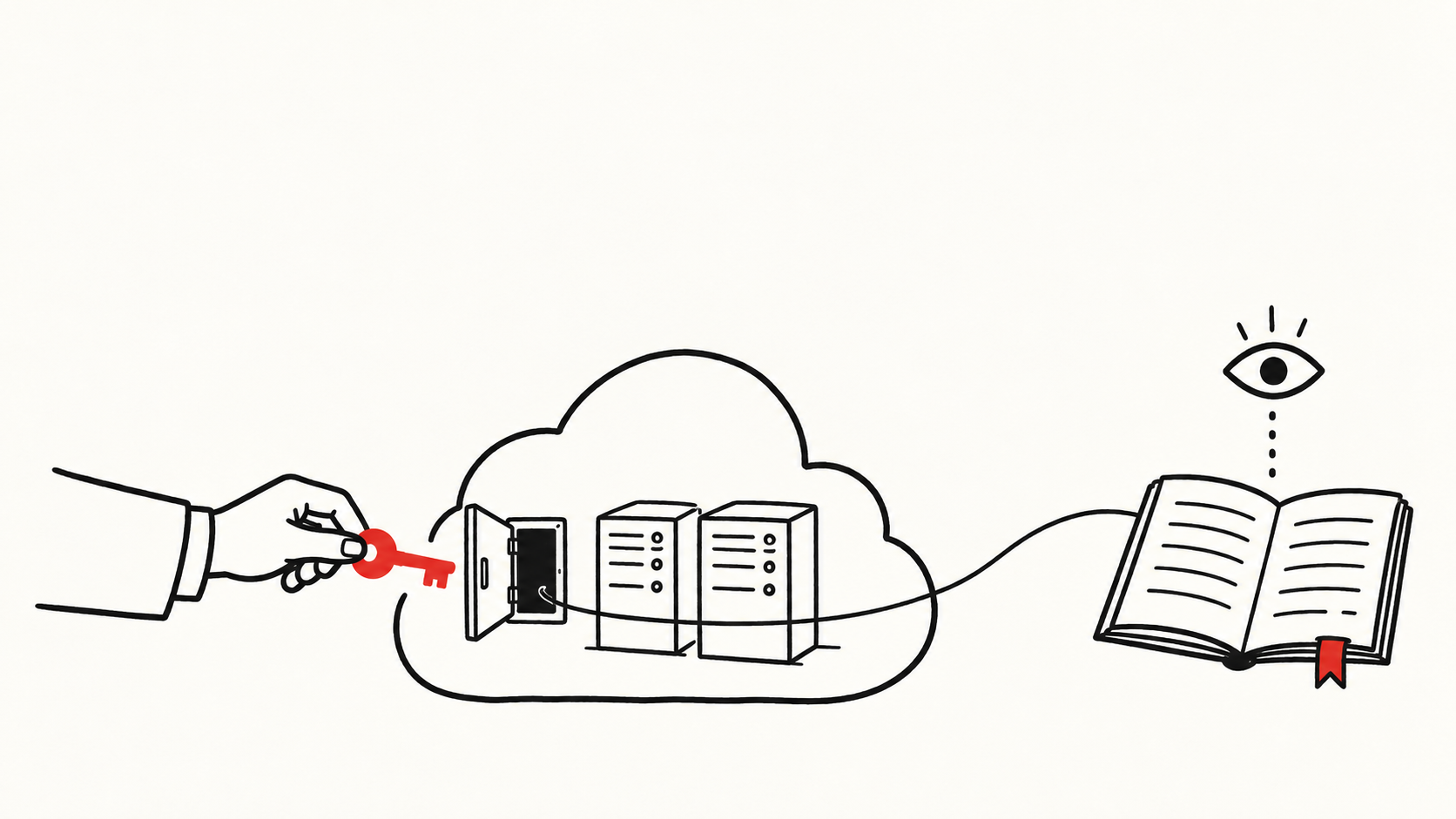
Microsoft’s 20 October 2026 sovereign-cloud update described Data Guardian oversight for specified production-system access in the EU and EFTA.Microsoft announcement A companion technical post describes phased rollout of Production Touch Ledger, with tamper-evident records of qualifying remote engineering actions.Technical explanation
A maintenance ticket offers a useful way to examine the change. Companies that rely on a cloud provider will still encounter problems requiring its intervention. At that point, a procurement commitment about data location must become a boundary around a particular job: who can enter, for what purpose, and what remains after the work. The discussion below is Open Market Notes’ independent analysis. Its incident scenarios are hypothetical, not accounts of actual Microsoft or customer events.
How much work does one ticket authorize?
Suppose an internal AI retrieval system develops a permissions fault. Some employees cannot read files they are entitled to see. The business wants service restored quickly, and the provider requests diagnostic information. That sounds reasonable, but diagnostics might mean a few error codes or include query text, user identifiers and document fragments. The operational usefulness and exposure can differ substantially.
The object of approval should therefore be more precise than “repair the system.” It is a bounded task: which fault, which system, which identity, which actions and what ending condition. If troubleshooting reveals a need for another class of information, the distinction between the original authorization and the additional request should remain visible. Otherwise, a limited consent can gradually become a broader operational permit.
Microsoft’s Customer Lockbox documentation supplies a concrete reference: customers can review and approve or reject qualifying data-access requests.Product documentation That does not decide whether an individual approval is sensible. The difficult work is giving the approver enough business context without transferring the entire technical investigation to someone who has only received a notification email.
Describe location and responsibility separately
Data residency concerns where information is located. Remote maintenance also involves an operator’s permissions, an observer’s responsibilities and the customer’s ability to establish what the work actually covered. A procurement agreement can address all of these, but one location field cannot answer every question.
Adding oversight does not necessarily remove work from the customer. An observer becomes a useful control when they know what to examine and what they can do about a deviation. If they can record but not interrupt, the customer needs to understand that boundary. If they can interrupt, someone must decide how to balance restoration against access restrictions. These are questions to verify with a supplier, not assertions here about the powers of the new products.
An organizational design can attach responsibility to specific handoffs. A business owner explains the repair’s purpose, technical staff delimit feasible operations, an approver accepts residual risk, and a reviewer who can challenge the work reconciles the outcome. A small team may not have four separate jobs, but it can still preserve the different judgments instead of compressing them into one screenshot marked “approved.”
Who can use the record afterwards?
A tamper-evident record helps assess whether the record was subsequently altered. That does not establish whether the original capture covered every relevant action, nor does it explain the business reason for an action. Integrity, coverage and interpretation are distinct verification problems.
Return to the hypothetical retrieval fault. A record might show that an identity read a resource at a particular time. The customer must still connect that event to the original ticket, its authorization and the repair result. Different resource names across systems, incompatible time formats or internal action codes that only the provider can explain can make reconstruction slow.
Evidence delivery is consequently worth testing during ordinary operations. Can the customer export readable records? How long are they retained? Can they still be obtained after the service relationship ends? Can a reviewer reconstruct an intervention without the original operator’s assistance? Those questions distinguish usable evidence from an interface visible only during a supplier demonstration. This article has not verified every new product term on these matters; the questions should not be mistaken for promises already delivered.
Balancing restoration with meaningful review
Requiring a person to approve every minor action can delay repair and encourage automatic acceptance. A broad standing permission can weaken event-level accountability in the opposite direction. No single threshold fits every system.
One testable approach is to differentiate actions by their possible consequences. Reading health metrics without customer content need not follow the same review path as exporting raw business records. Emergency arrangements can be defined in advance, with triggers, permitted actions and subsequent review. “Exceptions when necessary” is inadequate if nobody is responsible for explaining how necessity was assessed.
Customers may incur review, storage and rehearsal costs. Suppliers may also benefit when a repeatable verification process reduces case-by-case evidence requests. Which party saves time, and how much, requires observation in use rather than inference from a new product name.
Test the promise through a reconstruction exercise
Before depending on an oversight or recording capability, a company could select a low-risk simulated repair outside production. Ask a colleague who did not perform the work to establish its purpose, approved scope, actual actions and result using only the delivered materials. Any answer that needs an oral supplement identifies a handoff that still needs improvement.
This does not require moving every cloud service on premises, nor does local operation inherently produce clearer responsibility. Self-operated systems can also have excessive permissions, missing records and ceremonial approval. Comparing operating models is more useful when it asks how much coordination, time and dependency are required to perform the same verification.
Microsoft’s announcement provides a starting point, while phased rollout and applicability remain important. Technical controls can support governance; they cannot alone replace legal assessment or guarantee flawless operations. A practical acceptance criterion is that, after service is restored, someone can still use obtainable materials to explain the intervention and investigate what remains unexplained.
Information only. No investment, legal, tax, or financial advice.